Where should the origin be for proving midpoints form a parallelogram?

Join the discussion
Registration is free. Ask a follow-up in this thread, or start your own.
13 replies · 2K views
gracy
Messages
2,486
Reaction score
83
While proving the Midpoints of the Sides of a Quadrilateral Form a Parallelogram , I got bogged down with position vectors.
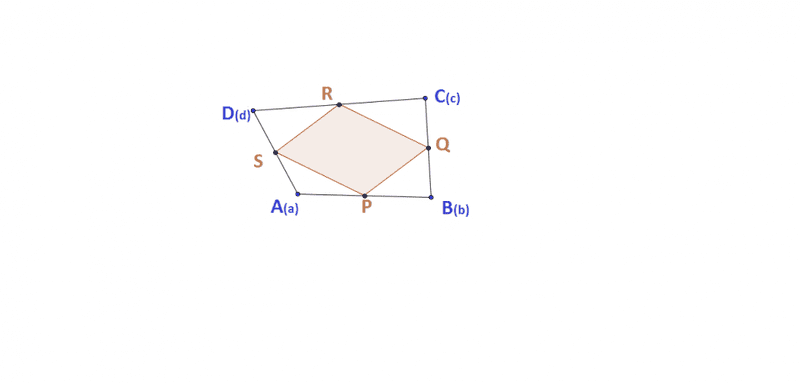
parallel.png

Let a,b,c and d be the position vectors of A,B,C and D. But where is the origin? Aren't we supposed to locate position of origin?
 
Physics news on Phys.org
gracy said:
Let a,b,c and d be the position vectors of A,B,C and D. But where is the origin? Aren't we supposed to locate position of origin?

You can put the origin wherever you like. I might put it at point ##A##.
 
  • Like
Likes   Reactions: gracy
If we take origin at A, position vector of A that is given to be a will be 0,0 . Right?
 
As PeroK said, you can put the origin at any point as per your convenience.
gracy said:
While proving the Midpoints of the Sides of a Quadrilateral Form a Parallelogram ,
This problem can be solved using simple properties of triangle.
 
  • Like
Likes   Reactions: gracy
gracy said:
If we take origin at A, position vector of A that is given to be a will be 0,0 . Right?

I'd say the position vector of ##A## in that case is ##\vec{0}##. This may simplify the problem.
 
  • Like
Likes   Reactions: gracy
I want to use the following formula for position vector of mid point
Su58k03_m27.gif

For that I need origin other than point A.
 
gracy said:
I want to use the following formula for position vector of mid point
Su58k03_m27.gif

For that I need origin other than point A.

That's the right formula, but it's even simpler with ##\vec{OA} = \vec{0}##.
 
  • Like
Likes   Reactions: gracy
If we take ##\vec{OA}## = ##\vec{0}##
The formula will be reduced to
##\vec{OM}## = ##\frac{OB}{2}##
(I meant position vector of OB , I don't know how to get vector sign on top of OB)
 
gracy said:
If we take ##\vec{OA}## = ##\vec{0}##
The formula will be reduced to
##\vec{OM}## = ##\frac{OB}{2}##
(I meant position vector of OB , I don't know how to get vector sign on top of OB)

Okay, that gives you the position vector of point ##P##.

Have you thought yet about what you need to do to show that ##PQRS## is a parallelogram?
 
  • Like
Likes   Reactions: gracy
In the book it's given
PQ= position vector of Q - position vector of P
How so? Is there any particular standard formula for this that I am missing?
 
gracy said:
In the book it's given
PQ= position vector of Q - position vector of P
How so? Is there any particular standard formula for this that I am missing?

It's not a formula. But, what defines a parallelogram?
 
  • Like
Likes   Reactions: gracy
PeroK said:
what defines a parallelogram?
A Parallelogram has opposite sides parallel and equal in length.
 
gracy said:
Parallelogram has opposite sides parallel.

Good. Think a bit more about what you need to do to show this.

gracy said:
In the book it's given
PQ= position vector of Q - position vector of P
How so? Is there any particular standard formula for this that I am missing?

You can get from the origin to point ##Q## in two ways:

##\vec{OQ}##

Or:

##\vec{OP} + \vec{PQ}##

Therefore:

##\vec{OQ} = \vec{OP} + \vec{PQ}##
 
  • Like
Likes   Reactions: gracy