Which area should I use to calculate the force on a submerged surface?

Click For Summary

Discussion Overview

The discussion revolves around calculating the force exerted by a liquid on a submerged wall in a tank. Participants explore the appropriate area to consider in the calculation, addressing the effects of pressure variation with depth and the relevance of the area in contact with the liquid.

Discussion Character

  • Technical explanation, Debate/contested, Mathematical reasoning

Main Points Raised

  • One participant suggests using the area of the wall in contact with the liquid, questioning whether to include the part of the wall not submerged.
  • Another participant emphasizes that air pressure on the upper part of the wall may need to be considered if it is not submerged.
  • Some participants point out that the pressure is not constant due to its dependence on depth, indicating that an integral approach is necessary for accurate calculations.
  • There is a reiteration that integrating over the entire area or just the area where pressure is non-zero will yield the same result, though this point is presented without consensus on its implications.

Areas of Agreement / Disagreement

Participants express differing views on whether to include the area not in contact with the liquid and how to approach the calculation of force due to varying pressure. The discussion remains unresolved with multiple competing perspectives.

Contextual Notes

There are limitations regarding the assumptions made about pressure distribution and the definitions of the areas involved in the calculations. The discussion does not resolve these aspects.

rbmartel
Messages
4
Reaction score
2
TL;DR
In order to find the resultant force applied to a submerged vertical wall, which area should I consider?
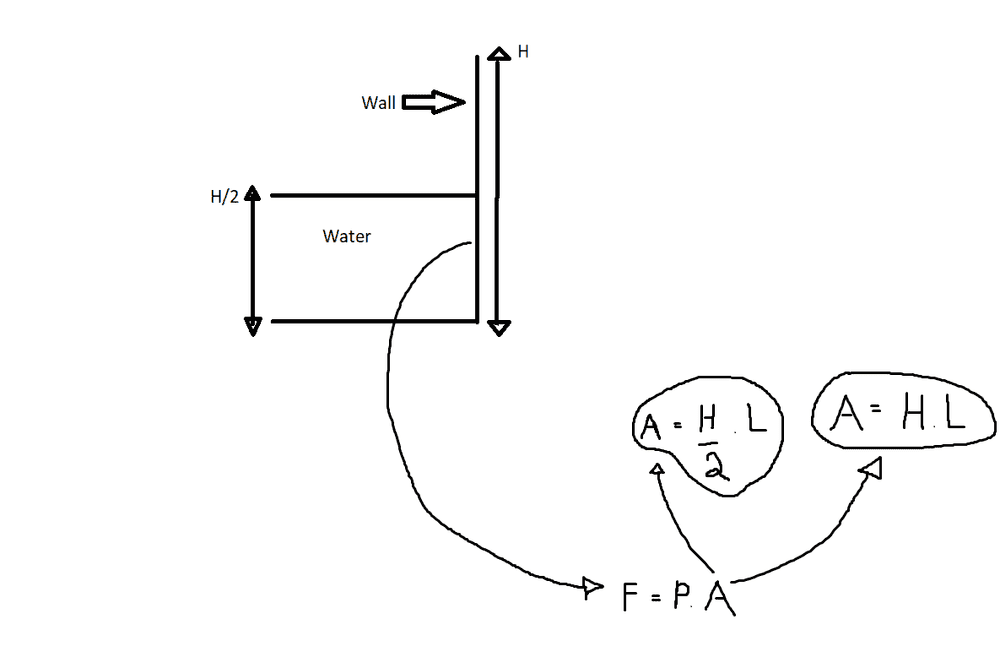
Let's say we have a tank filled with water only half way up. I want to calculate the force being applied by the liquid on one of the walls, that's F = P.A. For the area (A), should I consider the area of the entire wall (H.L), or only the area of the wall that's in contact with the liquid ((H/2).L).
I'm having a hard time trying to understand if I should or shouldn't include in the calculations the part of the wall that is not in contact with the water.
Hydro question.png
 
Physics news on Phys.org
You should take area in contact with liquid. If the upper part is in contact with air, you may have to consider air pressure on that part.
 
Last edited:
  • Like
Likes   Reactions: Delta2
You also need to consider that the total force is pressure times area only if the pressure is constant. Here the pressure is not constant because it increases with depth. You will have to do an integral.
 
  • Like
Likes   Reactions: Delta2
kuruman said:
You also need to consider that the total force is pressure times area only if the pressure is constant. Here the pressure is not constant because it increases with depth. You will have to do an integral.
And, of course, an integral taken over the whole area will yield the same result as an integral taken over the area where the pressure is non-zero.
 

Similar threads

  • · Replies 14 ·
Replies
14
Views
2K
  • · Replies 14 ·
Replies
14
Views
3K
  • · Replies 22 ·
Replies
22
Views
1K
  • · Replies 8 ·
Replies
8
Views
3K
  • · Replies 13 ·
Replies
13
Views
21K
  • · Replies 3 ·
Replies
3
Views
3K
  • · Replies 25 ·
Replies
25
Views
3K
  • · Replies 9 ·
Replies
9
Views
2K
  • · Replies 20 ·
Replies
20
Views
2K
  • · Replies 4 ·
Replies
4
Views
3K