Which of these magnets should have the strongest strength at 10cm?

Click For Summary

Discussion Overview

The discussion revolves around selecting the most effective type of magnet for generating a strong magnetic field at a distance of 10 cm, specifically for a physics application involving the observation of the Larmor frequency of H+ ions. Participants explore various magnet types, their dimensions, and configurations, as well as the implications for magnetic field strength and uniformity.

Discussion Character

  • Exploratory
  • Technical explanation
  • Debate/contested
  • Conceptual clarification

Main Points Raised

  • One participant questions whether a larger diameter flat magnet or a thicker smaller diameter magnet would produce a stronger magnetic field at 10 cm, considering their suction ratings.
  • Another participant suggests that magnets optimized for sticking to metal may not be suitable for generating a strong field at a distance, proposing that a horseshoe magnet or a bar magnet with extended poles might be more effective.
  • There is a discussion about the need for a uniform magnetic field in a specified volume, with one participant expressing a desire for a field strength of at least 200 Gauss.
  • Participants discuss the geometry of the setup, including the possibility of placing poles on both sides of the tissue sample, which is not feasible due to physical constraints.
  • One participant clarifies that their application involves stimulating ions in biological tissues rather than traditional nuclear magnetic resonance imaging, which influences the choice of magnet configuration.
  • Another participant emphasizes the importance of uniformity in the magnetic field for achieving a desired signal-to-noise ratio in experiments.
  • There is a mention of the challenges in generating a large uniform field with alternative geometries compared to traditional methods used in NMR machines.

Areas of Agreement / Disagreement

Participants express differing views on the best type of magnet to use, with no consensus reached on which configuration would yield the strongest magnetic field at the specified distance. The discussion remains unresolved regarding the optimal approach for the intended application.

Contextual Notes

Participants note limitations in describing their setups and applications, which may affect the quality of responses. The discussion highlights the complexity of achieving the desired magnetic field strength and uniformity given the constraints of the experimental apparatus.

coquelicot
Messages
304
Reaction score
70
Basically, I need to generate the strongest possible field at 10 cm from a circular magnet, in its central axis.
I hesitate about what buying.

For example, the following magnet has a large diameter of 90mm and is flat, with a suction of 250 kg.
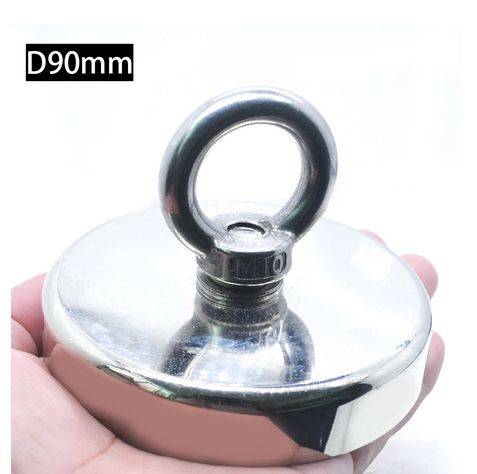
large_flat_magnet.jpg

This other magnet has a smaller diameter of 60mm, but is thicker (40 mm) with a suction of 250 kg too.
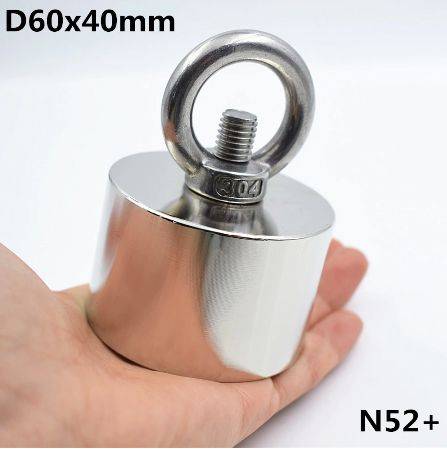
thick_magnet.jpg


This last magnet has dimension somewhere between the two others (diam = 75mm), but it is advertised to have an incredible suction of 800 kg (which I suspect to be wrong, as AliExpress is not the most reliable place should I say).

very_strong_magnet.jpg


My question is: what is best suitable for a B-field at 10 cm: a large diameter flat magnet, a not so large diameter thick magnet, or simply the strongest possible suction magnet (of course, in general, the more the suction, the more the B-field, but there may be a trade-off with the other parameters).

Also, the two first magnets are single sided (the shield on the other side leads the B-field lines directly to the first side) in order to increase the suction. But I'm not sure this increases the B-field at 10 cm far; in fact, this may well be the contrary. So, my second question is: is a shielded single side magnet stronger than the same magnet without shield, at some distance from the magnet?
 
Physics news on Phys.org
coquelicot said:
Summary:: strength of magnets at some distance

Also, the two first magnets are single sided (the shield on the other side leads the B-field lines directly to the first side) in order to increase the suction. But I'm not sure this increases the B-field at 10 cm far; in fact, this may well be the contrary.
Yeah, to get much of a field 10cm away, you do not want to use a magnet that is optimized for sticking to metal like those are. You need the poles to be farther away from each other like a horseshoe magnet.

You could also use a bar magnet with a couple pieces of metal stuck to the ends and coming out to make two poles that face each other. Is your wish to have a pretty flat field in some volume 10cm away? How big of a volume?
 
  • Like
Likes   Reactions: hutchphd
coquelicot said:
Summary:: strength of magnets at some distance

I hesitate about what buying.
Is magnet fishing your application? If yes, then a constant distance of 10 cm should not be your criterion.
 
anorlunda said:
Is magnet fishing your application? If yes, then a constant distance of 10 cm should not be your criterion.
What's magnet fishing? Fishing for magnets, or catching some kind of fish with magnets?
 
Please, don't mock. I want these magnets because they are very strong and relatively cheap. That's for a physics application: observing the Larmor frequency of H+ ions.

Berkeman: Yes, ideally, I would like a uniform field in a volume of radius 10cm and thickness 5 cm at least, but it appears to be difficult. I will content myself with a not very uniform field. But I need a strong field, at least of the order of 200 Gauss. That's not easy unless you spend a lot of money.
 
I don't think anybody is mocking. You just didn't say anything about your application, so we are having to guess to try to be helpful.

So you have a vacuum chamber with a beam source of H+ ions, and want to have a B field in the vacuum chamber to observe/measure the Lamor motion? What material is the vacuum chamber?
 
No. I want to stimulate the ions inside biological tissues, like in nuclear magnetic resonance. But I cannot stick the magnets to the tissues because of the physical geometry of my apparatus. So, I have to put it 10cm far away.
 
What level of B-field are you wanting to generate at that 10cm distance?
 
1000 Gauss: very good
500 Gauss: good
300 Gauss: passable
100 Gauss: bad but will try
 
  • #10
coquelicot said:
No. I want to stimulate the ions inside biological tissues, like in nuclear magnetic resonance. But I cannot stick the magnets to the tissues because of the physical geometry of my apparatus. So, I have to put it 10cm far away.
Can you say more about the shape of the tissues that you want to have in the test zone? Like, is it the front surface of a large body (like the abdomen of a person), or a fingertip, or an arm, etc. If it is possible to have the test volume between two magnet poles, that will help to increase the field you can achieve quite a bit, IMO. I'm thinking of the magnet geometry like in the drawing below, but with the sample volume where the "SN" block is shown...

https://openstax.org/books/physics/pages/20-1-magnetic-fields-field-lines-and-force

1613066407166.png
 
  • #11
coquelicot said:
No. I want to stimulate the ions inside biological tissues, like in nuclear magnetic resonance. But I cannot stick the magnets to the tissues because of the physical geometry of my apparatus.

Nuclear Magnetic Resonance has been around for seventy years, and the cyclotron longer than that. The usual method for producing the required large uniform field is two flat (or slightly curved) pole faces separated by less than their radius.
You will not produce anything like that level of uniformity with a different geometry. The NMR imaging machines produce a known huge inhomogeneous field and then use computed tomography to figure it all out.
So do you just want to make something move or do you need the uniformity to reach a desired signal to noise ratio? Clearly this needs a little more description if we are to be of utility. Speak, please.

'
 
  • Like
Likes   Reactions: berkeman
  • #12
berkeman said:
bar magnet with a couple pieces of metal stuck to the ends and coming out to make two poles that face each other
Or a geometry like this.
1856146.jpg
 
  • #13
I'm not sticking my head in that thing! :oops:
 
  • Like
Likes   Reactions: davenn
  • #14
I am not trying to do nuclear magnetic imaging, but something related and much simpler: to excite the H+ ions with RF coils and to receive their emission at the Larmor frequency with another RF coil. Unfortunately, I cannot describe all my project here. It suffice to say that I'm limited regarding what can be put near the experiments, and only a magnetic field from the bottom of the cup will fit (actually, I still have a big coil around the cup, but the field is not sufficient). What about simply trying to answer the question :-) ?
 
  • #15
coquelicot said:
What about simply trying to answer the question :-) ?
Which question? And I don't think you've answered my question about if you can put poles on both sides of the tissue sample...
 
  • Like
Likes   Reactions: Keith_McClary
  • #16
Oh, I missed it. No I cannot put poles on both sides because there are other things above (I cannot describe here all the project). Also, it will not be possible to put two poles laterally, because I need the B field be directed from bottom to top (or the contrary).

The question is what I asked at the beginning regarding magnets.
 
  • #17
berkeman said:
What's magnet fishing? Fishing for magnets, or catching some kind of fish with magnets?
It's a surprisingly popular hobby. Lots of videos on Youtube like this one. For that hobby, they sell strong magnets with eyes exactly like the ones shown in the OP.

1613072938011.png
 
  • Informative
Likes   Reactions: berkeman
  • #18
coquelicot said:
I am not trying to do nuclear magnetic imaging, but something related and much simpler: to excite the H+ ions with RF coils and to receive their emission at the Larmor frequency with another RF coil
In my world that is called NMR (spectroscopy is added sometimes). The required signal to noise is not trivial. Here is the paper that won the 1952 Nobel Prize:
http://www.fas.harvard.edu/~phys191r/References/c4/bloembergen1948.pdf
This is pretty well investigated stuff. Very interesting but not easy.
 
  • #19
coquelicot said:
What about simply trying to answer the question :-) ?

we cannot because of this ...

coquelicot said:
Unfortunately, I cannot describe all my project here

as has been indicated...
The quality of peoples answers directly relates to the quality of the information you give
 
  • Like
Likes   Reactions: hutchphd and Vanadium 50
  • #20
hutchphd. Thank you so many for this paper. I will read it with avidity.
 
  • Like
Likes   Reactions: hutchphd

Similar threads

  • · Replies 7 ·
Replies
7
Views
4K
  • · Replies 198 ·
7
Replies
198
Views
16K
  • · Replies 42 ·
2
Replies
42
Views
3K
  • · Replies 1 ·
Replies
1
Views
1K
  • · Replies 4 ·
Replies
4
Views
2K
  • · Replies 2 ·
Replies
2
Views
2K
  • · Replies 13 ·
Replies
13
Views
4K
  • · Replies 27 ·
Replies
27
Views
4K
Replies
2
Views
2K
  • · Replies 1 ·
Replies
1
Views
4K