Which Rocket Body Shape is Aerodynamically Superior: Saturn V or N1?

  • Context: Undergrad 
  • Thread starter Thread starter Polyverse
  • Start date Start date
  • Tags Tags
    Rocket Shapes
Click For Summary
SUMMARY

The discussion centers on the aerodynamic superiority of the Saturn V and N1 rocket designs. The Saturn V features a straight body with conical regions, promoting consistent aerodynamic flow and lower drag. In contrast, the N1 has a progressively expanding conical shape, designed to accommodate thrusters but potentially increasing drag. The consensus suggests that while both designs have their merits, the Saturn V is likely more aerodynamically efficient, particularly given its historical success compared to the N1's failures.

PREREQUISITES
  • Understanding of rocket aerodynamics
  • Familiarity with thrust-to-weight ratio concepts
  • Knowledge of shock wave formation in high-speed flight
  • Basic principles of drag and lift in aerospace engineering
NEXT STEPS
  • Research the aerodynamic principles of rocket design
  • Study the flight envelopes of Saturn V and N1 rockets
  • Examine the impact of payload variations on rocket performance
  • Learn about modern rocket designs and their aerodynamic features
USEFUL FOR

Aerospace engineers, rocket designers, students of aerodynamics, and anyone interested in the comparative analysis of historical rocket designs.

Polyverse
Messages
5
Reaction score
0
When looking at the design of the both the U.S. Saturn V rocket, and the Soviet N1 rocket, there is an obvious design difference between the basic overall rocket body shape.
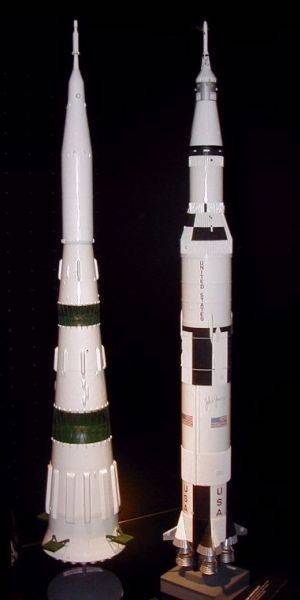
n1-saturnv.jpg


The Saturn V shows several conical regions, with a straight body design throughout.

The N1 shows more of a conical design, progressively expanding towards the wide base.


My belief is that the Saturn V shape is aerodynamically more logical, as it allows less drag along more consistent regions, whereas the N1 provides less area where there would be increased atmospheric friction, but I would like feedback on this, as I'd love to truly know which body design is aerodynamically superior.

(It also seems that more modern rocket body designs follow more similarity to that of the Saturn V, which supports my thinking as well.)
 
Physics news on Phys.org
Keep in mind that rockets are not designed solely to be the most aerodynamically sound vehicles possible. For example, the N1 has a larger cross-sectional area at the bottom in order to accommodate the massive number of thrusters at the bottom.
 
One also must consider the speed which the vehicles will be traveling as a function of altitude, and the thrust to weight/mass ratio.
 
Yes, though I'm basically asking which basic shape contains a more optimal aerodynamic flow, regardless of optimization for internal component housing.
 
"Optimal aerodynamic flow", for what velocity and altitude? (amongst other things).

I think the flight envelope on this vehicle is soooo large, it is a game of "trade offs"

Alter the payload and all of a sudden, the problem is different. Now the altitude where shock waves form is different.

They both work, perhaps one is only better than the other given a specific set of variables.
 
Actually, they don't both work. The N1 failed rather spectacularly, and was never successfully flown as designed. As for the drag though, I would imagine that the Saturn V would be the lower drag design, although as stated above, neither was designed with drag as the primary consideration.
 

Similar threads

  • · Replies 271 ·
10
Replies
271
Views
28K
  • · Replies 2 ·
Replies
2
Views
10K
  • · Replies 21 ·
Replies
21
Views
5K
  • · Replies 10 ·
Replies
10
Views
5K
  • · Replies 2 ·
Replies
2
Views
3K
  • · Replies 1 ·
Replies
1
Views
4K
Replies
24
Views
8K
  • · Replies 1 ·
Replies
1
Views
4K
  • · Replies 6 ·
Replies
6
Views
4K
  • · Replies 2 ·
Replies
2
Views
4K