gfd43tg
Gold Member
- 949
- 48
Hello, I have been working on this Truss problem and have not managed to get it right. I have checked my equations over and over and everything seems to check out, but I only get 4/24 on the autograder.
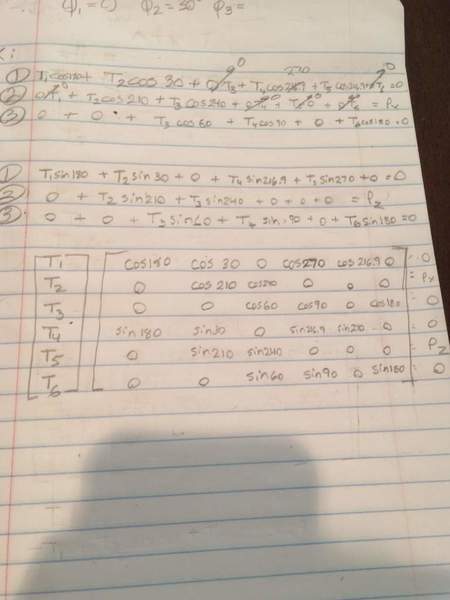
Here is my paper worked out.
Here is my Code. Because I don't like the opposite sign convention from the problem statement, I just used the normal sign convention and multiplied by -1, -(A\b). Whether I keep it -(A\b) or A\b, I still get 4/24 points.
I run the autograder and here is an example of the feedback I get
EDIT: Wrote it on a paper and uploaded as PDF so that my work is easier to see.
Here is my paper worked out.
Here is my Code. Because I don't like the opposite sign convention from the problem statement, I just used the normal sign convention and multiplied by -1, -(A\b). Whether I keep it -(A\b) or A\b, I still get 4/24 points.
Code:
function T = trussAnalyze(Px,Pz)
A = [cosd(180),cosd(30),0,cosd(270),cosd(atand(3/4)+180),0;
    0, cosd(210),cosd(240),0,0,0;
    0,0,cosd(60),cosd(90),0,cosd(180);
    sind(180),sind(30),0,sind(atand(3/4)+180),sind(270),0;
    0,sind(210),sind(240),0,0,0;
    0,0,sind(60),sind(90),0,sind(180)];
b =[0;Px;0;0;Pz;0];
T = -(A\b);
I run the autograder and here is an example of the feedback I get
Code:
In test case 2:
    'Pure downward loading'

*Right size and class, but wrong values (even accounting for roundoff)
Argument 1:
     0

Argument 2:
100Attachments
Last edited: