Why are tension and friction in the same direction?

Click For Summary
SUMMARY

The discussion centers on the confusion surrounding the direction of friction and tension in a physics problem involving a box being pulled. Participants clarify that tension can influence the direction of friction, particularly when considering the actions of individuals involved. The importance of accurately representing forces in free body diagrams (FBD) is emphasized, particularly the normal force and its relationship to the ground. The conversation highlights the necessity of understanding the problem's constraints, such as the presence or absence of friction, to accurately analyze the forces at play.

PREREQUISITES
  • Understanding of fundamental physics concepts, including tension and friction.
  • Ability to create and interpret free body diagrams (FBD).
  • Knowledge of normal force and its relationship to contact surfaces.
  • Familiarity with the principles of acceleration and force interactions.
NEXT STEPS
  • Review the principles of tension and friction in physics problems.
  • Learn how to accurately construct free body diagrams (FBD) for complex systems.
  • Study the effects of normal force in various scenarios, particularly in contact mechanics.
  • Examine case studies where friction is present or absent and its impact on motion.
USEFUL FOR

Students studying physics, educators teaching mechanics, and anyone interested in understanding the dynamics of forces in physical systems.

pibbler
Messages
1
Reaction score
1
Homework Statement
I have the solution I just want to know the intuition behind it,

So you have a frictionless box being pulled by two people. The first person has a rope connecting them and the box, the second has a rope that goes from the first to the second and lastly a rope that goes to the machine that pulls the rope. Draw the resulting free body diagrams for each one.
Relevant Equations
F=ma
For the box I understand it’s just normal and force of gravity as well as tension pulling them, it was declared to have no friction so it just points up down and right. It’ll be accelerating right.

The second person again has the normal force, gravity and the tension going to the left as a result of pulling the box. This is where I get confused, why is the friction in the direction of the tension of the third person pulling the first person? Is it because they are pushing off the ground?

Lastly the same thing would apply to the last person.

I’m having a hard time trying to understand why, we haven’t gotten far in my fundamental physics on friction mostly just basic principles, so that may be why but any help on why this is the case is greatly appreciated!
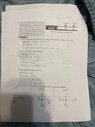
 

Attachments

  • image.jpg
    image.jpg
    41.5 KB · Views: 159
Physics news on Phys.org
Welcome to PF.

Please upload your FBD to help us help you -- click the "Attach files" link below the Edit window. Thanks very much.
 
  • Like
Likes   Reactions: topsquark and pibbler
Personally, given the problem, I'd tend towards arguing that ##F_g## does not act upon the bodies for the purpose of diagramming, but enables the bodies to act against the ground, countering that normal force. You may or may not get yelled at for that, though.

The problem states "There is no friction". What elements of the system have you chosen to have, or have not, friction ?

Meanwhile, if you have the official solution, why not post it for us to look at.
 
Last edited:
  • Like
Likes   Reactions: topsquark
I assume the "no friction" bit at the end is crossed out, not highlighted.

Since the cart is accelerating to the right and the black rope remains taut, the first person must be accelerating to the right at least as fast. But we are not told what action that person is taking with her body. If merely standing (but pulling with her arms), she is being dragged to the right and friction is to the left; but if she is actively hauling to the right friction on her feet is to the right.

Btw, it is better not to describe a force as merely "the normal force". A normal force arises between any two bodies in contact. You should always state which other body exerts a normal force, in this case, the ground. I have seen students form the belief that a normal force is always vertical.
 
  • Like
Likes   Reactions: topsquark
pibbler said:
... This is where I get confused, why is the friction in the direction of the tension of the third person pulling the first person? Is it because they are pushing off the ground?
...
Welcome!
Is the official solution of the problem stating the direction of friction?
Sorry, I don’t see a representation of friction in any of your free body diagrams.
 
When walking on a hard surface, it's the friction force exerted on you by the surface that propels you. If you doubt this, try walking on a wet ice rink.
 
Well, there are some things that need clarification before we can figure out what is really going on.
  • Is the "no friction" at the end of the problem statement crossed out, or highlighted? Without knowing that, we don't know if there is friction exerted on Denise and Cindy.
  • If there is friction, do Denise and Cindy remain in the same place, or do they move/accelerate? Do they move/accelerate in the same direction as the cart?
  • Why is "friction" listed among the forces exerted on Cindy, but missing in her free-body diagram?
 

Similar threads

  • · Replies 2 ·
Replies
2
Views
1K
  • · Replies 10 ·
Replies
10
Views
2K
Replies
16
Views
3K
  • · Replies 38 ·
2
Replies
38
Views
5K
  • · Replies 30 ·
2
Replies
30
Views
4K
  • · Replies 7 ·
Replies
7
Views
1K
  • · Replies 6 ·
Replies
6
Views
1K
Replies
2
Views
1K
Replies
29
Views
3K
  • · Replies 9 ·
Replies
9
Views
7K