Why are the accelerations not equal?

  • Context: Undergrad 
  • Thread starter Thread starter annamal
  • Start date Start date
  • Tags Tags
    Dynamics Kinematic
Click For Summary
SUMMARY

The forum discussion centers on the discrepancies in the acceleration equations derived from the velocity vector of a pendulum system. Participants analyze the expressions for velocity and acceleration, specifically comparing the forms of equations (1) and (2). They conclude that the normal vectors ##\vec n_1## and ##\vec n_2## are time-dependent and require their derivatives to be included in the acceleration calculations. The discussion emphasizes the importance of consistent sign conventions and the correct application of vector calculus in dynamic systems.

PREREQUISITES
  • Understanding of vector calculus and derivatives
  • Familiarity with pendulum motion and angular velocity
  • Knowledge of LaTeX for mathematical expressions
  • Concept of normal vectors in physics
NEXT STEPS
  • Study the derivation of acceleration in polar coordinates
  • Learn about the application of LaTeX for formatting mathematical equations
  • Explore the implications of sign conventions in rotational dynamics
  • Research the relationship between angular velocity and linear velocity in pendulum systems
USEFUL FOR

Physics students, mechanical engineers, and anyone involved in the study of dynamic systems, particularly those focusing on pendulum motion and vector calculus.

annamal
Messages
393
Reaction score
33
TL;DR
I have a slider moving with a pendulum. I take the derivative of the velocity vector. Then I get the acceleration but just using a for acceleration. How come the accelerations from equations (1) and (2) [both ways of getting the acceleration] are not equal?
##\vec n_2## points to the diagonal top left.
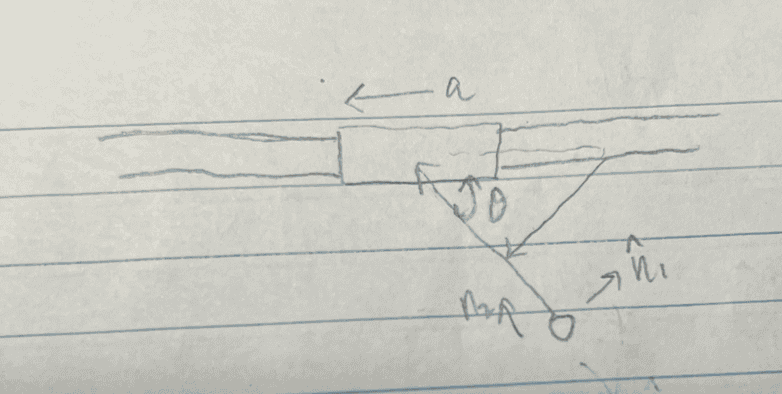
Screenshot 2024-04-11 at 9.35.25 PM.png


The velocity v is a function of t. So for example ##2t^2## and a = dv/dt.
Putting the velocity vector into ##\vec n_1## and ##\vec n_2## terms.
$$\vec v = v sin\theta \vec n_1 + v cos\theta \vec n_2$$
$$\vec v = -v \vec i$$
$$\vec a = \frac{d\vec v}{dt} = -a \vec i = -asin\theta \vec n_1 + acos\theta \vec n_2\ (1)$$
$$\vec a = \frac{d(v sin\theta \vec n_1 + v cos\theta \vec n_2)}{dt} = (asin\theta - 2v cos\theta \dot{\theta})\vec n_1 + (-2vsin\theta \dot{\theta} + acos\theta)\vec n_2\ (2)$$
How come ##\vec a \neq -asin\theta \vec n_1 + acos\theta \vec n_2\ (1) \neq (2)##?
 

Attachments
  • Screenshot 2024-04-11 at 9.14.26 PM.png
    Screenshot 2024-04-11 at 9.14.26 PM.png
    40.2 KB · Views: 67
Last edited:
Physics news on Phys.org
Are ##\vec n_1## and ##\vec n_2## constant, and it's only coincidence that they happen to point along your pendulum rod when you draw the diagram? If so, ##\vec v=v\sin\theta\vec n_1+v\cos\theta\vec n_2## is not generally true. If not, then where are the ## \dot{\vec n}_i## terms in your expression for ##\vec a##?
 
Ibix said:
Are ##\vec n_1## and ##\vec n_2## constant, and it's only coincidence that they happen to point along your pendulum rod when you draw the diagram? If so, ##\vec v=v\sin\theta\vec n_1+v\cos\theta\vec n_2## is not generally true. If not, then where are the ## \dot{\vec n}_i## terms in your expression for ##\vec a##?
Yes ##\vec n_2## points along my pendulum rod as it moves and ##\vec n_1## points perpendicular to that constantly.
 
Then they are functions of time also, and you need their derivatives also.
 
Ibix said:
Then they are functions of time also, and you need their derivatives also.
I already included and simplified their derivatives in equation (2)
 
annamal said:
I already included and simplified their derivatives in equation (2)
Ah, I see. My mistake - I missed the factors of 2 somehow. Just to note, for those of us reading on small screens it's much easier to follow maths if you break it across lines a bit using the eqnarray or eqnarray* environments in LaTeX.

Are you sure your signs are consistent? In the case ##\theta=\pi/2## your un-numbered expression for ##\vec v## becomes ##\vec v=-v\vec i=v\vec n_1##, implying ##\vec i## and ##\vec n_1## are anti-parallel, but (1) becomes ##\vec a=-a\vec i=-a\vec n_1##, implying they are parallel.
 
Ibix said:
Ah, I see. My mistake - I missed the factors of 2 somehow. Just to note, for those of us reading on small screens it's much easier to follow maths if you break it across lines a bit using the eqnarray or eqnarray* environments in LaTeX.

Are you sure your signs are consistent? In the case ##\theta=\pi/2## your un-numbered expression for ##\vec v## becomes ##\vec v=-v\vec i=v\vec n_1##, implying ##\vec i## and ##\vec n_1## are anti-parallel, but (1) becomes ##\vec a=-a\vec i=-a\vec n_1##, implying they are parallel.
Above I forgot to add a negative to ##\vec n_1## so ##\vec v = -v \vec i = -v sin\theta \vec n_1 + v cos\theta \vec n_2## not just ##v\vec n_1##. But the equations (1) and (2) should be correct.
 
Not quite. Like this:$$\begin{eqnarray*}
\vec v &=& -v\vec i \\
&=&v\sin\theta\vec n_1 + v\cos\theta \vec n_2
\end{eqnarray*}$$Note the & symbols each side of the thing I want to align (= in this case) and the \\\\ marking the end of each line except the last.
 
Ibix said:
Not quite. Like this:$$\begin{eqnarray*}
\vec v &=& -v\vec i \\
&=&v\sin\theta\vec n_1 + v\cos\theta \vec n_2
\end{eqnarray*}$$Note the & symbols each side of the thing I want to align (= in this case) and the \\ marking the end of each line except the last.
I forgot to add the negative sign to ##vsin\theta## but everything else is the same
 
  • #10
annamal said:
I forgot to add the negative sign to ##vsin\theta## but everything else is the same
Looks like you edited while I was replying. Ignore my last post, and I'll read your revised post.
 
  • #11
Ibix said:
Looks like you edited while I was replying. Ignore my last post, and I'll read your revised post.
$$\vec a = \frac{d(-v sin\theta \vec n_1 + v cos\theta \vec n_2)}{dt} = (-asin\theta - 2v cos\theta \dot{\theta})\vec n_1 + (-2vsin\theta \dot{\theta} + acos\theta)\vec n_2\ (2)$$
$$\vec a \neq -asin\theta \vec n_1 + acos\theta \vec n_2\ (1) \neq (2)$$
 
  • #12
I think your algebra's gone wrong somewhere. Defining ##\vec i## pointing to the left right and ##\vec j## pointing up the page, we have:$$\begin{eqnarray}
\vec n_1 &=&\sin\theta \vec i+\cos\theta \vec j\\
\vec n_2&=&-\cos\theta \vec i+\sin\theta\vec j\\
\dot{\vec n}_1&=&-\vec n_2\dot\theta\\
\dot{\vec n}_2&=&\vec n_1\dot\theta
\end{eqnarray}$$Then, taking your definition ##\vec v = -v\vec i## and noting that ##\vec i=\vec n_1\sin\theta-\vec n_2\cos\theta## we can write:$$\begin{eqnarray}
\vec v&=&-v\vec i\\
&=&-v\vec n_1\sin\theta+v\vec n_2\cos\theta\\
\frac{d}{dt}\vec v&=&\frac{d}{dt}\left(-v\vec n_1\sin\theta+v\vec n_2\cos\theta\right)\\
&=&-a\left(\vec n_1\sin\theta-\vec n_2\sin\theta\right)\nonumber\\
&&+v\left(-\dot{\vec n}_1\sin\theta+\dot{\vec n}_2\cos\theta\right)\nonumber\\
&&-v\left(\vec n_1\cos\theta\dot\theta+\vec n_2\sin\theta\dot\theta\right)
\end{eqnarray}$$Substituting in the definitions (3 and 4) of the two ##\dot{\vec n}##s, the last two brackets cancel.

They must cancel, of course, because you are simply writing ##\vec a=-\frac{dv}{dt}\vec i-v\frac{d\vec i}{dt}## and expanding ##\frac{d\vec i}{dt}## in terms of your normal vectors.
 
Last edited:
  • #13
Ibix said:
I think your algebra's gone wrong somewhere. Defining ##\vec i## pointing to the left and ##\vec j## pointing up the page, we have:$$\begin{eqnarray}
\vec n_1 &=&\sin\theta \vec i+\cos\theta \vec j\\
\vec n_2&=&-\cos\theta \vec i+\sin\theta\vec j\\
\dot{\vec n}_1&=&-\vec n_2\dot\theta\\
\dot{\vec n}_2&=&\vec n_1\dot\theta
\end{eqnarray}$$Then, taking your definition ##\vec v = -v\vec i## and noting that ##\vec i=\vec n_1\sin\theta-\vec n_2\cos\theta## we can write:$$\begin{eqnarray}
\vec v&=&-v\vec i\\
&=&-v\vec n_1\sin\theta+v\vec n_2\cos\theta\\
\frac{d}{dt}\vec v&=&\frac{d}{dt}\left(-v\vec n_1\sin\theta+v\vec n_2\cos\theta\right)\\
&=&-a\left(\vec n_1\sin\theta-\vec n_2\sin\theta\right)\nonumber\\
&&+v\left(-\dot{\vec n}_1\sin\theta+\dot{\vec n}_2\cos\theta\right)\nonumber\\
&&-v\left(\vec n_1\cos\theta\dot\theta+\vec n_2\sin\theta\dot\theta\right)
\end{eqnarray}$$Substituting in the definitions (3 and 4) of the two ##\dot{\vec n}##s, the last two brackets cancel.

They must cancel, of course, because you are simply writing ##\vec a=-\frac{dv}{dt}\vec i-v\frac{d\vec i}{dt}## and expanding ##\frac{d\vec i}{dt}## in terms of your normal vectors.
For this ##\dot{\vec n_1}## and ##\dot{\vec n_2}## I have them negated.
##\dot{\vec n_1} = \dot{\theta}\vec k \times \vec n_1 = \dot{\theta}\vec n_2## where ##\vec k## is pointing out of the screen and ##\vec n_1 \times \vec n_2 = \vec k##.
##\dot{\vec n_2} = \dot{\theta}\vec k \times \vec n_2 = -\dot{\theta}\vec n_1##
 
  • #14
I did it by direct calculation$$\begin{eqnarray*}
\vec n_1&=&\sin\theta\vec i+\cos\theta\vec j\\
\dot{\vec n}_1&=&\cos\theta\dot\theta\vec i-\sin\theta\dot\theta\vec j\\
&=&-\vec n_2\dot\theta
\end{eqnarray*}$$and similarly for the other one.
 
  • #15
Ibix said:
I think your algebra's gone wrong somewhere. Defining ##\vec i## pointing to the left and ##\vec j## pointing up the page, we have:$$\begin{eqnarray}
\vec n_1 &=&\sin\theta \vec i+\cos\theta \vec j\\
\vec n_2&=&-\cos\theta \vec i+\sin\theta\vec j\\
\dot{\vec n}_1&=&-\vec n_2\dot\theta\\
\dot{\vec n}_2&=&\vec n_1\dot\theta
\end{eqnarray}$$Then, taking your definition ##\vec v = -v\vec i## and noting that ##\vec i=\vec n_1\sin\theta-\vec n_2\cos\theta## we can write:$$\begin{eqnarray}
\vec v&=&-v\vec i\\
&=&-v\vec n_1\sin\theta+v\vec n_2\cos\theta\\
\frac{d}{dt}\vec v&=&\frac{d}{dt}\left(-v\vec n_1\sin\theta+v\vec n_2\cos\theta\right)\\
&=&-a\left(\vec n_1\sin\theta-\vec n_2\sin\theta\right)\nonumber\\
&&+v\left(-\dot{\vec n}_1\sin\theta+\dot{\vec n}_2\cos\theta\right)\nonumber\\
&&-v\left(\vec n_1\cos\theta\dot\theta+\vec n_2\sin\theta\dot\theta\right)
\end{eqnarray}$$Substituting in the definitions (3 and 4) of the two ##\dot{\vec n}##s, the last two brackets cancel.

They must cancel, of course, because you are simply writing ##\vec a=-\frac{dv}{dt}\vec i-v\frac{d\vec i}{dt}## and expanding ##\frac{d\vec i}{dt}## in terms of your normal vectors.
I think you meant to say ##\vec i## has to be pointing to the right and ##\vec j## has to be pointing up.

That is interesting that the ##\frac{dn_1}{dt}## and ##\frac{dn_2}{dt}## ended up that way. In order for my way of calculating them to be true, we would have to be rotating clockwise so ##-\dot{\theta}## by default instead of just ##\dot{\theta}##. Then ##\frac{dn_1}{dt} = \vec \omega \times \vec r = -\dot{\theta}\vec n_3 \times \vec n_1 = -\dot{\theta}\vec n_2##. I don't know why we would have to use a negative theta though. Perhaps because if we move in the positive ##\vec i## direction we have clockwise rotation?
 
Last edited:
  • #16
annamal said:
I think you meant to say ##\vec i## has to be pointing to the right and ##\vec j## has to be pointing up.
I did. I've corrected my post - thank you.

It's quite likely that something you've done implies clockwise instead of anti clockwise, yes. I suspect the fundamental issue is all the different conventions you are using. Notably, the way you've defined ##\theta##, an increasing value means clockwise rotation if your ##\vec n## vectors, and I rather suspect your cross products assume the opposite - I haven't checked, though.

Honestly, I'd just start again, defining ##\theta## so that it is zero when ##\vec n_1=\vec i## and increases under anticlockwise rotation and defining ##\vec v=v\vec i##. Competing conventions are always a mess - you can make them work, but you have to be constantly on guard for clashes. Much simpler to use standard choices.
 
  • #17
Ibix said:
Notably, the way you've defined ##\theta##, an increasing value means clockwise rotation if your ##\vec n## vectors, and I rather suspect your cross products assume the opposite - I haven't checked, though.
So you think the way I have defined ##\theta## is clockwise b/c we are measuring the angle from the horizontal to the pendulum string correct? How come we cannot measure the angle from the pendulum string to the horizontal and say that ##\theta## is defined counterclockwise (the way I have the angle arrow drawn in my first post)?
 
Last edited:
  • #18
annamal said:
So you think the way I have defined ##\theta## is clockwise b/c we are measuring the angle from the horizontal to the pendulum string correct? How come we cannot measure the angle from the pendulum string to the horizontal and say that ##\theta## is defined counterclockwise (the way I have the angle arrow drawn in my first post)?
I think ( and I believe @Ibix is saying) you have to be careful about the negative ##\dot \theta##. imagine the slider still; If the angle is decreasing the angular velocity is negative, but by your assumed convention the bobs velocity is positive. That doesn’t seem to be mathematically consistent.
 
  • Like
Likes   Reactions: Ibix

Similar threads

  • · Replies 20 ·
Replies
20
Views
2K
  • · Replies 12 ·
Replies
12
Views
4K
  • · Replies 6 ·
Replies
6
Views
1K
  • · Replies 2 ·
Replies
2
Views
6K
  • · Replies 3 ·
Replies
3
Views
1K
  • · Replies 4 ·
Replies
4
Views
1K
  • · Replies 1 ·
Replies
1
Views
2K
  • · Replies 17 ·
Replies
17
Views
2K
Replies
1
Views
1K