Why are the eigenvectors the axes of an ellipse?

Click For Summary
SUMMARY

The discussion centers on the relationship between eigenvectors and the axes of an ellipse in the context of linear transformations. The user demonstrates an understanding of the equation 1 = \vec{x}^T A \vec{x} = \lambda \vec{x}^T \vec{x} and derives the relationship ||\vec{x}|| = 1/√λ. The key conclusion is that the eigenvectors of a matrix A represent the directions of the ellipse's major and minor axes, as they correspond to the principal axes of the quadratic form defined by A. This relationship is established through the diagonalization of the matrix A using its eigenvectors.

PREREQUISITES
  • Understanding of linear algebra concepts, specifically eigenvalues and eigenvectors.
  • Familiarity with quadratic forms and their geometric interpretations.
  • Knowledge of matrix diagonalization techniques.
  • Experience with linear transformations and their effects on geometric shapes.
NEXT STEPS
  • Study the process of diagonalizing matrices, focusing on the role of eigenvectors and eigenvalues.
  • Explore the geometric interpretation of quadratic forms in linear algebra.
  • Learn about the applications of eigenvectors in principal component analysis (PCA).
  • Investigate the relationship between eigenvalues, eigenvectors, and conic sections in greater detail.
USEFUL FOR

Students and professionals in mathematics, physics, and engineering who are looking to deepen their understanding of linear transformations and their geometric implications, particularly in relation to ellipses and quadratic forms.

kostoglotov
Messages
231
Reaction score
6
I'm almost there in terms of understanding it, but I need to go beyond the text.

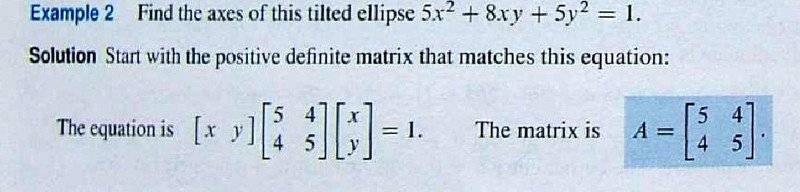
Here is the example problem:
UMj55tF.jpg


imgur link: http://i.imgur.com/UMj55tF.jpg

I can see that where we have 1 = \vec{x}^T A \vec{x} = \lambda \vec{x}^T \vec{x} that 1=\lambda \vec{x}^T \vec{x} = \lambda ||\vec{x}||^2

so ||\vec{x}|| = \frac{1}{\sqrt{\lambda}}

and I understand that the length of the vector ||\vec{x}|| will have min and max values when pointing along the minor and major axis'.

What I cannot prove to myself, or see the reason behind, is why the eigenvectors that you would solve for would be pointing in the direction of the minor and major axis'. Why is that? What is the reason for that?
 
Physics news on Phys.org
Using the Eigenvectors as a basis, the linear transformation corresponds to a diagonal matrix. Another way of putting that is that, creating the matrix S, having the eigenvectors as columns, such that A= S^TAS and where D is a diagonal matrix, having the eigenvalues on the diagonal. Then x^TAx= x^T(S^TD)x= (Sx)^TD(Sx)= 1. So the equation becomes \begin{bmatrix}x & y \end{bmatrix}\begin{bmatrix}\lambda_1 & 0 \\ 0 & \lambda_2\end{bmatrix}\begin{bmatrix}x \\ y \end{bmatrix}= \lambda_1x^2+ \lambda_2^2= 1.
 

Similar threads

  • · Replies 33 ·
2
Replies
33
Views
3K
  • · Replies 2 ·
Replies
2
Views
2K
  • · Replies 3 ·
Replies
3
Views
3K
  • · Replies 3 ·
Replies
3
Views
4K
  • · Replies 2 ·
Replies
2
Views
1K
  • · Replies 9 ·
Replies
9
Views
2K
Replies
13
Views
2K
  • · Replies 20 ·
Replies
20
Views
4K
  • · Replies 9 ·
Replies
9
Views
2K
  • · Replies 5 ·
Replies
5
Views
6K