Why are there only two possible spin-eigenstates for deuterium's nucleus?

Click For Summary
SUMMARY

The discussion centers on the spin eigenstates of deuterium's nucleus, specifically addressing the misconception that there are four possible eigenstates for a spin-1/2 particle system. Participants clarify that the total nuclear spin of deuterium can only yield two values: S = 1 (with three possible M_S values) and S = 0 (with one M_S value). The confusion arises from the interpretation of spin combinations and the application of Clebsch-Gordon coefficients in angular momentum addition. The consensus emphasizes that the eigenstates are determined by the coupling of the individual spins of the proton and neutron.

PREREQUISITES
  • Understanding of quantum mechanics, specifically spin-1/2 particles
  • Familiarity with Clebsch-Gordon coefficients and their role in angular momentum addition
  • Knowledge of Russell-Saunders coupling and its implications in nuclear physics
  • Basic grasp of nuclear spin and its measurement in deuterium
NEXT STEPS
  • Study Clebsch-Gordon coefficients and their application in quantum mechanics
  • Learn about Russell-Saunders coupling and its significance in nuclear physics
  • Explore the mathematical framework of angular momentum addition in quantum mechanics
  • Review literature on nuclear spin states, particularly in the context of deuterium
USEFUL FOR

Students and professionals in nuclear physics, quantum mechanics enthusiasts, and researchers focusing on angular momentum and spin states in particle physics.

JD_PM
Messages
1,125
Reaction score
156
I am studying the deuterium's nucleus.

As we know, there are just two eigenstates for a spin 1/2 particle: either spin up or spin down.

Thus, over the whole nucleus, you get 4 possible combinations:

1) Spin up-spin up

2) Spin up-spin down

3) Spin down-spin up

4) Spin down-spin down

If you add the spins up, the four cases, you get +1, 0, 0, -1 respectively.

S = 1 means there are 3 possible values for the total nuclear spin of the nucleus, while s = 0 means there is just 1 possible value.

You can watch the enlightening Dr. Physics video on nuclear spin for further details:

But I have been told there are just two possible cases instead: Spin up-spin up and Spin up-spin down.

I asked why and the following table was used to argue it:
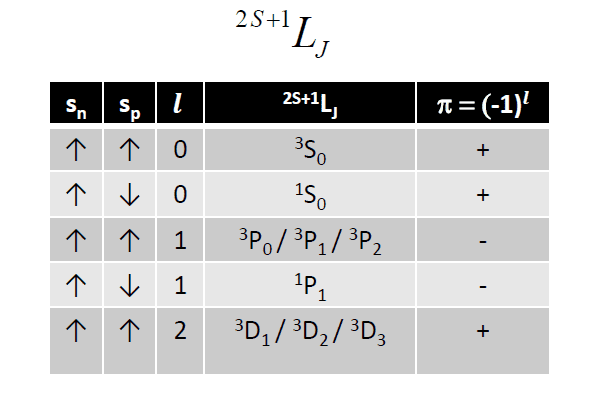
Screenshot (259).png

Note that here the cases are not as expected; the eigenstate of the neutron never is spin-down...

May you shed some light on why I am wrong assuming four possible eigenstates for the coupled proton-neutron case and on how to interpret the attached table?

Note: what I think it is going on here is that the general state of deuterium is just the normalized linear combination of both spin-up and spin-down, but I want to go further than that.

Thanks
 
  • Like
Likes   Reactions: Charles Link
Physics news on Phys.org
I look forward to the subsequent discussion. I don't understand why a down-down state is impossible. Perhaps the author goofed. If the author is indeed correct in his assessment, he would do well to provide an explanation for why this is the case. I'm not so sure he is correct. ## \\ ## @DrClaude Can you help us on this one? ## \\ ## One comment: For each of the various ##J##-##J## states, if I remember correctly, there are ## M_J ## states that run from +##J ## to -##J ##. The down-down nuclear spin state is the ##S_{total}=+1 ## with ##M_S=-1 ##. This one is complicated by the ## L ##. The ## L ## is apparently a mechanical rotation of the neutron and proton. ## \\ ## I am not sure if they are doing Russell-Saunders or ## J##-##J## Coupling. Perhaps both will lead to similar results. Since the ## L ## is necessarily the same for both neutron and proton (scratch that), I think the ## L's ## will first get added, and the ##S's ## are added from each. ## \\ ## ## \vec{L}_{total}=\vec{L}_1+\vec{L}_2 ## are determined with Clebsch-Gordon coefficients, and ## M_L ## runs from +## L_{total} ## to -##L_{total} ## for each possible ## L_{total} ##. As the table correctly shows, ##L_{total}=2,1, ## and ## 0 ##. This would then be Russell-Saunders type coupling,(and not ##J##-##J## coupling), where the ##L_{total} ## and ## S_{total} ## are first computed. ## \\ ## Just like with ## \vec{L}_{total}=\vec{L}_1+\vec{L}_2 ## , ## \vec{S}_{total}=\vec{S}_1+\vec{S}_2 ## ,and ## M_S ## runs from ## S_{total} ## to −##S_{total} ## with ##S_{total}=+1,0 ##. The particles are each spin1/2, (## S1=S2=\frac{1}{2} ## ), while the ## L## for each particle, (## L_1 ## and ##L_2## ) is ## +1## or ##0 ##. ## \\ ## The ## \vec{J}_{total}=\vec{L}_{total}+\vec{S}_{total}## is then subsequently computed,(again by a Clebsch−Gordon process). ## \\ ## I need to review this a little. It was 40+ years ago that I first had this material at the University of Illinois at Urbana-Champaign.
 
Last edited:
  • Like
Likes   Reactions: JD_PM
Charles Link said:
@DrClaude Can you help us on this one?
Unfortunately, I don't know much about nuclear physics. Maybe @mfb can help.

Why guess is that the table lists only half the possibilities, since there is a redundancy for spin-down neutrons.

JD_PM said:
1) Spin up-spin up

2) Spin up-spin down

3) Spin down-spin up

4) Spin down-spin down

If you add the spins up, the four cases, you get +1, 0, 0, -1 respectively.
That's not correct. Addition of angular momenta is more involved than that, see @Charles Link's post. For example, spin-up and spin-down combine into both a spin-1 state and a spin-0 state.
 
  • Like
Likes   Reactions: JD_PM and Charles Link
It is probably just a list "up to symmetry". Without relevant external magnetic field the direction of "up" is arbitrary anyway. If you flip both spin states and all other coordinate-dependent properties you still get a valid state, of course, but it won't look different from the one you had before.
 
  • Like
Likes   Reactions: DrClaude, Charles Link and JD_PM
I will provide further details today
 
  • Like
Likes   Reactions: Charles Link
mfb said:
It is probably just a list "up to symmetry". Without relevant external magnetic field the direction of "up" is arbitrary anyway. If you flip both spin states and all other coordinate-dependent properties you still get a valid state, of course, but it won't look different from the one you had before.
Yes. Thank you @mfb . I never thought of it previously that way, but the quantum mechanical designation does tell the symmetry group to which a given state belongs. I had a group theory course in graduate schoolat UCLA, taught by Professor Eugene Wong, that used Tinkham's book a couple of years after we learned about Clebsch-Gordon coefficients, both from Professor Gary Gladding at the University of Illinois at Urbana-Champaign, and from Professor J.J. Sakurai at UCLA. ## \\ ## @bhobba You might find this entire thread of interest. I welcome your inputs and expertise.
 
OK I will start from scratch.

We're dealing with two 1/2 spin particles here (one proton and one neutron). I claim that the eigenstate of each of these particles will be a linear combination of both spin-up and spin-down eigenstates, such that:

$$\chi_p = a\uparrow + b\downarrow$$

$$\chi_n = c\uparrow + d\downarrow$$

Then, the composite eigenstate will be a linear combination of the 2 eigenstates for the individual proton and neutron:

$$\chi_{pn} = a\uparrow + b\downarrow + c\uparrow + d\downarrow$$

Which can be illustrated as well:

$$\uparrow\uparrow$$
$$ \uparrow\downarrow$$
$$ \downarrow\uparrow$$
$$ \downarrow\downarrow$$

@DrClaude I meant the spin angular momentum, so I think this is correct.

Then, based on the composite eigenstate, we can see that there are two possible values for the total nuclear spin of deuterium: ##s=0## and ##s=1##


I still don't completely understand the attached table. It has to do with spectroscopy notation, so I will read more about it and then come back
 
  • Like
Likes   Reactions: Charles Link
JD_PM said:
OK I will start from scratch.

We're dealing with two 1/2 spin particles here (one proton and one neutron). I claim that the eigenstate of each of these particles will be a linear combination of both spin-up and spin-down eigenstates, such that:

$$\chi_p = a\uparrow + b\downarrow$$

$$\chi_n = c\uparrow + d\downarrow$$

Then, the composite eigenstate will be a linear combination of the 2 eigenstates for the individual proton and neutron:

$$\chi_{pn} = a\uparrow + b\downarrow + c\uparrow + d\downarrow$$

Which can be illustrated as well:

$$\uparrow\uparrow$$
$$ \uparrow\downarrow$$
$$ \downarrow\uparrow$$
$$ \downarrow\downarrow$$

@DrClaude I meant the spin angular momentum, so I think this is correct.

Then, based on the composite eigenstate, we can see that there are two possible values for the total nuclear spin of deuterium: ##s=0## and ##s=1##


I still don't completely understand the attached table. It has to do with spectroscopy notation, so I will read more about it and then come back
Suggest you read about Clebsch-Gordon coefficients and adding angular momentum using Russell-Saunders coupling. I believe what I posted above is correct.
 
  • Like
Likes   Reactions: JD_PM
JD_PM said:
I claim that the eigenstate of each of these particles will be a linear combination of both spin-up and spin-down eigenstates

Not "eigenstate", just "state". Only the spin-up and spin-down states themselves are eigenstates (more precisely, eigenstates of the relevant spin operator that you are using to determine the basis for the one-particle Hilbert space).

JD_PM said:
Then, the composite eigenstate will be a linear combination of the 2 eigenstates for the individual proton and neutron:
$$
\chi_{pn} = a\uparrow + b\downarrow + c\uparrow + d\downarrow
$$

No, that's not what the state of the two-particle system will be. It will be the product of the one-particle states:

$$
\chi_{pn} = \left( a \uparrow + b \downarrow \right) \left ( c \uparrow + d \downarrow \right) = a c \uparrow \uparrow + a d \uparrow \downarrow + b c \downarrow \uparrow + b d \downarrow \downarrow
$$
 
  • Like
  • Informative
Likes   Reactions: bhobba, Charles Link and JD_PM
  • #10
OK, while studying the total angular momentum of the deuterium:
Screenshot (269).png

Experimentally you always get I = 1, so there are 4 possible combinations:

Screenshot (270).png


Where:

a) ##I = \frac{1}{2} + \frac{1}{2} + 0 = 1##

b) ##I = \frac{1}{2} - \frac{1}{2} + 1 = 1##

c) ##I = - \frac{1}{2} - \frac{1}{2} + 1 = -1?!##

d) ##I = -\frac{1}{2} - \frac{1}{2} + 2 = 1##

I am clearly missing something in case c), as I get ##I = -1## instead of 1.
 
  • #11
What book does this come from?
 
  • #12
Krane; introduction to Nuclear Physics, page 84. It's available online
 
  • #13
This is one of the worst treatment of addition of quantum angular momentum I have ever seen.

First, when adding to spin-1/2 particles, one gets two possible value of total spin:
$$
\begin{align*}
| S = 1, M_S = 1 \rangle &= |1/2\rangle_\mathrm{n} |1/2\rangle_\mathrm{p} \\
| S = 1, M_S = 0 \rangle &= \frac{1}{\sqrt{2}} \left[ |1/2\rangle_\mathrm{n} |-1/2\rangle_\mathrm{p} + |-1/2\rangle_\mathrm{n} |1/2\rangle_\mathrm{p} \right] \\
| S = 1, M_S = -1 \rangle &= |-1/2\rangle_\mathrm{n} |-1/2\rangle_\mathrm{p} \\
| S = 0, M_S = 0 \rangle &= \frac{1}{\sqrt{2}} \left[ |1/2\rangle_\mathrm{n} |-1/2\rangle_\mathrm{p} - |-1/2\rangle_\mathrm{n} |1/2\rangle_\mathrm{p} \right]
\end{align*}
$$
The first three (##S=1##), the authors calls "parallel" and the other one (##S=0##) "anti-parallel." The are usually called the triplet and single state, respectively (because, as you see, the z-component of the spins are not always aligned in the different cases).

Now, one wants to build up a ##I=1## state by adding ##S## and ##\ell##. There are indeed four ways to do this. I'll concentrate on the ##| I = 1, M_I=0 \rangle## state, but the process is similar for ##M_I=\pm 1##. I'll concentrate on the Clebsch-Gordan coefficients, the following four combinations correspond to ##| I = 1, M_I=0 \rangle##:
$$
|\ell = 0, m_\ell = 0 \rangle |S = 1, M_S= 0\rangle \\
|\ell = 1, m_\ell = 0 \rangle |S = 0, M_S= 0\rangle \\
\frac{1}{\sqrt{2}} \left[ |\ell = 1, m_\ell = 1 \rangle |S = 1, M_S= -1\rangle + |\ell = 1, m_\ell = -1 \rangle |S = 1, M_S= 1\rangle \right] \\
\sqrt{\frac{2}{5}} |\ell = 2, m_\ell = 0 \rangle |S = 1, M_S= 0\rangle + \sqrt{\frac{3}{10}} |\ell = 2, m_\ell = 1 \rangle |S = 1, M_S= -1\rangle + \sqrt{\frac{3}{10}} |\ell = 2, m_\ell = -1 \rangle |S = 1, M_S= 1\rangle
$$
which correspond to cases (a)-(d) in the text, respectively.
 
  • Like
  • Informative
  • Love
Likes   Reactions: bhobba, mfb, JD_PM and 1 other person
  • #14
If you don't mind I will delve more into it (this time using Griffiths) and then come back
 
  • Like
Likes   Reactions: bhobba and Charles Link
  • #15
I tried to understand @DrClaude's post (I'm still stuck on understanding how Clebsch-Gordan coefficients work) and was going to post a long response but I eventually changed my mind I decided to go step by step.

My goal is understanding how addition of angular momentum works. Let's focus on the spin for the moment. I've read that if you combine two spins, the outcomes go like:

$$s_t = (s_1 + s_2), (s_1 + s_2 - 1), (s_1 + s_2 - 2), ... |s_1 - s_2|$$

I don't see why it goes down by 1 unit each step and the final term is ##|s_1 - s_2|##. I see ##s_1 + s_2## can yield either a +ive or -ive number (depending on the value of each individual spin, of course) but why ##|s_1 - s_2|## as the last step?

I know this is more a mathematical Q, but wanted to ask. Actually, Griffiths recommends the book Claude Cohen-Tannoudji, Bernard Diu and Frank Laloe, QM's book.
 
  • #16
Why it goes down by unit steps is a bit hard to explain simply. It requires understanding angular momentum operators as ladder operators. As a start, take it for granted that quantum angular momentum has to be quantised.

To understand why ##|s_1 - s_2|## is the smallest possible resulting value, remember that angular momentum is a vector quantity. The limits follow from the triangle rule for vectors of given magnitude but with undefined directions.
 
  • Like
Likes   Reactions: JD_PM
  • #17
DrClaude said:
Why it goes down by unit steps is a bit hard to explain simply. It requires understanding angular momentum operators as ladder operators. As a start, take it for granted that quantum angular momentum has to be quantised.

To understand why ##|s_1 - s_2|## is the smallest possible resulting value, remember that angular momentum is a vector quantity. The limits follow from the triangle rule for vectors of given magnitude but with undefined directions.

Then the smallest possible resulting value comes from the subtraction of both vectors:

Captura de pantalla (563).png

And if the directions are undefined but the magnitudes are known, why not?:

$$s_t = |s_1 + s_2 |, |s_1 + s_2 - 1 |, |s_1 + s_2 - 2 |, ... |s_1 - s_2|$$
 
  • #18
This whole thing involves a quantized condition for angular momentum that comes from the solutions of the Schrödinger equation. I am not an expert in this material, although I did know it much better about 40 years ago when I was taking college courses in Quantum Mechanics.
@bhobba Perhaps you might have a helpful input or two.
 
  • #19
JD_PM said:
And if the directions are undefined but the magnitudes are known, why not?:$$s_t = |s_1 + s_2 |, |s_1 + s_2 - 1 |, |s_1 + s_2 - 2 |, ... |s_1 - s_2|$$
How is this different than what you posted in #15?
 
  • #20
Nugatory said:
How is this different than what you posted in #15?

##s_1## and ##s_2## can either be +ive or -ive, while in #17 I am taking the absolute values
 
  • #21
JD_PM said:
##s_1## and ##s_2## can either be +ive or -ive, while in #17 I am taking the absolute values
##s_1## and ##s_2## are the magnitudes of vectors so are both positive. It's the z components of these vectors (corresponding to the ##m## quantum number) that may be positive or negative.

And I have to agree with what @DrClaude said in #13 about this treatment of addition of angular momenta... you might want to give something like https://www2.ph.ed.ac.uk/~ldeldebb/docs/QM/lect15.pdf a try.
 
  • Like
Likes   Reactions: JD_PM

Similar threads

  • · Replies 2 ·
Replies
2
Views
2K
  • · Replies 1 ·
Replies
1
Views
1K
  • · Replies 1 ·
Replies
1
Views
1K
  • · Replies 4 ·
Replies
4
Views
2K
  • · Replies 2 ·
Replies
2
Views
2K
  • · Replies 5 ·
Replies
5
Views
4K
  • · Replies 1 ·
Replies
1
Views
2K
  • · Replies 5 ·
Replies
5
Views
3K
  • · Replies 2 ·
Replies
2
Views
1K
  • · Replies 13 ·
Replies
13
Views
3K