Why are there three wires in secondary coil of transformer?

Click For Summary

Discussion Overview

The discussion revolves around the configuration of a 12-0-12 transformer, specifically addressing the presence of three wires in the secondary coil and their implications for circuit design. Participants explore the use of the transformer for rectification purposes, including the potential for full-wave and half-wave rectification, as well as considerations regarding capacitor sizing in relation to load requirements.

Discussion Character

  • Technical explanation
  • Conceptual clarification
  • Debate/contested
  • Mathematical reasoning

Main Points Raised

  • Some participants explain that the center tap allows for different voltage outputs, enabling configurations like 6VDC using two rectifiers instead of a full bridge.
  • Others propose that the presence of two live wires may indicate multiple secondary windings or taps from a single winding, which could provide various output voltages.
  • There is a discussion about the use of four 1N5408 rectifier diodes for converting AC to DC, with some questioning the necessity of four diodes and suggesting alternatives.
  • Participants express uncertainty about the efficiency and voltage outcomes when treating both windings as one, noting that common reasoning suggests a higher voltage when using windings separately.
  • One participant mentions that rectifying AC will yield a peak voltage as DC, but others clarify that this results in pulsed DC and highlight the role of capacitors in smoothing the output voltage.
  • There are differing opinions on the appropriate size of capacitors for the circuit, with suggestions ranging from 100uF to 6800μF, depending on the expected load current.
  • Concerns are raised about the inrush current that large capacitors may impose on diodes, prompting discussions about diode ratings and circuit design considerations.

Areas of Agreement / Disagreement

Participants express multiple competing views regarding the transformer configuration, rectification methods, and capacitor sizing. The discussion remains unresolved on several technical points, particularly concerning the implications of using the center tap and the appropriate capacitor values for specific applications.

Contextual Notes

Limitations include the dependency on specific circuit configurations and the ambiguity in the transformer datasheet regarding voltage ratings. Participants also note the importance of measuring voltages before connecting components.

Who May Find This Useful

Readers interested in transformer applications, rectification techniques, and circuit design considerations, particularly in the context of low-power electronics and Arduino projects, may find this discussion relevant.

Wrichik Basu
Science Advisor
Insights Author
Gold Member
Messages
2,186
Reaction score
2,694
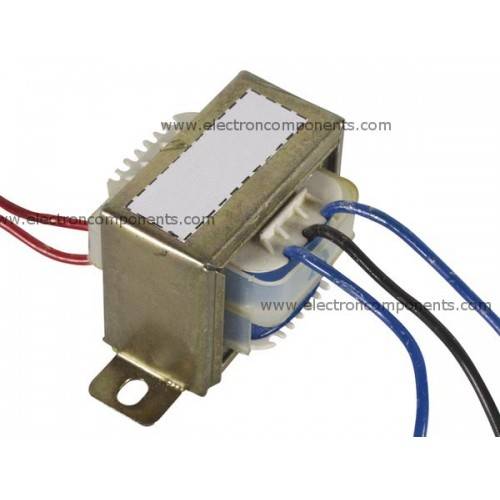
This is a 12-0-12 transformer that I intend to use in my circuit:

EC_trx_12_500-500x500.jpg


Why are there three wires in the secondary? One is of course the neutral (in black). Why are there two live wires?

As an additional question, can I use four 1N5408 rectifier diodes to convert the output of this transformer to DC (full wave rectifier)?
 

Attachments

  • EC_trx_12_500-500x500.jpg
    EC_trx_12_500-500x500.jpg
    19.8 KB · Views: 2,092
Engineering news on Phys.org
The center tap gives you the option of taking 6 volts and rectifying to 6VDC with two rectifiers instead of a full wave bridge.
 
  • Like
Likes   Reactions: Wrichik Basu
Wrichik Basu said:
Why are there three wires in the secondary? One is of course the neutral (in black). Why are there two live wires?
Probably there is more than one secondary winding, or more than one tap from a single winding, giving multiple output voltages.

Wrichik Basu said:
As an additional question, can I use four 1N5408 rectifier diodes to convert the output of this transformer to DC (full wave rectifier)?

Why 4? You can't use diodes in parallel. Please show your proposed circuit schematic and tell us whay you are trying to accomplish.
 
One winding and a four diode bridge, two windings and two diodes?
 
anorlunda said:
Why 4? You can't use diodes in parallel. Please show your proposed circuit schematic and tell us whay you are trying to accomplish.
Something like this:

current_flow_in_bridge_rectifier_1.jpg
 

Attachments

  • current_flow_in_bridge_rectifier_1.jpg
    current_flow_in_bridge_rectifier_1.jpg
    8.3 KB · Views: 1,185
Borek said:
One winding and a four diode bridge, two windings and two diodes?
I can do that, but since I had already made a four-diode rectifier bridge last year (but never used it), I want to use it here so as to reduce some work. :smile:
 
Check if you can treat both windings as one (ignore black wire).

Not sure how much sense it makes in terms of efficiency nor what voltage you will get (common reason suggests twice more than when using windings separately).
 
Borek said:
Check if you can treat both windings as one (ignore black wire).

Not sure how much sense it makes in terms of efficiency nor what voltage you will get (common reason suggests twice more than when using windings separately).
I haven't bought the equipment yet. So, I'll have to check after I buy it.

Anyways, thanks for your help. Problem solved (at least theoretically).
 
One last question, not worthy of posting in a separate thread: When I rectify AC, I will get the peak voltage as DC, right? (Irrespective of half-wave or full-wave rectification)
 
  • Like
Likes   Reactions: sophiecentaur
  • #10
No idea what you mean. You will get so called pulsed DC.
 
  • Like
Likes   Reactions: Wrichik Basu
  • #11
Borek said:
No idea what you mean. You will get so called pulsed DC.
Leave it, I've understood.
 
  • #13
Wrichik Basu said:
One last question, not worthy of posting in a separate thread: When I rectify AC, I will get the peak voltage as DC, right? (Irrespective of half-wave or full-wave rectification)
So @berkeman showed you the difference between the full wave rectification and the half wave rectification. I'll warn you ahead of time that you need to take those voltage plots with a grain of salt. I will explain later.

Let me run through the possibilities:
If you don't use the black center tap, you will get the full rating of the transformer - 12V rms.
At 12Vrms, you can get full wave (4 diode) or half wave (2 diode) rectification and the result is what @berkeman showed.
If you use the center tap as the DC ground, then you will have the equivalent of 6Vrms. In that case, you only need two diodes to get full wave rectification.

Now let's talk about that "peak" issue. And for that we need to talk about capacitance and your load. In the simplest circuits (not ones that compensate for power factor), the next component after the full-wave or half-wave bridge is usually a good size capacitor (in the 100uF or mF range). With such a capacitor and no load, your voltage will hang out well above 12 volts. Basically, it will catch the peak voltage and never drop below that. So you will not see the scalloping that @berkman showed.

As your load increases, those sine wave peaks will become more and more evident. The voltage plot will become more and more lumpy. This is why power factor becomes an issue. You end up powering your device with only a portion of the waveform.
 
Last edited:
  • Like
Likes   Reactions: Nik_2213, Wrichik Basu and berkeman
  • #14
Thank you, @.Scott That was a very good explanation. I felt I had read about the peak voltage case somewhere, but I couldn't remember the capacitor. Later, I thought I was wrong. Your explanation was indeed very helpful, especially the centre tap topic, and the peak voltage issue.
 
  • #15
Be aware:
That transformer is rated as 12-0-12, normally meaning that there is 12V each side of the center tap (Black wire). That gives a total voltage across the two Blue wires of 24V. When rectified, expect peak 32VDC output.

The datasheet is slightly ambiguous, so I suggest you measure all three secondary voltages before you connect any parts.

Cheers,
Tom

edit: fixed typo
 
Last edited:
  • Like
Likes   Reactions: jim hardy, davenn and Wrichik Basu
  • #16
Wrichik Basu said:
I had already made a four-diode rectifier bridge last year

In the future if you need to buy new parts anyway you can consider buying the bridge an one component. That saves more work.

BoB
 
  • Like
Likes   Reactions: davenn
  • #17
.Scott said:
If you don't use the black center tap, you will get the full rating of the transformer - 12V rms.
no, 24 VAC across the two blues :wink:

12 VAC is ONLY across the black and ONE of the blue wires

.Scott said:
the next component after the full-wave or half-wave bridge is usually a good size capacitor (in the 100uF or mF range).

100uF isn't a good sized capacitor for this unless you were only drawing a few 10's of mA

1000uF minimum / 1 A of current is the normal rule of thumb
and 1000 uF would be the best place to start for any thing up to 1 A and go higher from there if the current is going to be higher
( of course that's got to be within the ratings of the transformer)Dave
 
Last edited:
  • Like
Likes   Reactions: berkeman and Wrichik Basu
  • #18
Or you could get a "split supply" out of it:
diode-bridge-split-supply.png
 

Attachments

  • diode-bridge-split-supply.png
    diode-bridge-split-supply.png
    3.2 KB · Views: 1,291
  • Like
Likes   Reactions: Wrichik Basu and Tom.G
  • #19
davenn said:
no, 24 VAC across the two blues :wink:

12 VAC is ONLY across the black and ONE of the blue wires
Thanks for pointing that out.
davenn said:
100uF isn't a good sized capacitor for this unless you were only drawing a few 10's of mA

1000uF minimum / 1 A of current is the normal rule of thumb
and 1000 uF would be the best place to start for any thing up to 1 A and go higher from there if the current is going to be higher
( of course that's got to be within the ratings of the transformer)
Arduino's cannot it stand more than 40mA per I/O pin, otherwise the microcontroller might be crippled. I am designing my circuit such that it draws no more than 30mA from the pins. Since I am using two Analog pins and two Digital pins as of now, the current isn't supposed to exceed 120mA or 130mA at most.

I was thinking of using a large value of capacitor (say 6800μF, though the voltage won't be greater than 15V in my circuit under any circumstance). Will that do any harm to my circuit or the Arduino?
 
  • Like
Likes   Reactions: davenn
  • #20
No need for a large capacitor if Arduino is all that will be powered (especially as it has its own, additional powering circuit that will smooth the voltage further).

davenn's comment was of a more general nature, as he stated - it doesn't matter much when you draw low currents.
 
  • Like
Likes   Reactions: Wrichik Basu and davenn
  • #21
Svein said:
Or you could get a "split supply" out of it:
View attachment 232771
Something wonky with the diode orientations, methinks. I see direct paths through the diode shorting the secondary.
 
  • #22
Wrichik Basu said:
I was thinking of using a large value of capacitor (say 6800μF, though the voltage won't be greater than 15V in my circuit under any circumstance). Will that do any harm to my circuit or the Arduino?

With very large capacitors you need to be aware of the maximum inrush your diodes can handle.

BoB
 
  • #23
rbelli1 said:
With very large capacitors you need to be aware of the maximum inrush your diodes can handle.
You mean to say current, right? If that is so, then: my rectifiers (1N5408) can handle 3A current. But I'll take the advice and decrease the capacitance.

Actually initially I had thought of giving a 1F capacitor o0)
 
  • #25
gneill said:
Something wonky with the diode orientations, methinks. I see direct paths through the diode shorting the secondary.
You're right - Good Eye !
They swapped the AC and DC terminals of the bridge.
Should be Plus at the bottom. Minus at the top, and AC into the sides.Going back to your OP's own sketch and making it split supply,

upload_2018-10-25_18-58-11.png


Simplify your thinking
When looking at a full wave bridge rectifier for a power supply circuit...
DC side always faces two anodes or two cathodes (or three for three phase)
AC side always faces one of each

Someday you'll run across a "Ring Modulator" that violates the rule , but it's for a signal not a power supply circuit.

old jim
 

Attachments

  • upload_2018-10-25_18-58-11.png
    upload_2018-10-25_18-58-11.png
    12.2 KB · Views: 749
Last edited:
  • Like
Likes   Reactions: davenn, Wrichik Basu, dlgoff and 1 other person
  • #26
jim hardy said:
You're right - Good Eye !
They swapped the AC and DC terminals of the bridge.
Should be Plus at the bottom. Minus at the top, and AC into the sides.
Thanks. Yup, over the (many) years I find I've become somewhat adept at spotting these little slip-ups in "pulp-published" circuits.

I just wanted to make sure that some newby didn't try to build the circuit as shown. Fried components can be quite discouraging.
 
  • Like
Likes   Reactions: Wrichik Basu, davenn, dlgoff and 1 other person
  • #27
To the OP: please link here the source of the circuit you are trying to build. More than half of the posts (and half of your connected topics) are completely unnecessary or missing the point if applied to that specific circuit.
 
  • #28
I think since my original question has been answered, so I will request moderators to close this thread.

To @Rive and others: I promise to post the project fully in the DIY forum when I finish with all the calculations.

Great advice was given in this thread, and I shall make good use of it. Thanks everyone for your input.
 
  • Like
Likes   Reactions: gneill, berkeman, jedishrfu and 1 other person
  • #29
Thread closed at the request of the Original Poster.
 
  • Like
Likes   Reactions: jim hardy

Similar threads

Replies
2
Views
1K
  • · Replies 10 ·
Replies
10
Views
5K
Replies
3
Views
2K
Replies
6
Views
4K
Replies
14
Views
3K
Replies
7
Views
8K
  • · Replies 7 ·
Replies
7
Views
4K
  • · Replies 5 ·
Replies
5
Views
3K
  • · Replies 7 ·
Replies
7
Views
5K
  • · Replies 7 ·
Replies
7
Views
2K