Transformer without separate primary and secondary windings....

Click For Summary

Discussion Overview

The discussion revolves around the design and safety considerations of an autotransformer, particularly one that allows for variable output voltages. Participants explore the implications of using a single winding transformer with taps for different voltage outputs, referencing a video demonstration and discussing the potential hazards associated with such a setup.

Discussion Character

  • Exploratory
  • Technical explanation
  • Debate/contested
  • Safety-related

Main Points Raised

  • One participant expresses a desire to create a transformer that provides AC at various voltages for testing purposes, referencing a video of a homemade transformer.
  • Another participant identifies the transformer design as an autotransformer, noting that it does not provide isolation from the mains and can produce dangerous voltages.
  • Concerns are raised about the safety of operating at high voltages, with suggestions to use an isolation transformer and to seek qualified supervision.
  • Some participants discuss the mathematical relationships between impedances in series and the implications of shared fields in the transformer core, leading to uncertainty about the calculations involved.
  • There is a mention of the importance of polarity marking in transformer design to indicate phase relationships between windings.
  • One participant indicates they are using the video for educational purposes and plans to limit their output to a safer voltage range, while others question the necessity of higher voltages for demonstration.
  • Safety hazards are a recurring theme, with participants emphasizing the risks associated with high voltage experimentation and the need for adequate safety measures.

Areas of Agreement / Disagreement

Participants express varying levels of concern regarding safety, with some advocating for caution and others questioning the need for high voltages. There is no consensus on the necessity of high voltage for educational purposes, and technical disagreements arise regarding the mathematical treatment of the transformer windings.

Contextual Notes

The discussion highlights limitations in understanding the implications of using an autotransformer, particularly regarding safety and mathematical modeling. There is also a lack of clarity on how to safely implement the design discussed in the video.

Wrichik Basu
Science Advisor
Insights Author
Gold Member
Messages
2,186
Reaction score
2,694
TL;DR
The person in this video makes a transformer that does not have separate primary and secondary windings. How is this supposed to work?
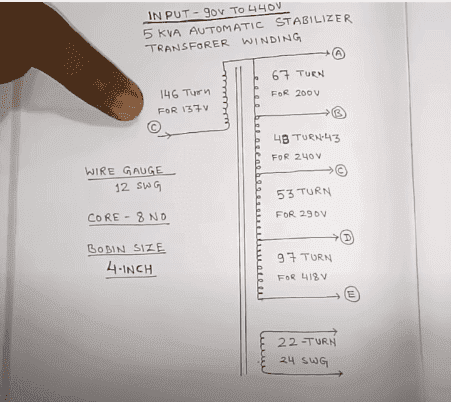
I have always longed to make a system where I can get AC over a wide range of voltages. This system would help me test how my other experiments behave when they are powered from the mains. In order to get different voltages, I need to design my own transformer where the secondary has been tapped at different places so as to give different voltages.

On YouTube, I found this video. The person winds transformers at his home. The video is not in English, so you can jump to the section where he shows his circuit:
1589704602006.png


The input is on the left (where his finger is), and the output is on the right. As you can see, he starts the primary winding, but instead of ending it, he bends it into an output terminal, and thereafter continues winding the secondary coil.

My question: I have seen transformers that have two wires for input (live and neutral). Here there is only one input wire. So, will the neutral be common from the input to the output? One end of my load will connect to the A, B, C, D or E terminals on the right, and the other end will be directly attached to the second input wire (that has not been attached to the transformer) - is this correct?
 
Engineering news on Phys.org
The primary can be isolated from the secondary or it can have a connection. Usually it is safer to have it isolated from the secondary. A transformer using just one winding, without a separate primary and secondary and with taps for taking off various voltages is called an auto transformer, but does not provide isolation from the mains.
The transformer you show will produce dangerous voltages.
 
The circuit in question is called autotransformer.
 
5kVA and 418V with a mains reference? Don’t build that unless you intend to run it from a proper isolation transformer. Even then, get some qualified supervision.
 
  • Like
Likes   Reactions: berkeman
tech99 said:
The transformer you show will produce dangerous voltages.
Guineafowl said:
5kVA and 418V with a mains reference? Don’t build that unless you intend to run it from a proper isolation transformer. Even then, get some qualified supervision.
No, I do not intent to exactly build the transformer shown in the video. I am using the video for learning purposes. I will be happy if my transformer provides 100V to 250V range on the secondary with 5-6A current. But I will make larger number of taps so that I can vary the voltage in small steps.
 
I am not sure cause I am not familiar with this type of transformer but I believe the mathematical explanation is that when two or more coils with impendances $$Z_1=R_1+i\omega L_1,Z_2=R_2+i\omega L_2,...,Z_n=R_n+i\omega L_n$$ are connected in series then the total impendance is $$Z=R+i\omega L=Z_1+Z_2+...+Z_n=\sum_{k=1}^nR_k+i\omega (\sum_{k=1}^nL_k)$$ and the voltages at each coil are $$V_i=V\frac{|Z_i|}{|Z|}=V\frac{\sqrt{R_i^2+\omega^2L_i^2}}{\sqrt{ ( \sum_{k=1}^nR_k)^2+\omega^2( \sum_{k=1}^{n} L_k )^2}}$$ where ##V## ,##\omega## the RMS value and frequency of the supply voltage.
 
Last edited:
Wrichik Basu said:
No, I do not intent to exactly build the transformer shown in the video. I am using the video for learning purposes. I will be happy if my transformer provides 100V to 250V range on the secondary with 5-6A current. But I will make larger number of taps so that I can vary the voltage in small steps.
That sounds promising, and experimenting with an autotransformer can be interesting. I have an infinitely variable version of that, commonly called a Variac.

Please note that the neutral is connected at A and is common to both ‘primary’ and ‘secondary’. So you have a mains reference at the output, and a shock from there will be every bit as dangerous as a mains shock.

The lower voltages you propose are still potentially unsafe for amateur experimentation with such a set-up. I suggest you look up ‘isolation transformer’ and tell us what you find.
 
Wrichik Basu said:
No, I do not intent to build exactly that transformer shown in the video. I am using the video for learning purposes. I will be happy if my transformer provides 100V to 250V range on the secondary with 5-6A current. But I will make larger number of taps so that I can vary the voltage in small steps.
That sounds like inadequate awareness of all the safety hazards. If you are just using it for education purposes, why is it necessary to have anything higher than 10 volts?
 
Delta2 said:
I am not sure cause I am not familiar with this type of transformer but I believe the mathematical explanation is that when two or more coils with impendances $$Z_1=R_1+i\omega L_1,Z_2=R_2+i\omega L_2,...,Z_n=R_n+i\omega L_n$$ are connected in series then the total impendance is $$Z=R+i\omega L=Z_1+Z_2+...+Z_n=\sum_{k=1}^nR_k+i\omega (\sum_{k=1}^nL_k)$$ and the voltages at each coil are $$V_i=V\frac{|Z_i|}{|Z|}=V\frac{\sqrt{R_i^2+\omega^2L_i^2}}{\sqrt{ ( \sum_{k=1}^nR_k)^2+\omega^2( \sum_{k=1}^{n} L_k )^2}}$$ where ##V## ,##\omega## the RMS value and frequency of the supply voltage.
These windings share the same fields as they are on the same core, so we cannot add the impedances in series.
 
  • #10
tech99 said:
These windings share the same fields as they are on the same core, so we cannot add the impedances in series.
Hmmm, maybe you are right, I said I am not sure and now even more not sure :S.

yes it seems to me you are right after all I tried to workout the whole thing with two coils that have different turns but same cross section area and same length and it turns out that the total ##L## when they are sharing the same core is quite different from ##L_1+L_2,## the algebra just doesn't work out as it should. Mathematically it boils down to the fact that ##(n_1+n_2)^2\neq n_1^2+n_2^2##.
 
Last edited:
  • #11
I think the most uncertain thing in the transformer diagram is the lack of polarity marking points to show the phase relation between the windings of the transformer.
 
  • #12
Guineafowl said:
I have an infinitely variable version of that, commonly called a Variac.
I would have bought that; it would have saved me from the trouble of running to stores to buy things. But the ones on the net are asking for incredibly high prices.
Guineafowl said:
So you have a mains reference at the output, and a shock from there will be every bit as dangerous as a mains shock.

The lower voltages you propose are still potentially unsafe for amateur experimentation with such a set-up.
anorlunda said:
That sounds like inadequate awareness of all the safety hazards.
It is good to talk about safety hazards, but let's not get drawn into that. I know these are dangerous voltages (I mark any voltage > 30 V as "dangerous"), and there are associated risks. I always show my plans physically to a learned person before executing them. And I carry out such experiments only where adequate safety measures are present.
Guineafowl said:
Please note that the neutral is connected at A and is common to both ‘primary’ and ‘secondary’.
That is what I wanted to know - how will the person in the video connect the transformer in the circuit.
 
  • #13
Wrichik Basu said:
It is good to talk about safety hazards, but let's not get drawn into that. I know these are dangerous voltages (I mark any voltage > 30 V as "dangerous"), and there are associated risks. I always show my plans physically to a learned person before executing them. And I carry out such experiments only where adequate safety measures are present.
No. You know how PF works. These threads are searchable and readable by all including children. We do not allow public discussion of dangerous topics, regardless of the qualifications of the OP.

I repeat. Why do you need high voltages to demonstrate the effects?
 
  • #14
anorlunda said:
No. You know how PF works. These threads are searchable and readable by all including children. We do not allow public discussion of dangerous topics, regardless of the qualifications of the OP.

I repeat. Why do you need high voltages to demonstrate the effects?
I have a long-time plan of making an automatic voltage stabilizer. I am fed up with the ones I have seen. The ones available in the market all have a fixed tap on the transformer, i.e. if the mains goes down to 200V, they will step it up to 230V, but if the mains goes down to 150V, they will use the same length of secondary coil to step it up to 190V. I have plans to make a stabilizer that will have multiple taps in the secondary. There will be a chip (ATmega 328p as of my previous plans) that will read the mains voltage, and then select the appropriate tap of the secondary via relays. This way, 200V will go up to 220V, and 150V will also go up to 220V.

This variable voltage generator would be helpful in testing the stabilizer. My project has been standing still only because I did not have tools to make a custom transformer. Now that I know what is required, I can at least go to shops and ask for it.

This is the explanation. If you are still unhappy, feel free to lock the thread/delete it entirely.
 

Similar threads

Replies
2
Views
1K
  • · Replies 8 ·
Replies
8
Views
3K
  • · Replies 9 ·
Replies
9
Views
3K
Replies
3
Views
2K
Replies
8
Views
2K
  • · Replies 27 ·
Replies
27
Views
4K
Replies
64
Views
8K
  • · Replies 13 ·
Replies
13
Views
4K
Replies
5
Views
3K
  • · Replies 6 ·
Replies
6
Views
3K