Why Are Volume Current Densities Zero on the Surface of Conductors?

Click For Summary

Discussion Overview

The discussion revolves around the concept of volume current densities being zero on the surface of current-carrying conductors, as presented in Griffiths' book on Electrodynamics. Participants explore the physical and mathematical reasoning behind this assertion, particularly in relation to surface integrals and the properties of current distribution.

Discussion Character

  • Exploratory, Technical explanation, Debate/contested

Main Points Raised

  • One participant questions the reasoning behind the assertion that volume current densities are zero on the surface of conductors, seeking clarification on the physical or mathematical basis for this claim.
  • Another participant suggests that if all current is contained within a finite volume, one can consider a larger volume where the surface integral must vanish.
  • A follow-up question arises regarding whether selecting the volume of integration to match the current-carrying body would still yield ##J=0## for the surface integral.
  • A response clarifies that only the integral involving ##\vec {\bf J}\cdot\vec {d\bf a}## vanishes, implying that the surface current density may not necessarily be zero in this specific case.

Areas of Agreement / Disagreement

Participants express differing views on the implications of selecting different volumes for integration, indicating that the discussion remains unresolved regarding the conditions under which the surface integral vanishes.

Contextual Notes

The discussion highlights the dependence on the choice of volume for integration and the assumptions regarding current distribution, which may not be fully addressed in the initial query.

WWCY
Messages
476
Reaction score
15
Hi all,

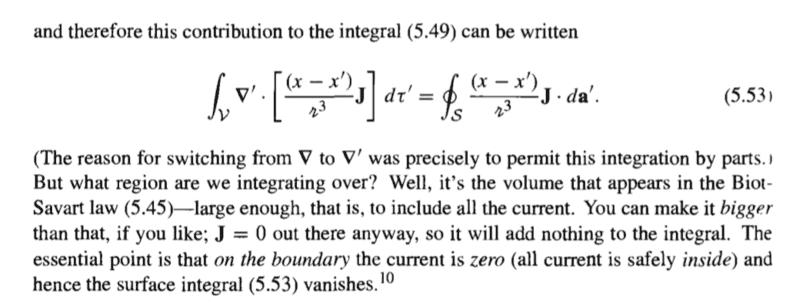
I have been reading Griffiths' book on Electrodynamics and have come across a point (image attached below) where he states that volume current densities are 0 on the surface of the current-carrying objects. He then uses these properties in pretty-important integrals.

However, I couldn't seem to find any explanation (physical or mathematical) in the book as to why it was the case. What exactly am I missing?

Thanks in advance!
Screenshot 2019-01-24 at 12.40.14 AM.png
 

Attachments

  • Screenshot 2019-01-24 at 12.40.14 AM.png
    Screenshot 2019-01-24 at 12.40.14 AM.png
    30 KB · Views: 469
Physics news on Phys.org
If you assume all the current is contained in some finite volume, then - as he says - you can always consider a larger volume, on which the surface integral must vanish
 
Hi, thank you for your response.

PeroK said:
If you assume all the current is contained in some finite volume, then - as he says - you can always consider a larger volume, on which the surface integral must vanish

Ah okay, it makes sense. However, if I choose to select the volume of integration such that it is exactly that of the current carrying body, will I still get ##J=0## for the surface integral?
 
No. Only the integral (containing ##\vec {\bf J}\cdot\vec {d\bf a}\ ##) vanishes
 
  • Like
Likes   Reactions: WWCY and PeroK

Similar threads

  • · Replies 8 ·
Replies
8
Views
6K
  • · Replies 4 ·
Replies
4
Views
2K
  • · Replies 10 ·
Replies
10
Views
4K
  • · Replies 1 ·
Replies
1
Views
2K
  • · Replies 6 ·
Replies
6
Views
1K
  • · Replies 1 ·
Replies
1
Views
2K
  • · Replies 8 ·
Replies
8
Views
6K
  • · Replies 9 ·
Replies
9
Views
3K
  • · Replies 2 ·
Replies
2
Views
1K
  • · Replies 2 ·
Replies
2
Views
7K