MHB Why Can't Two Functions Cover the Unit Circle?

Click For Summary
The discussion centers on the challenge of covering the unit circle with only two functions, specifically $$y = \sqrt{1 - x^2}$$ and $$y = -\sqrt{1 - x^2}$$. It is clarified that these functions do not cover the entire circle because they only represent the upper and lower halves, respectively, and do not account for the entire manifold. To adequately cover the unit circle, four patches are required, ensuring that every point lies within the interior of at least one patch. This understanding aligns with the concepts presented in the book "Vector Calculus, Linear Algebra and Differential Forms" by John H. Hubbard and Barbara Burke Hubbard. The clarification helps resolve the initial confusion regarding manifold coverage.
Math Amateur
Gold Member
MHB
Messages
3,920
Reaction score
48
I am reading the book: "Vector Calculus, Linear Algebra and Differential Forms" (Fourth Edition) by John H Hubbard and Barbara Burke Hubbard.

I am currently focused on Section 3.1: Manifolds ...

I need some help in order to understand Example 3.1.3 ... ...

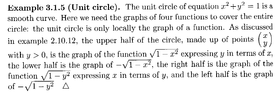
Example 3.1.3 reads as follows:View attachment 8633In the above text from H&H we read the following:

"Here we need the graphs of four functions to cover the entire circle ... "My question is as follows:

Why can we not cover the unit circle with the following two functions:

$$y = \sqrt{ 1 - x^2 }$$ where $$-1 \le x \le 1$$

and

$$y = - \sqrt{ 1 - x^2 }$$ where $$-1 \lt x \lt 1$$

I must be misunderstanding something ...

Hope someone can help ...

Peter
 

Attachments

  • H&H - Example 3.1.5 ... .png
    H&H - Example 3.1.5 ... .png
    12.3 KB · Views: 135
Physics news on Phys.org
In the context of the Hubbards' book, one wants to cover a manifold (the circle, in this example) with open patches. So each point of the manifold must lie in the interior of one of the patches. The easiest way to do that in this case is to use four patches.
 
Opalg said:
In the context of the Hubbards' book, one wants to cover a manifold (the circle, in this example) with open patches. So each point of the manifold must lie in the interior of one of the patches. The easiest way to do that in this case is to use four patches.
Thanks Opalg ...

That makes the issue clear ... grateful for that!

Peter
 
We all know the definition of n-dimensional topological manifold uses open sets and homeomorphisms onto the image as open set in ##\mathbb R^n##. It should be possible to reformulate the definition of n-dimensional topological manifold using closed sets on the manifold's topology and on ##\mathbb R^n## ? I'm positive for this. Perhaps the definition of smooth manifold would be problematic, though.

Similar threads

Replies
1
Views
2K
  • · Replies 2 ·
Replies
2
Views
2K
  • · Replies 8 ·
Replies
8
Views
2K
  • · Replies 3 ·
Replies
3
Views
1K
  • · Replies 4 ·
Replies
4
Views
2K
  • · Replies 5 ·
Replies
5
Views
2K
Replies
1
Views
2K
Replies
2
Views
2K
Replies
2
Views
2K
  • · Replies 2 ·
Replies
2
Views
2K