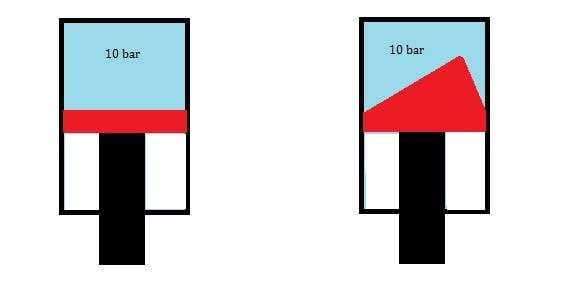
Discussion Overview
The discussion centers around the relationship between fluid pressure and the forces exerted on objects of varying shapes in a fluid environment. Participants explore how constant pressure can yield the same vertical force on differently shaped pistons and the implications of pressure integration in both static and dynamic scenarios.
Discussion Character
- Exploratory
- Technical explanation
- Debate/contested
- Mathematical reasoning
- Experimental/applied
Main Points Raised
- Some participants question how the shape of an object can be irrelevant when fluid pressure is constant, seeking mathematical proof through integration of pressure over the piston surface.
- Others suggest starting with simpler shapes to perform integration and illustrate that vertical force remains constant despite changes in shape.
- There is a discussion about integrating forces on objects in flow where pressures vary at different points, with some participants emphasizing the need for equations to describe the shape or methods for measurement.
- One participant introduces the concept of vector calculus to explain surface forces, noting that the total force must equal the weight of the fluid parcel in equilibrium.
- Concerns are raised about the complexity of dynamic problems and the integration of pressure over objects, with some suggesting that the topic could warrant extensive study.
- Participants express confusion about the integration process and the assumptions involved, particularly regarding pressure distributions and the nature of the forces acting on the object.
- One participant asserts that knowing the pressure distribution is essential for integration, while another challenges the feasibility of knowing such distributions in practice.
- There are references to specific mathematical formulations for calculating forces, including contour integrals and the components of pressure and frictional forces.
Areas of Agreement / Disagreement
Participants do not reach a consensus on the integration of pressure forces, with multiple competing views on how to approach the problem, particularly in dynamic scenarios. The discussion remains unresolved regarding the specifics of integrating pressure distributions and the implications for different shapes.
Contextual Notes
Limitations include the dependence on specific assumptions about pressure distributions and the complexity of dynamic fluid problems, which are not fully resolved in the discussion.