inkblotch
- 5
- 2
- TL;DR
- What happens to the resulting force in a pneumatic cylinder, if the piston inside were chamfered.
I was reading up on forces on hydraulic/pneumatic cylinders, and I've been thinking of this for a while:
So for a pneumatic cylinder, the force on the piston is simply:
P = F/a
F = P x a
where a = area of the piston that the air pressure is acting on.
So what would happen if the piston is chamfered, thus increasing the surface area?
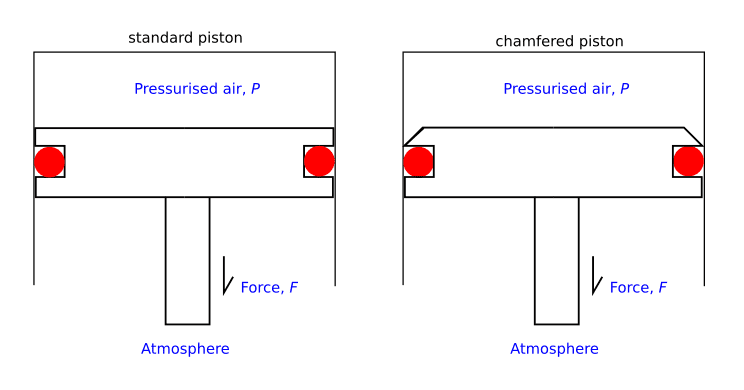
See above, (red circles are o-rings). In a closed system, my guess is :
Edit : The next step is, given the same air pressure, how could we estimate the increase in downward force?
So for a pneumatic cylinder, the force on the piston is simply:
P = F/a
F = P x a
where a = area of the piston that the air pressure is acting on.
So what would happen if the piston is chamfered, thus increasing the surface area?
See above, (red circles are o-rings). In a closed system, my guess is :
- The overall volume has increased, decreasing the pressure inside
- However, surface area is increased due to the chamfer
- Therefore the resulting downward force is the same.
Edit : The next step is, given the same air pressure, how could we estimate the increase in downward force?
Last edited: