Why Do Equations Remain Unchanged Across Different Transistor Operating Regions?

Click For Summary

Discussion Overview

The discussion revolves around the analysis of transistor circuits, specifically focusing on the conditions under which equations remain unchanged across different operating regions, such as saturation and active regions. Participants explore the implications of these conditions on circuit behavior and the assumptions made in deriving equations.

Discussion Character

  • Technical explanation
  • Debate/contested
  • Mathematical reasoning

Main Points Raised

  • One participant questions why the solver assumed saturation mode when trying to find the active region, noting that the equations used appear to apply to both regions.
  • Another participant asserts that the equations hold for both active and saturated regions, challenging the assumption of saturation.
  • There is a discussion about the behavior of the BC diode and whether it should be in reverse mode in the active region, with one participant stating that this condition is implicit in setting VCE = 0.
  • A participant critiques the second set of equations provided, labeling them as incorrect and suggesting that additional equations are necessary for a complete analysis.
  • One participant provides a method for calculating the emitter current and suggests additional equations to solve for the unknowns in the circuit analysis.

Areas of Agreement / Disagreement

Participants express differing views on the applicability of the equations across operating regions. There is no consensus on the assumptions made regarding the saturation and active regions, and the discussion remains unresolved regarding the correctness of the second set of equations.

Contextual Notes

Participants highlight the importance of using appropriate notation for currents and voltages, indicating that lower-case subscripts may imply different meanings than upper-case subscripts. There is also mention of the need for additional equations to fully analyze the circuit.

noamriemer
Messages
50
Reaction score
0
Hi there! I'm having trouble understanding the transistor circuit analysis. Hope you could help me :)
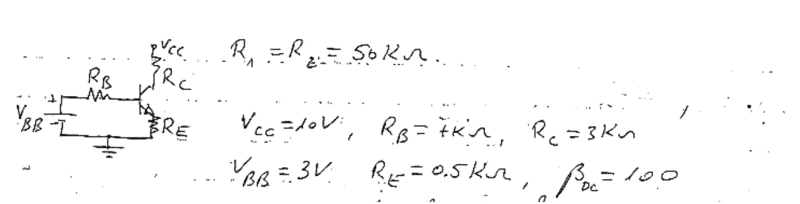
Capture.PNG


First I need to find the active region of the transistor. What I saw in the solutions was an assumption that the transistor is in saturation region and then:

VBB=IbRb+Vbe+IeRe
Vcc=IcRc+Vce+IeRe

Why did the solver assume the transistor is in saturation mode, when he is supposed to find the active region?

Next, I have to calculate the minimal RE needed for the transistor to be active.
This time, they did refer to it as in active region. But, the equations remained the same. I thought that in Active region, it is supposed to reverse:

VBB=IbRb+Vbe+IeRe
Vce-IcRc-Vcc=IeRe

Why isn't there any change in the equations ? the BC diode is supposed to be in reverse mode, isn't it ?

Thank you!
 
Physics news on Phys.org
noamriemer said:
First I need to find the active region of the transistor. What I saw in the solutions was an assumption that the transistor is in saturation region and then:

VBB=IbRb+Vbe+IeRe
Vcc=IcRc+Vce+IeRe

Why did the solver assume the transistor is in saturation mode, when he is supposed to find the active region?
There is nothing here to indicate an assumption of saturation. Those equations hold for both regions of operation, active and saturated.
Why isn't there any change in the equations ? the BC diode is supposed to be in reverse mode, isn't it ?
Yes, and that condition is implicit in setting VCE = 0. (Explanation: If VCE = 0 and VBE = 0.6, then it follows that VCE = -0.6)

[PLAIN]https://www.physicsforums.com/images/icons/icon2.gifAlso, may I point out that you should not be using lower-case subscripts here, as they mean something different from the capitals subscripts. For DC or average values, use upper-case subscripts.
 
Last edited by a moderator:
noamriemer said:
Hi there! I'm having trouble understanding the transistor circuit analysis. Hope you could help me :)
View attachment 50224

First I need to find the active region of the transistor. What I saw in the solutions was an assumption that the transistor is in saturation region and then:

VBB=IbRb+Vbe+IeRe
Vcc=IcRc+Vce+IeRe

Why did the solver assume the transistor is in saturation mode, when he is supposed to find the active region?

Next, I have to calculate the minimal RE needed for the transistor to be active.
This time, they did refer to it as in active region. But, the equations remained the same. I thought that in Active region, it is supposed to reverse:

VBB=IbRb+Vbe+IeRe
Vce-IcRc-Vcc=IeRe

Why isn't there any change in the equations ? the BC diode is supposed to be in reverse mode, isn't it ?

Thank you!

The first set of 2 equations is correct irrespective of values of the R's or power supply voltages. The second set is garbage.

A quick check shows that this configuration IS in saturation. Approximately,
ie = (3V-0.7V)/0.5K = 4.6 mA which when multiplied by Rc = 3K gives Vcc - Vc = 13.8V, exceeding even the Vcc power supply.

(How did I do that? I just assumed β = ∞, a reasonable approx. with the low value of Rb).

To get your answer, you need 3 more equations:

Obviously,

ie = ic + ib

and ic = βib.

Then you need one more. Hint: what is the current ib thru Rb? And if you know Ve do you automatically also know Vb?

That's 5 independent equations and 5 unknowns: the three currents plus emitter and collector voltages. Set Vc - Ve = 0 and solve for Re.
 
Thank you both for your great help!
 

Similar threads

  • · Replies 2 ·
Replies
2
Views
4K
Replies
68
Views
7K
Replies
4
Views
4K
Replies
5
Views
6K