Why Do Euler-Lagrange Equations Fail for This Piecewise Smooth Function?

  • Thread starter Thread starter baby_1
  • Start date Start date
  • Tags Tags
    Function Smooth
Click For Summary
SUMMARY

The discussion centers on the failure of the Euler-Lagrange equations for a specific piecewise smooth function in the context of the calculus of variations. The problem involves minimizing the functional ##J = \int_0^1 (1-y'^2)^2 dx##, leading to the conclusion that the Euler-Lagrange equations yield incorrect results under certain conditions. The participants explore why the boundary condition resulting in ##y=0## is not acceptable and how to derive constants in the Euler approach when dealing with multidisciplinary functions.

PREREQUISITES
  • Understanding of Euler-Lagrange equations
  • Familiarity with calculus of variations
  • Knowledge of piecewise smooth functions
  • Basic concepts of functional minimization
NEXT STEPS
  • Study the derivation and applications of Euler-Lagrange equations in depth
  • Explore the concept of piecewise smooth functions and their implications in calculus
  • Investigate the necessary conditions for optimality in variational problems
  • Learn about alternative methods for solving variational problems without Euler-Lagrange equations
USEFUL FOR

Mathematicians, physicists, and engineers involved in optimization problems, particularly those dealing with calculus of variations and functional analysis.

baby_1
Messages
159
Reaction score
16
Member warned about posting without the homework template
Hello
Here is my question

Capture.110PNG.PNG

So I solved Euler DE and find
gif.gif

and when we apply the boundary condition we obtain y=0 . My teacher said that we should write it as two different function as
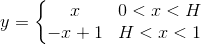
matrix%7D%20x%20%26%200%3Cx%3CH%5C%5C%20-x+1%20%26%20H%3Cx%3C1%20%5Cend%7Bmatrix%7D%5Cright.gif

where H is (1/2).He solved this equation with this way

gif.gif


So Here are my questions:
a) why don't we accept the y=0 as our desire function?
b)how can obtain (a) constant in my equation with Euler approach?because in multidisciplinary function we can't find a ?
 
Physics news on Phys.org
baby_1 said:
Hello
Here is my question
View attachment 94931
So I solved Euler DE and find
gif.gif

and when we apply the boundary condition we obtain y=0 . My teacher said that we should write it as two different function as
matrix%7D%20x%20%26%200%3Cx%3CH%5C%5C%20-x+1%20%26%20H%3Cx%3C1%20%5Cend%7Bmatrix%7D%5Cright.gif

where H is (1/2).He solved this equation with this way
gif.gif


So Here are my questions:
a) why don't we accept the y=0 as our desire function?
b)how can obtain (a) constant in my equation with Euler approach?because in multidisciplinary function we can't find a ?

What is a "multidisciplinary function"? I have never heard that term.

Anyway, is the subject matter one of Calculus of Variations, for ##J = \int_0^1 (1-y'^2)^2 dx##? If so, ##F_{y'} = -4 y'(1-y'^2) = -4 y' + 4 y'^3##, so the Euler equation gives ##F_{y} = 0 = (d/dx) F_{y'}##, or ##(3 y'^2- 1) y'' = 0##, so either ##y'' = 0## or ##y' = \pm 1/ \sqrt{3}##.

On the other hand, we can change variables to ##y'= z##, to get the problem
[tex]\min \:K(z) = \int_0^1 (1-z^2)^2 \, dx[/tex]
with no specified boundary conditions on ##z(0), z(1)##. Without using the Euler-Lagrange equation at all we see that we can make ##K(z) = 0## by taking ##z(t)^2 = 1## for all ##t##, and that gives ##x'(t) = \pm 1##, as your instructor said. Certainly that is an optimal solution, since ##K(z) \geq 0## for all PWS functions ##z(t)##, and ##K(z) = 0## is attained by the solution where ##z(t)^2 = 1 \; \forall \, t##.

The interesting thing about this problem is that the so-called necessary conditions of Euler and Lagrange give the wrong solution. In other words, the Euler-Lagrange equations fail! I suspect that the reason lies in some violation of the hypotheses that underlie the Euler-Lagrange derivation (and which are normally not stated or are ignored when solving problems).
 
Last edited:
  • Like
Likes   Reactions: baby_1

Similar threads

  • · Replies 18 ·
Replies
18
Views
3K
  • · Replies 6 ·
Replies
6
Views
2K
  • · Replies 2 ·
Replies
2
Views
2K
Replies
17
Views
2K
Replies
2
Views
1K
  • · Replies 10 ·
Replies
10
Views
2K
  • · Replies 11 ·
Replies
11
Views
2K
Replies
6
Views
2K
  • · Replies 3 ·
Replies
3
Views
3K
  • · Replies 5 ·
Replies
5
Views
2K
