Why Do Signs Matter in Calculating Forces Between Charges?

Click For Summary

Homework Help Overview

The discussion revolves around calculating the net forces between three charged particles arranged in a line, specifically focusing on the impact of the signs of the charges on the forces involved. The participants are exploring concepts related to electric fields and forces between charges.

Discussion Character

  • Exploratory, Assumption checking, Conceptual clarification

Approaches and Questions Raised

  • Participants attempt to calculate the forces between the charges using Coulomb's law and express confusion regarding the signs of the forces and their implications. Questions are raised about the interpretation of force notations, such as F_13, and whether it refers to the force on charge 1 due to charge 3 or vice versa.

Discussion Status

Some participants provide guidance on interpreting the problem, suggesting that the original poster may have misapplied the charge values in their calculations. There is acknowledgment of a potential typo in the calculations, but the correctness of the numerical results is affirmed. The discussion is ongoing with participants clarifying the requirements of the problem.

Contextual Notes

There is a mention of homework constraints, specifically the need to report magnitudes and directions separately, which may have contributed to some confusion among participants.

Bensky
Messages
82
Reaction score
0
Another question on electric fields. :(

I have another problem I don't understand on electric fields. I thought I understood these after my last post, but I guess not. I'm guessing it has something to do with the signs of the forces, but I am not sure.

Homework Statement


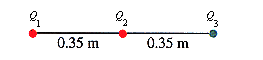
Particles of charge Q1 = +68 µC, Q2 = +49 µC, and Q3 = -80 µC are placed in a line (Fig. 16-37). The center one is 0.35 m from each of the others. Calculate the net force on each charge due to the other two.
16-37alt.gif

Figure 16-37

Homework Equations


F = KQ_1Q_2/r^2

The Attempt at a Solution


F = K * Q1Q2/r^2
F_12 = (K)(6.8 X 10⁻⁵)(4.9 X 10⁻⁵)/.35^2
F_12 = 244.8 N (goes to the left, repels)

F_13 = K(Q1Q2)/r^2
F_13 = (K)(6.8 X 10⁻⁵)(4.9 X 10⁻⁵)/.7^2
F_13 ~= 100 N (goes to the right, attracts)

F_q1 = -244.8 + 100
F_q1 = -144.8 N (wrong)

However, the second part of the question asked which direction it went in, and based on my answer, I put "left" and that was correct. I'm confused.
 
Physics news on Phys.org
What does F_13 mean? 1 on 3 or 1 due to 3?
 
Bensky said:
I have another problem I don't understand on electric fields. I thought I understood these after my last post, but I guess not. I'm guessing it has something to do with the signs of the forces, but I am not sure.

Homework Statement


Particles of charge Q1 = +68 µC, Q2 = +49 µC, and Q3 = -80 µC are placed in a line (Fig. 16-37). The center one is 0.35 m from each of the others. Calculate the net force on each charge due to the other two.

16-37alt.gif

Figure 16-37


Homework Equations


F = KQ_1Q_2/r^2


The Attempt at a Solution


F = K * Q1Q2/r^2
F_12 = (K)(6.8 X 10⁻⁵)(4.9 X 10⁻⁵)/.35^2
F_12 = 244.8 N (goes to the left, repels)

F_13 = K(Q1Q2)/r^2
F_13 = (K)(6.8 X 10⁻⁵)(4.9 X 10⁻⁵)/.7^2
F_13 ~= 100 N (goes to the right, attracts)

F_q1 = -244.8 + 100
F_q1 = -144.8 N (wrong)

However, the second part of the question asked which direction it went in, and based on my answer, I put "left" and that was correct. I'm confused.

Watch out! In F_13 you used the charge of q2 instead of q3!
 
Your answers look good to me. Since they ask for the direction separately, I suspect that for the first part they just wanted the magnitude of the force.
 
nrqed said:
Watch out! In F_13 you used the charge of q2 instead of q3!
That was a typo; the answer matches the correct numbers. :wink:
 
Doc Al said:
That was a typo; the answer matches the correct numbers. :wink:

Ah, ok! :smile: I should have checked!

To the OP: yes, they surely want the magnitude only. And be careful with sig figs.
 
Wow. That was dumb of me for not seeing magnitude right next to the problem...thank you everyone in this thread. At least I know what I'm doing now...
 

Similar threads

  • · Replies 16 ·
Replies
16
Views
2K
  • · Replies 2 ·
Replies
2
Views
2K
  • · Replies 2 ·
Replies
2
Views
2K
  • · Replies 5 ·
Replies
5
Views
2K
Replies
6
Views
2K
Replies
4
Views
4K
  • · Replies 1 ·
Replies
1
Views
2K
Replies
11
Views
2K
  • · Replies 2 ·
Replies
2
Views
2K
  • · Replies 1 ·
Replies
1
Views
2K