Why do some resistors have a value of zero in a circuit with a short circuit?

  • Thread starter Thread starter gprd3
  • Start date Start date
  • Tags Tags
    Circuits Short
Click For Summary

Homework Help Overview

The discussion revolves around understanding short circuits in electrical circuits, specifically in the context of a problem involving identical resistors and a battery. The original poster expresses confusion about why certain resistors are considered to have a value of zero in a circuit with a short circuit.

Discussion Character

  • Exploratory, Assumption checking

Approaches and Questions Raised

  • Participants explore the concept of short circuits and their implications on circuit resistance. Questions are raised about the conditions under which resistors can be considered to have zero resistance and how this affects the overall circuit analysis.

Discussion Status

Participants are actively engaging with the problem, clarifying concepts related to short circuits and discussing the implications for the resistors in the circuit. Some guidance has been provided regarding the identification of short-circuited components and their impact on total resistance.

Contextual Notes

There is an ongoing examination of the circuit setup, including which resistors are short-circuited or not connected, and how this affects calculations. The original poster's homework problem involves specific values and configurations that are not fully detailed in the discussion.

gprd3
Messages
4
Reaction score
0
I am having trouble understanding short circuits and would appreciate some help with it.

From what I understand, a short circuit occurs when we have a connection with a very low (zero) resistance is made between two points in a circuit. With R=0, the only resistance in our circuit would be the internal resistance of the battery. This causes a large current to go through the circuit Any clarifications, corrections, or additional information is greatly appreciated.

I also had trouble solving a homework problem that uses this concept. The following is the problem:

Homework Statement


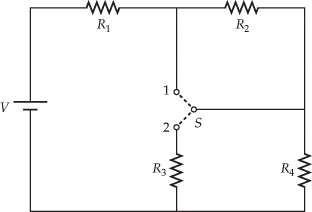
In the circuit below, all four resistors are identical (R1 = R2 = R3 = R4 = R) and the battery has a voltage of 5.17 V.
21-p-018.gif


(a) When the switch is placed in position 1, the measured current in the battery is 1.14 mA. What is the value of each resistor?

Homework Equations


[; I=V/R;]
For resistors in series:
[;R_t_o_t=R_1+R_2;]
For resistors in paraller:
[;R_t_o_t=(1/R_1+1/R_2)^-^1;]

The Attempt at a Solution


Finding the total resistance of the circuit using Ohm's Law is easy:
[;R_t_o_t=V/I=5.17 V/1.14e^3 A= 4.54e^3 ohm;]

I then use [;R_t_o_t=R_1+R_2+R_3+R_4;] to find an expression for the total resistance in terms of R. Using this second equation with the value found with the first equation allows me to find R.

It turns out that [;R_2;] and [;R_3;] are both equal to zero! This is what I don't understand; WHY are they zero? I believe it has something to do with short circuits but I don't really understand what.

I appreciate your help.
 
Physics news on Phys.org
gprd3 said:
I am having trouble understanding short circuits and would appreciate some help with it.

From what I understand, a short circuit occurs when we have a connection with a very low (zero) resistance is made between two points in a circuit. With R=0, the only resistance in our circuit would be the internal resistance of the battery. This causes a large current to go through the circuit Any clarifications, corrections, or additional information is greatly appreciated.

If a resistor is short-circuited, it means connected parallel with a zero resistance: The net resistance becomes zero, the resistor is eliminated from the circuit.

gprd3 said:
I also had trouble solving a homework problem that uses this concept. The following is the problem:

Homework Statement


In the circuit below, all four resistors are identical (R1 = R2 = R3 = R4 = R) and the battery has a voltage of 5.17 V.

21-p-018.gif


(a) When the switch is placed in position 1, the measured current in the battery is 1.14 mA. What is the value of each resistor?

Homework Equations


[; I=V/R;]
For resistors in series:
Rtot=R1+R2
For resistors in paraller:
Rtot=(1/R1+1/R2)-1

The Attempt at a Solution


Finding the total resistance of the circuit using Ohm's Law is easy:

Rtot=V/I=5.17 V/1.14e^-3 A= 4.54e^3 ohm

I then use Rtot=R1+R2+R4 to find an expression for the total resistance in terms of R. Using this second equation with the value found with the first equation allows me to find R.

It turns out that R2 and R3 are both equal to zero! This is what I don't understand; WHY are they zero? I believe it has something to do with short circuits but I don't really understand what.

I appreciate your help.


Redraw the circuit with the switch at position 1. One resistor is short-circuited. Which one? One resistor is not connected into the circuit. Which one?
Why do you think that both R2 and R3 are zero? The resistors are all equal, then the other two would be zero, too. Is it possible?

ehild
 
ehild said:
Redraw the circuit with the switch at position 1. One resistor is short-circuited. Which one? One resistor is not connected into the circuit. Which one?

Why do you think that both R2 and R3 are zero? The resistors are all equal, then the other two would be zero, too. Is it possible?

ehild

That makes sense. So resistor 3 is not part of the circuit so it is not taken into consideration when calculation the total resistance. Is that correct? But I do not know which one is short circuited, how can I tell?
 
gprd3 said:
That makes sense. So resistor 3 is not part of the circuit so it is not taken into consideration when calculation the total resistance. Is that correct?

yes, it is correct.

gprd3 said:
But I do not know which one is short circuited, how can I tell?

The switch is at position 1. You have a single wire connected parallel to resistor R2: it is short-circuited. The wire has zero resistance. The current chooses the zero resistance path, and nothing flows through R2.
(Or you can say that the total resistance of R2 and the zero-resistance wire is zero.)

ehild
 

Attachments

  • short.JPG
    short.JPG
    4.9 KB · Views: 904
That makes so much sense. So it isn't that R2 and R3 are zero, what happens is that R2 is short circuited and R3 is not connected to the circuit and therefore, they do not contribute any resistance to the total resistance of the circuit! Thank you!
 
you are welcome.

ehild
 

Similar threads

Replies
6
Views
1K
  • · Replies 2 ·
Replies
2
Views
2K
  • · Replies 3 ·
Replies
3
Views
2K
  • · Replies 6 ·
Replies
6
Views
2K
Replies
4
Views
2K
  • · Replies 5 ·
Replies
5
Views
2K
Replies
4
Views
2K
Replies
3
Views
2K
  • · Replies 17 ·
Replies
17
Views
3K
  • · Replies 3 ·
Replies
3
Views
2K