Why do we always see interference pattern in Michelson interferometer?

Click For Summary

Discussion Overview

The discussion centers on the behavior of light in a Michelson interferometer, particularly why an interference pattern is consistently observed even when one of the mirrors is moved. Participants explore the conditions under which constructive and destructive interference occurs, the nature of wavefronts, and the practical setup of the interferometer.

Discussion Character

  • Exploratory
  • Technical explanation
  • Debate/contested

Main Points Raised

  • Some participants question why moving a mirror does not lead to total destructive interference, suggesting that certain distances might allow for this outcome.
  • Others explain that the setup of the interferometer can affect the type of interference observed, with some configurations allowing for varying degrees of light intensity rather than complete darkness.
  • A participant notes that achieving perfect constructive or destructive interference requires specific mirror alignments, such as setting mirrors perpendicular to one another.
  • There is a discussion about the nature of wavefronts, with some asserting that plane waves do not exist in nature, which complicates the conditions for total destructive interference.
  • One participant mentions that while total destructive interference is theoretically possible, practical setups typically favor configurations that yield more useful data.
  • Another participant highlights that spherical waves can still lead to cancellation at certain points, but this is not uniform across the entire screen.

Areas of Agreement / Disagreement

Participants express differing views on the conditions necessary for total destructive interference and the practicalities of setting up the interferometer. There is no consensus on whether total destructive interference can be achieved in practice, as some argue it is theoretically possible while others emphasize practical limitations.

Contextual Notes

Participants acknowledge that the nature of wavefronts and the curvature of waves play significant roles in the observed interference patterns, with some noting that assumptions about ideal conditions may not hold in real-world scenarios.

Salmone
Messages
101
Reaction score
13
In a Michelson interferometer with a monochromatic laser, why do we always see an interference pattern even if we move one of the mirrors?
Shouldn't it be a certain distance for which the movable mirror reflects the wave to be in opposite phase with the other wave so that they interfere destructively and we do not see anything on the screen?
Instead, I see in some videos that we always see an interference pattern and the only effect one see when moving the mirror is a change in this pattern but we still see light.
Shouldn't the movable mirror give in a certain position the same situation as the image?
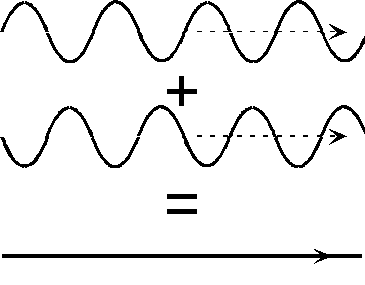
Image158.gif
 
Science news on Phys.org
Depends how you set up the interferometer. It's possible to set it up so that the wavefronts from the two arms are parallel planes, and then the screen varies from dark to light and back as you vary the path difference, as you seem to expect. However, it's quite difficult to use the interferometer in that mode. Exactly how dark is it? How do you recognise when you have 25% as much light as you do at maximum brightness? Your eye is lousy at that kind of estimation. Even if you have a digital camera you need to sample the adjacent maximum and minimum brightnesses to know where your brightness-of-interest lies between them.

So it's actually easier to tilt one of the mirrors slightly so that the path difference varies slightly across the field of view and you get straight line interference fringes. Then as you change the path difference the fringes flow across the screen, and you can get the path difference just by counting fringes passing a point. Or you can defocus the arms slightly so that curved fringes from one arm interfere with slightly differently curved fringes from the other. That gives you circular fringes that flow inwards or outwards as you adjust the path length. Again, counting fringes is easier than estimating how black the thing you're looking at is.
 
  • Like
Likes   Reactions: sophiecentaur, Salmone, topsquark and 1 other person
Ibix said:
Depends how you set up the interferometer. It's possible to set it up so that the wavefronts from the two arms are parallel planes, and then the screen varies from dark to light and back as you vary the path difference, as you seem to expect. However, it's quite difficult to use the interferometer in that mode. Exactly how dark is it? How do you recognise when you have 25% as much light as you do at maximum brightness? Your eye is lousy at that kind of estimation. Even if you have a digital camera you need to sample the adjacent maximum and minimum brightnesses to know where your brightness-of-interest lies between them.

So it's actually easier to tilt one of the mirrors slightly so that the path difference varies slightly across the field of view and you get straight line interference fringes. Then as you change the path difference the fringes flow across the screen, and you can get the path difference just by counting fringes passing a point. Or you can defocus the arms slightly so that curved fringes from one arm interfere with slightly differently curved fringes from the other. That gives you circular fringes that flow inwards or outwards as you adjust the path length. Again, counting fringes is easier than estimating how black the thing you're looking at is.
Thank you for your answer, while it's clear why we do this I still don't understand why this happen: how two waves don't interfere 100% destructively? In the first part of the answer you say: "It's possible to set it up so that the wavefronts from the two arms are parallel planes", so two waves do not cancel if they are spherical? How does it work?
 
You don't have plane waves in nature!
 
  • Like
Likes   Reactions: Salmone
vanhees71 said:
You don't have plane waves in nature!
Maybe I did not explain myself well, I try to rephrase the question:
why it is not possible to make two waves interfere totally destructively so that in a Michelson interferometer on the screen I see no more light? Is it because totally destructive interference would occur only in the case of plane waves, waves that in the interferometer we cannot use (since they do not exist in nature)?
 
Salmone said:
why it is not possible to make two waves interfere totally destructively so that in a Michelson interferometer on the screen I see no more light?
It is possible (at least in principle - as @vanhees71 says, in practice there's always some curvature to the wavefronts). It's just not the best way to get quantitative data out of a Michelson interferometer, so you don't usually set it up that way.
 
  • Like
Likes   Reactions: Salmone
To get perfect constructive or destructive interference you set the mirrors up perpendicular to one another. I've sketched wavefronts coming back along both arms, red in one and blue in the other, and you can see that they're parallel in the output arm on the left. This would be near-perfect constructive interference since both arms' waves are in phase (give or take my lousy free-hand sketching) (edit: and that I got the 45° mirror on the wrong diagonal, as noticed by sophiecentaur below):
Notes_220817_195801.jpg

But the usual operating mode is to tilt one mirror very slightly (you're looking to displace one side of the mirror a couple of wavelengths, about ##1\mathrm{\mu m}##) so you get constructive interference in some parts of the field and not others:
Notes_220817_200002.jpg

It's much easier to use in this mode, so nobody sets it up in the first mode. But you can do it.
 
Last edited:
  • Like
Likes   Reactions: vanhees71 and Salmone
Ibix said:
To get perfect constructive or destructive interference you set the mirrors up perpendicular to one another. I've sketched wavefronts coming back along both arms, red in one and blue in the other, and you can see that they're parallel in the output arm on the left. This would be near-perfect constructive interference since both arms' waves are in phase (give or take my lousy free-hand sketching):
View attachment 312898
But the usual operating mode is to tilt one mirror very slightly (you're looking to displace one side of the mirror a couple of wavelengths, about ##1\mathrm{\mu m}##) so you get constructive interference in some parts of the field and not others:
View attachment 312899
It's much easier to use on this mode, so nobody sets it up in the first mode. But you can do it.
Thank you so much, now everything is clear.
 
  • Like
Likes   Reactions: Ibix
Salmone said:
so two waves do not cancel if they are spherical? How does it work?
The waves are actually spherical but the radius of the curvature is so great that it is possible to get cancellation over the width of the screen because the path lengths are near enough equal.
And when you have cancellation in one place, you will always have addition somewhere else.
Ibix said:
To get perfect constructive or destructive interference you set the mirrors up perpendicular to one another.
Are you sure you've got the diagonal mirror the right way round?
 
  • Like
Likes   Reactions: Salmone and Ibix
  • #10
sophiecentaur said:
Are you sure you've got the diagonal mirror the right way round?
It's... erm... reflected in... er... something.

I'll add a note to my post above - thanks.
 

Similar threads

  • · Replies 2 ·
Replies
2
Views
1K
  • · Replies 10 ·
Replies
10
Views
3K
  • · Replies 3 ·
Replies
3
Views
2K
  • · Replies 7 ·
Replies
7
Views
2K
  • · Replies 9 ·
Replies
9
Views
2K
  • · Replies 1 ·
Replies
1
Views
1K
  • · Replies 7 ·
Replies
7
Views
5K
  • · Replies 7 ·
Replies
7
Views
2K
  • · Replies 6 ·
Replies
6
Views
3K
  • · Replies 1 ·
Replies
1
Views
2K