Why do we use the work energy theorem in systems of energy and work problems?

Click For Summary
SUMMARY

The discussion centers on the application of the work-energy theorem in physics, particularly in problems involving multiple forces such as gravitational and spring forces. The work-energy principle states that the total work done on an object equals its change in kinetic energy, represented by the equation Ki + Wg + Ws = Kf. The participants emphasize the importance of understanding when to apply energy concepts versus Newtonian mechanics, especially for complex systems. The conversation highlights the necessity of grasping the foundational principles of energy conservation before advancing to related topics.

PREREQUISITES
  • Understanding of kinetic energy and potential energy concepts
  • Familiarity with Newton's second law and free body diagrams
  • Basic knowledge of vector mathematics and the dot product
  • Introduction to the work-energy theorem and its applications
NEXT STEPS
  • Study the derivation and applications of the work-energy theorem
  • Learn about energy conservation principles in closed systems
  • Explore examples of problems best solved using energy methods versus Newtonian mechanics
  • Review the Physics tutorial in the 'Math and Science Learning Materials' section for additional resources
USEFUL FOR

Students in physics courses, educators teaching energy concepts, and anyone seeking to deepen their understanding of the work-energy theorem and its applications in problem-solving.

FeelTheFire
Messages
8
Reaction score
0
Hey all, I was feeling confident with the idea of work when dealing with vectors and using the dot product to find the work.
However, recently we have begun to discuss work while considering the object experiencing the force as part of a system. I'm having trouble transitioning into this idea and I don't really know when to consider energies and apply the work energy theorem versus using vectors and dot products. An example that I'm having trouble with:
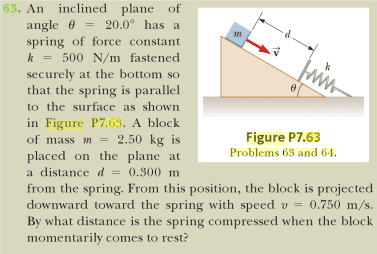
Chapter7_Problem63_Physics.png


The first thing I'm tempted to do is draw a free body diagram and begin plugging vectors into Newton's second law.

I was able to solve the problem using a hint from my instructor but I don't understand why the method works. It was as follows:

Ki + Wg + Ws = Kf Where Ki is initial kinetic energy, Wg is the work done by the gravitational force, Ws is the work done by the spring force and Kf is the final kinetic energy. When you substitute and simplify all this down you can solve for the displacement (x) via a quadratic equation and arrive at 0.131 m.

We have not learned about the conservation of energy yet. Any insight would be much appreciated. I really want to understand this concept!
 
Last edited:
Physics news on Phys.org
Well that is odd that you would be given a problem that uses work-energy principles when you haven't been taught it yet. Your instructor has hinted at using the Work-Energy principle that states that the net or total work done on an object is equal to its change in kinetic energy. You could also use conservation of energy that states that the sum of the initial potential and kinetic energy is equal to the sum of the final potential and kinetic energy (in the absence of any work done by non conservative forces), which I thiink is a bit simpler because of issues with plus or minus signs. It isn't very helpful to use an equation you are not familiar with and just plug in numbers without knowing when or how to properly use the equation with little understanding of the theory behind it.
 
Thanks for the reply PhanthomJay, I appreciate it.

PhanthomJay said:
Well that is odd that you would be given a problem that uses work-energy principles when you haven't been taught it yet.

Sorry I must not have been clear. I have heard the lecture and read the text on the ideas of energy and work, but I'm having a hard time understanding and applying the new concepts.

In particular, I can't distinguish which problems would be better solved using energy concepts instead of Newtonian vector concepts. I don't really understand the difference or the NEED to work with energies.

Also, until you said it, I didn't even recognize the instructors hint as the work-energy theorem. I have never seen it used with multiple sources of work before, only as W = delta K.

The next chapter in my text deals with the "conservation of energy", and I'd really like to understand conceptually the idea of energies before I move on to it. So I guess my query is more about the nature of energy concepts rather than a specific problem...
 
Oh, fine.. The work energy principle is derived form the conservation of energy principle which basically states that energy cannot be created or destroyed---just transferred into different forms. Often you can use Newton's laws and the kinematic equations OR energy methods to solve a problem.. In your specific problem, it would be rather difficult to solve using the Newton/kinematic approach. Rather than me explain the principle and do probably a lousy job at it, you should check the Physics tutorial in the 'Math and Science Learning Materials' section of this sub-forum.
 

Similar threads

  • · Replies 58 ·
2
Replies
58
Views
3K
Replies
18
Views
2K
  • · Replies 9 ·
Replies
9
Views
2K
Replies
7
Views
2K
  • · Replies 12 ·
Replies
12
Views
3K
  • · Replies 2 ·
Replies
2
Views
1K
Replies
10
Views
2K
  • · Replies 23 ·
Replies
23
Views
2K
  • · Replies 9 ·
Replies
9
Views
2K
  • · Replies 16 ·
Replies
16
Views
1K