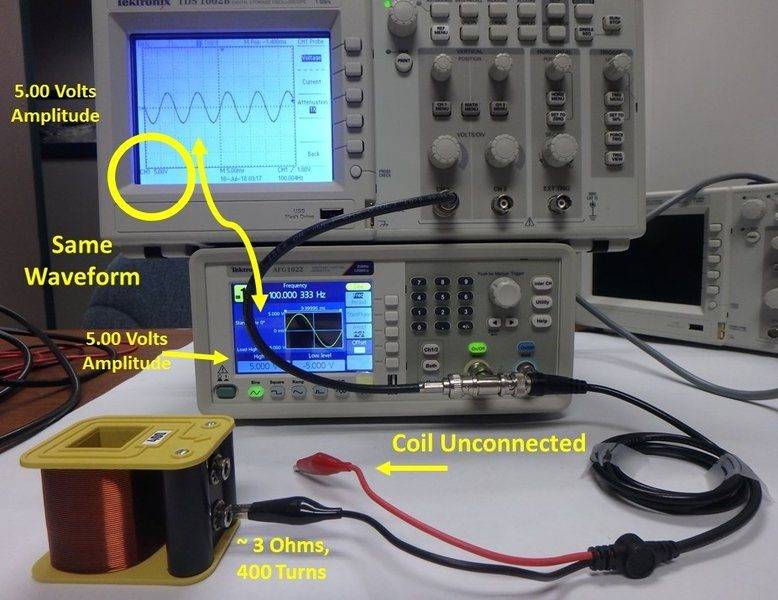
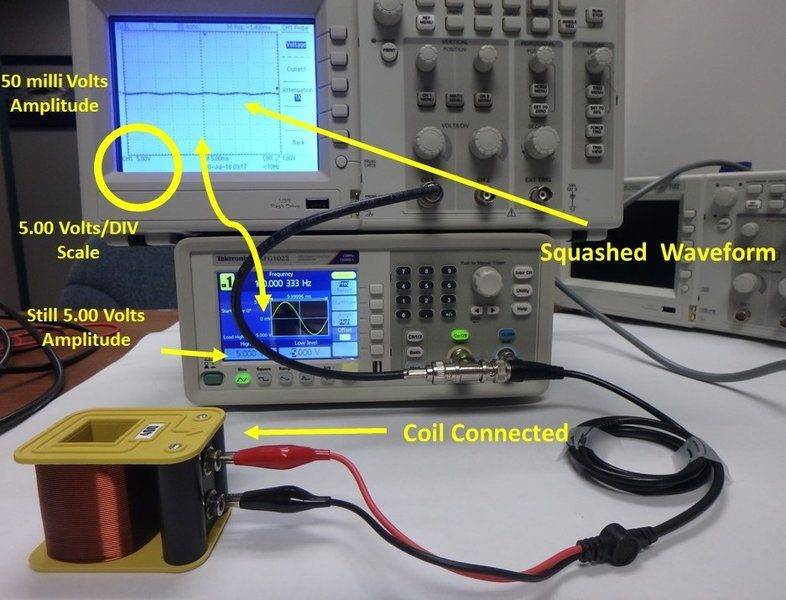
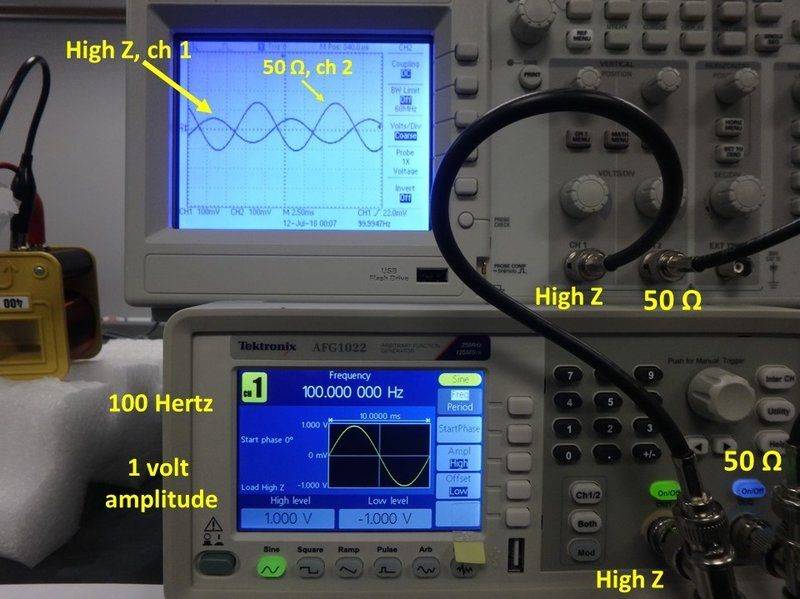
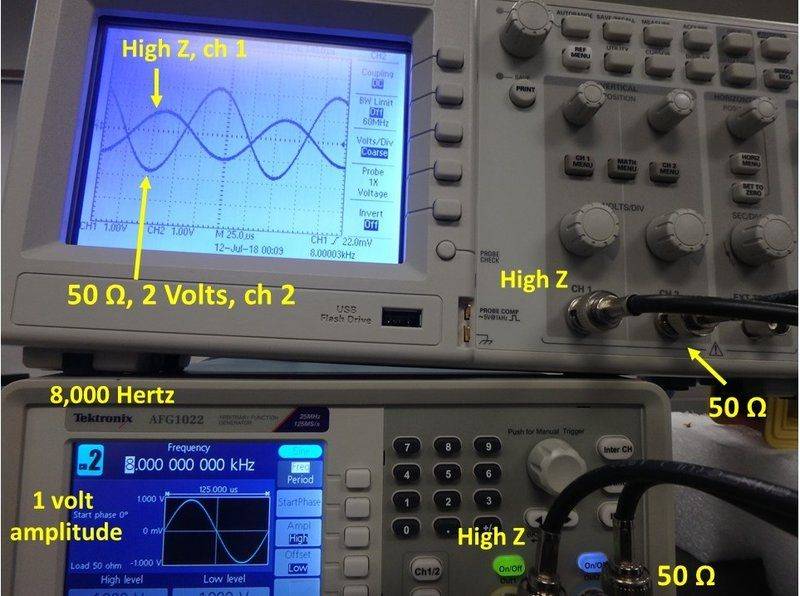
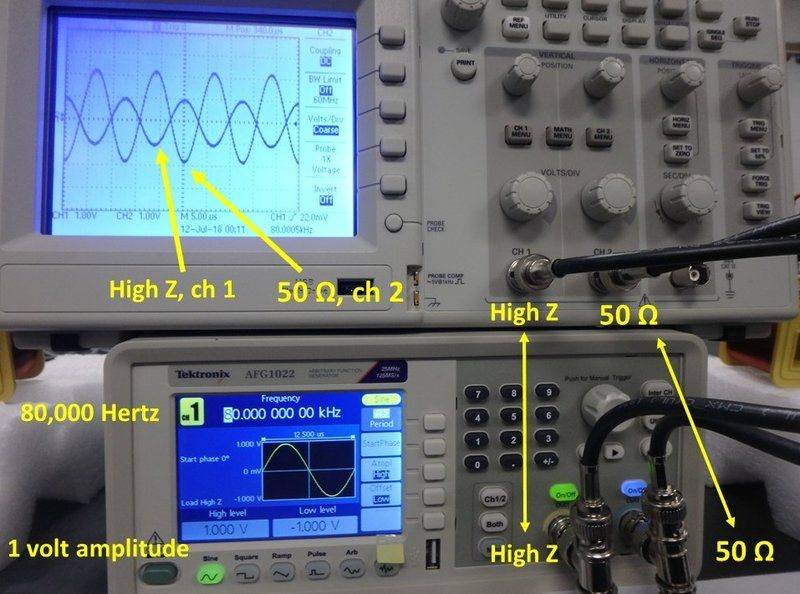
The first picture below, setup.jpg, shows my circuit. The waveforms coming out of the function generator are identical in freq and voltage for each jpeg on this reply. The output voltage from both function generator output channels are always 1 volt amplitude (I changed from 5 volts to 1 volt to make study easier). The coils are the same also, each with an inductance of 0.0212 Henry. The Channel 1 function generator is on the “High Z” impedance output and function generator Channel 2 is on the 50-Ohm Impedance output---this is what "High Z" and "50 Ohm" mean where marked on all he jpegs I attached to this reply.
In the setup, hopefully there is no interference with any other flux except what the coils themselves produce. The coils are elevated on styrofoam. I did try the coils to be horizontal and vertical, with no change in signal.
In regards to what “High Z” means numerically, the user manual had this to say:
"Selectable: 50 Ω, 1 Ω to 10.000 kΩ, High Z (adjusts displayed amplitude according to selected load impedance)"
(The website is
https://www.tek.com/datasheet/arbitrary-function-generator)
I don’t know what it means that “
according to selected load impedance”. Does the Function Generator somehow sense what impedance is in my circuit and then adjusts its output impedance to match, for cases of “High Z”? Seems unlikely a function generator can do this, but I'm not sure.
Some data:
In the jpeg, 100Hz.jpg below, both channels are driven at 100 Hertz so the impedance of each coils is 13.2 Ohms. The 50-Ohm FC output impedance should give a voltage of 13/(13+50) = 0.21 volts on the oscope display, but you can see from "50 Ohm, ch2" on the jpeg below that this calculation disagrees with the 0.12 volts that is actually there. The voltages divisions on both oscope channels are 100 millivolts per division. The High Z output function generator impedance gave on the scope a voltage of 80 millivolt, (High Z, ch 1) but if you calculate what the voltage should be on the oscope screen assuming High Z = 10,000 Ohms, you get 13/(13+10,000) = 1 millivolt, far different than the 80 millivolts measured below.
In the jpeg below, 8000 Hz, each channels is driven at 8000 Hertz so the impedance of each coil is 1065 Ohms. The 50-Ohm FC output impedance should give a voltage of 1065/(1065+50) = 0.95 volts on the oscope display, but you can see below that this calculation disagrees with the nearly 2.0 volts that is actually there (50 Ohms, 2 Volts, ch 2). The High Z output function generator impedance gave on the scope, assuming again a High Z of 10,000 Ohms, 1065/(1065+10,000) = 0.09 volt, but the scope clearly shows a display of 1 volt (High Z, ch 1), or, exactly what is coming out of the function generator. The vertical volts/div are now 1.00 volts for both oscope channels. Thus, the High Z cannot be 10,000 Ohms. This is not a problem for me, because I know that for this kind of circuit, as long as I run it at 8,000 Hertz or higher, what I output from the function generator will be, indeed, what is fed to my circuit.
The jpeg 80000Hz.jpg below has the same story as the jpeg 8000 Hz. Each channels is driven at 80,000 Hertz so the impedance of each coil is 10,656 Ohms. The 50-Ohm FC output impedance should give a voltage of 10656/(10656+50) = 0.99 volts on the oscope display, but you can see below that this calculation disagrees with the nearly 2.0 volts that is actually there (50 Ohms, ch 2). The vertical volts per division is again 1.00 volts for both channels on the oscope. The High Z output channel, however, gave the same waveform on the scope as the function generator, though at some other function generator output of 10,000 or 100,000 Ohms (which both predict the wrong oscope display). At 80,000 Hertz, the High Z will be the function generator output impedance option selected for my circuit.
In regards to Asymptotic, I could not find the max currents from the usual datasheet. I contacted tech support at Textronix and they could not find this information immediately, but promised to send me an email when they do so. Its obviously a good point, though, and I will report here what they tell me. 13 Ohms at 5 volts expects, from Ohm’s Law, a current of 0.38 Amps. A DC power supply could put this out, no problem, but it remains to be seen whether a function generator of the tabletop class I am using can do that AC.
For Ashtown, let me if I understand what you wrote in your last reply.
No coil means a load on the oscope input of R_s = 1,000,000 Ohms, R_fg = 100,000 Ohms so that 1,000,000/(1,000,000+100,000) ~ V_disp = V_fg
With Coil at 100 Hz as load R_c = 13 Ohms, R_fg = 100,000 Ohms, 13/(13+100,000) ~ (0.0001)*V_disp << V_fg hence, a squashed signal and is what is meant when you said the low impedance is responsible for squashing the signal. Where does the oscope impedance go in this calc though? Why is it not considered anymore?
Finally, the last jpeg, schematic.jpg. Do I have this schematic correct for the circuit I am working on? No one has mentioned the 20 pF capacitor. When is it important? I know that the impedance of a capacitor is 1/(omega*capacitance). As some frequencies of my circuit, it did have impedances on the order of other impedances in my circuit, but the cap did not seem to have any effect. How come?