Albertgauss
Gold Member
- 298
- 38
- TL;DR
- For a lab transformer, I can only get V2/V1 = N2/N1 to be valid at one frequency. However, in Phys Calc Sem 2, a whole section is treated on this subject, and it seems this expression should be valid at all freqs. Why is Vs/Vp = Ns/Np only valid at one, single freq?
Hi all,
Recently, I have been playing around with the Pasco Transformer Demo set of SF-8616. I have been trying to verify the transformer relationship

where the "2"s mean secondary and "1's" mean primary. However, no matter what configuration I try, this relationship holds at a single frequency only. It does not hold true at almost any other frequency except for one--what appears to be--resonant frequency. Why does this relationship hold only at a single frequency when you test out a transformer in real life? Shouldn't this formula hold for a wide range of frequencies? Since this relationship only seems to be valid at one single frequency, why is it taught as such a general principle in many semester 2 calculus/engineering science courses?
The primary is input with a sine wave from a Tektronix Function Generator AFG 1022 of about 2.0 volts peak-peak (which doesn’t always mean 2 volts peak-peak on the oscilloscope). I measure both waveforms from the primary and secondary (labelled 2ndary) with a Tektronix TDS 1002B oscilloscope. The step-up transformers I have tried are A) 200 turns to 400 turns, B) 200 to 800 turns, and C) 400 to 800 turns. I tried the following configurations in the picture: Configs_Tried.jpg
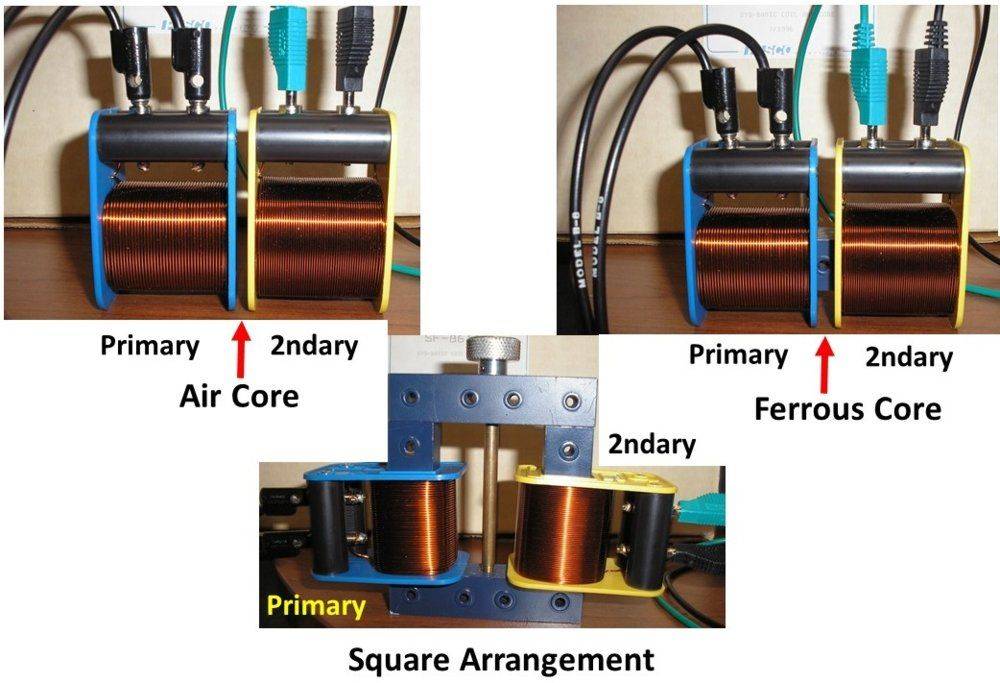 In each configuration I went from 100 Hertz to 500,000 Hertz. Usually, the single frequency in which the transformer relationship above held occurred somewhere between 50,000 and 200,000 Hertz. The best working configuration (see the file above "Configs_Tried.jpg" for what my transformer labels mean) for this result was when the two coils shared just a “Ferrous Core” between them; neiither the “Air Core” or “Square Arrangement” worked very well for verifying the transformer relationship above. Below, you can see the only frequency for the “Ferrous Core” configuration at a frequency of 121,000 Hertz in which the transformer relationship above holds in the file: "OutputScopeTrans,jpg"
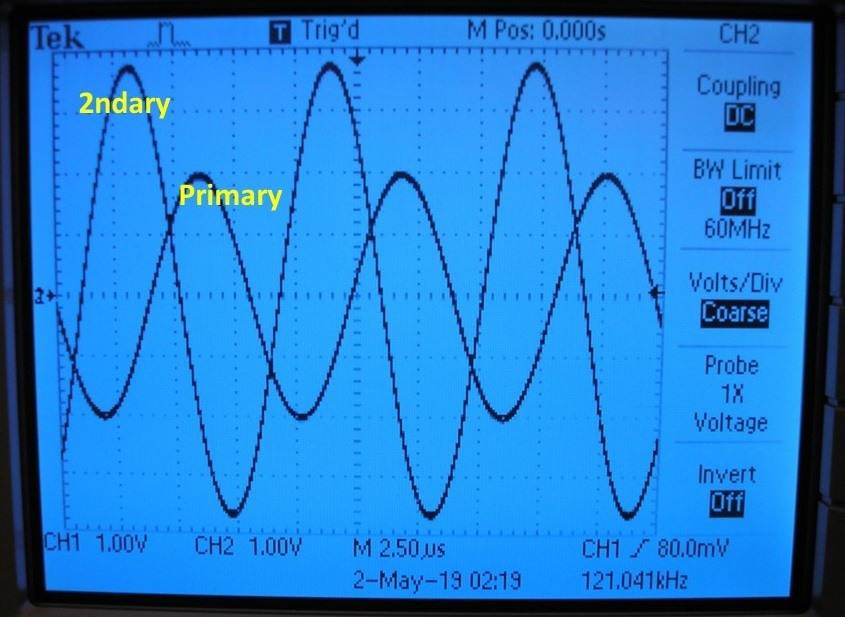
The circuit does behave like an LRC circuit where the single frequency at which the transformer relationship holds acts like a resonance frequency. My guess is there a capacitor in the scope somewhere (as has happened before) but shouldn’t the oscilloscope know how to nullify its effect in a circuit when someone is trying to make an objective measurement?
I could not find, but does anyone know of a more advanced transformer relationship then the one I listed above but that has frequency dependence and explain my outcomes a little better?
Recently, I have been playing around with the Pasco Transformer Demo set of SF-8616. I have been trying to verify the transformer relationship
where the "2"s mean secondary and "1's" mean primary. However, no matter what configuration I try, this relationship holds at a single frequency only. It does not hold true at almost any other frequency except for one--what appears to be--resonant frequency. Why does this relationship hold only at a single frequency when you test out a transformer in real life? Shouldn't this formula hold for a wide range of frequencies? Since this relationship only seems to be valid at one single frequency, why is it taught as such a general principle in many semester 2 calculus/engineering science courses?
The primary is input with a sine wave from a Tektronix Function Generator AFG 1022 of about 2.0 volts peak-peak (which doesn’t always mean 2 volts peak-peak on the oscilloscope). I measure both waveforms from the primary and secondary (labelled 2ndary) with a Tektronix TDS 1002B oscilloscope. The step-up transformers I have tried are A) 200 turns to 400 turns, B) 200 to 800 turns, and C) 400 to 800 turns. I tried the following configurations in the picture: Configs_Tried.jpg
The circuit does behave like an LRC circuit where the single frequency at which the transformer relationship holds acts like a resonance frequency. My guess is there a capacitor in the scope somewhere (as has happened before) but shouldn’t the oscilloscope know how to nullify its effect in a circuit when someone is trying to make an objective measurement?
I could not find, but does anyone know of a more advanced transformer relationship then the one I listed above but that has frequency dependence and explain my outcomes a little better?