Why Does a Dipole Experience Zero Force from Another Dipole?

  • Thread starter Thread starter cherrios
  • Start date Start date
  • Tags Tags
    Dipole Force
Click For Summary
SUMMARY

The discussion centers on the phenomenon where a dipole experiences zero net force from another dipole due to the symmetrical arrangement of charges. The first dipole consists of charges Q+ and Q- positioned along the y-axis, while the second dipole, with charges q+ and q-, is located on the x-axis. The calculations performed indicate that despite the individual forces acting on each charge, the net force results in zero due to the equal and opposite nature of the forces acting on the dipoles. Additionally, the discussion raises the question of how to calculate the torque experienced by one dipole due to another.

PREREQUISITES
  • Understanding of dipole moments and their configurations
  • Familiarity with Coulomb's Law for calculating forces between charges
  • Knowledge of vector addition in physics
  • Concept of torque and its calculation in the context of dipoles
NEXT STEPS
  • Study the principles of dipole interactions in electrostatics
  • Learn how to calculate torque on dipoles using the formula τ = p × E
  • Explore vector calculus applications in force and torque calculations
  • Investigate the effects of dipole orientation on net forces and torques
USEFUL FOR

This discussion is beneficial for physics students, researchers in electromagnetism, and anyone interested in understanding the dynamics of dipole interactions and their implications in electrostatics.

cherrios
Messages
8
Reaction score
0
I've worked this problem out, but I seem to get zero force on the second dipole due to the first dipole.

The problem is situated as such:

There are Q charges along the y axis: Q+ and Q-. They are a distance r apart. Their distance from the origin (at the center of the two charges) is r/2. This is the first dipole.

The second dipole is on the the x-axis, to the right. These have charges q+ and q-. The distance q+ has from the origin is x-d/2, for q-, the distance is x+d/2. (q+ and q- are a distance 'd' apart).
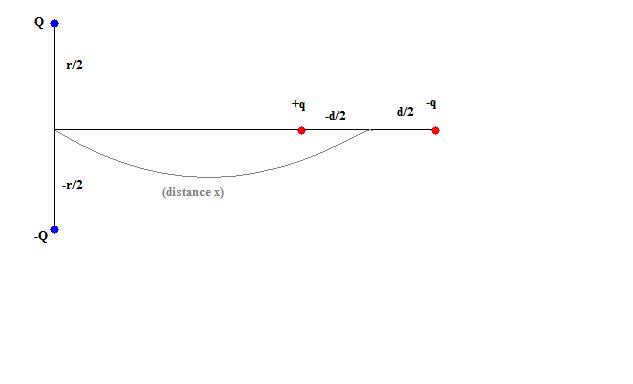

dip.jpg


I took the force on each q+ and q- charge by Q+ and Q-. I took the tangent as the distance between them, but I seem to get zero.

Also, how would torque on one dipole due to another be calculuated?
 
Physics news on Phys.org
The force is a vector quantity hence we have to add them vectorically and then the resultant will not be zero on each charge q. The distances of +q and -q are different so the resultant force on +q and -q will not be zero.
 

Similar threads

  • · Replies 10 ·
Replies
10
Views
1K
Replies
14
Views
2K
Replies
1
Views
3K
Replies
1
Views
2K
Replies
7
Views
2K
  • · Replies 25 ·
Replies
25
Views
2K
  • · Replies 4 ·
Replies
4
Views
3K
  • · Replies 3 ·
Replies
3
Views
3K
Replies
2
Views
2K