Why does back EMF in DC machines deviate from a pure sine wave?

Click For Summary

Discussion Overview

The discussion centers on the nature of back electromotive force (EMF) in DC machines, specifically why the voltage output deviates from a pure sine wave. Participants explore the implications of different motor types, such as brushless DC (BLDC) motors, and the effects of armature reaction and inductance on the waveform produced.

Discussion Character

  • Technical explanation
  • Debate/contested
  • Conceptual clarification

Main Points Raised

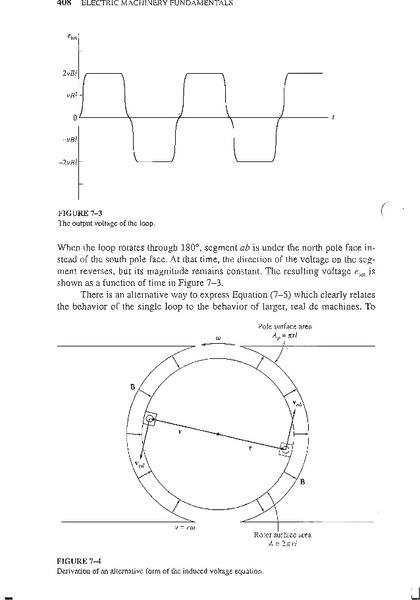
  • Some participants question why the voltage output from the rotating loop is not sinusoidal, suggesting that the waveform is constant positive and negative, peaking at 2vBL before dropping to zero.
  • One participant proposes that the non-sinusoidal shape is due to the use of trapezoidal commutation in BLDC motors, which simplifies control compared to sinusoidal commutation.
  • Another participant notes that adding more loops and offsetting them in series can alter the signal shape, indicating that the behavior of a single loop differs from that of larger DC machines.
  • Concerns are raised about why a sine wave shape is not adopted in certain motor designs, particularly in relation to four-loop DC motors.
  • One participant highlights that the continuous change in flux in the machine leads to a sustained peak voltage level, contrasting with the brief peak observed in generator outputs.
  • Another participant emphasizes the role of magnetic flux lines and their orientation in determining the voltage waveform, suggesting that the model assumptions affect the output shape.
  • A later reply identifies two factors contributing to the deviation from a pure sine wave: the armature's magnetic field distorting the permanent magnets' field and the phase shift caused by armature inductance.

Areas of Agreement / Disagreement

Participants express multiple competing views regarding the reasons for the non-sinusoidal waveform of back EMF, with no consensus reached on a single explanation. The discussion remains unresolved as different models and assumptions are presented.

Contextual Notes

Participants mention various assumptions related to motor design and magnetic field interactions, but these assumptions are not fully explored or agreed upon. The discussion reflects differing perspectives on the implications of motor types and configurations.

Syed Taha ahmed
Messages
4
Reaction score
0
Why voltages out of the rotating loop is constant positive and negative **Why nOT varying like sinusoidal **.

Like it has a wave form of O to 2*vBL and then it maintain its value there for some time before failing to zero and changing direction. I have attach the image file from my book Electrical machines Stephen J Chapman.
mHaJW.jpg
 
Physics news on Phys.org
Syed Taha ahmed said:
Why voltages out of the rotating loop is constant positive and negative **Why nOT varying like sinusoidal **.
I suggest that it is because it's a BLDC-motor with trapezoidal commutation ( instead of sinusoidal commutation ).
It's quite normal to design BLDC-motors in this way, because it is easier to control such motors. Sinus look-up tables are not needed.
The shape of the induced voltage is made by adapting the shape of the poles and by arranging the windings of the coils.

main02.gif


BLDC-motors were invented many years ago, when motors were controlled by an Intel 8085 processor.
Today much more powerful processors can easily handle synchronous motors with sinusoidal commutation, and with much higher efficiency.
 
Last edited:
I think a key piece of information to keep in mind in relation to the signal in the figure is the statement in the last paragraph in the figure itself: "which clearly relates the behavior of the single loop to the behavior of larger, real dc marchines". In other words, if you add more loops and you offset them from each other and you connect them in series, you start getting a different signal shape.
 
But my question is that why they do not adopt sine wave shape. If it BLDC motor then why four loop dc motor Induce EMf diagram shape is like this
 

Attachments

  • Untitled.png
    Untitled.png
    46.8 KB · Views: 591
In Machine the loop is continuously changing the flux so why it 2VBL peak voltage level is maintain for some interval of time then it falls to zero like a sinusoidal way.
But what we read for generators is a sinusoidal graph which shows that the peak volatge is onyly for short time that is at at zero position.
 
Hesch said:
I suggest that it is because it's a BLDC-motor with trapezoidal commutation ( instead of sinusoidal commutation ).
It's quite normal to design BLDC-motors in this way, because it is easier to control such motors. Sinus look-up tables are not needed.
The shape of the induced voltage is made by adapting the shape of the poles and by arranging the windings of the coils.

main02.gif


BLDC-motors were invented many years ago, when motors were controlled by an Intel 8085 processor.
Today much more powerful processors can easily handle synchronous motors with sinusoidal commutation, and with much higher efficiency.
Brother Thanks for Your help but it is not BLDC motor.
 
Hhhmmm, I think I understand your concern.

One thing that occurs to me at this point is in regards to the model assumptions.

It seems that the single-loop generator that produces a sinusoidal voltage wave is one where the magnetic flux lines are always horizontal as they go from the north pole to the south pole stator pieces. When this is the case, the velocity of the wire that needs to be considered for vB is the component that is perpendicular to the direction of B and because the wire is rotating in circular motion, well...get it?

On the flip side, the model that you show above indicates that the magnetic flux lines are always perpendicular to the surface of the rotor, and, so, in this case, vB remains constant and you can assume to always take advantage of the entire tangential velocity of the wire.
 
Back EMF deviates from a pure sine wave because 1. the magnetic field of the armature distorts the field of the permanent magnets (armature reaction), offsetting the magnetic neutral plane from the geometric neutral plane, and 2. armature inductance, throwing back emf out of phase with armature current.
 

Similar threads

Replies
1
Views
7K
Replies
4
Views
8K