Why Does CFL Lighting Cause a Violet Line in Laundry Detergent?

  • Context: Undergrad 
  • Thread starter Thread starter JFS321
  • Start date Start date
Click For Summary
SUMMARY

The phenomenon of a violet line appearing in laundry detergent under compact fluorescent lamps (CFLs) is attributed to the interaction between the detergent's optical brighteners and the UV light emitted by CFLs. Optical brighteners absorb UV light and re-emit it in the blue-violet spectrum. Unlike sunlight, which is filtered through glass and lacks sufficient UV intensity, CFLs emit UV light that can escape due to their design, allowing for this fluorescence effect. Research indicates that CFLs leak more UV light compared to traditional fluorescent tubes, contributing to this observable effect.

PREREQUISITES
  • Understanding of optical brighteners in laundry detergents
  • Knowledge of CFL technology and UV light emission
  • Familiarity with fluorescence and light refraction principles
  • Basic principles of light behavior in different mediums
NEXT STEPS
  • Research the properties of optical brighteners in detergents
  • Investigate the UV emission characteristics of different light sources, including CFLs and LEDs
  • Study the effects of light refraction at liquid/air interfaces
  • Explore the design differences between CFLs and traditional fluorescent tubes regarding UV leakage
USEFUL FOR

This discussion is beneficial for chemists, lighting engineers, and anyone involved in product formulation or the study of light interactions with materials, particularly in the context of household products like laundry detergents.

JFS321
Messages
75
Reaction score
6
All, I'm looking for a little hypothesis help here. I know that most detergents these days contain optical brighteners--they absorb UV and re-emit visible light the blue violet region. I noticed, though, that looking at my laundry detergent under a CFL bulb produces this rather neat violet line at the top of the detergent.
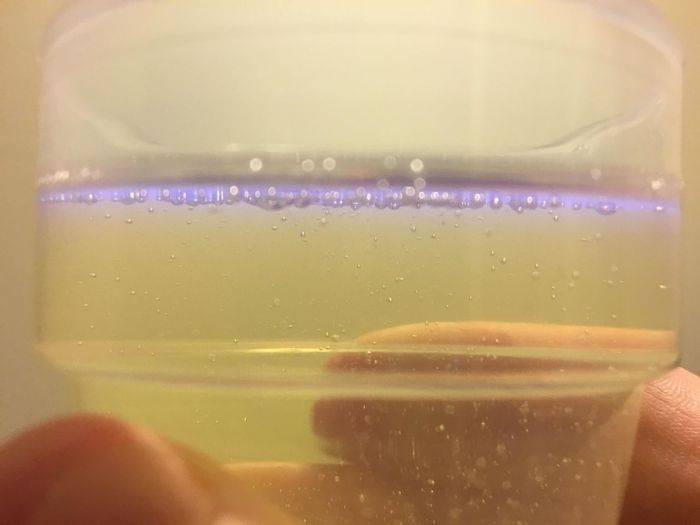
image.jpg

So, I'm wondering why this is the case. Holding the detergent in front of a sunny window does not produce the violet line, but turning on a CFL above the sunny window does. I haven't been able to see if the line is produced by LEDs or incandescent bulbs yet. My guess is that CFLs could not possibly be emitting enough UV to cause this to fluoresce at the top, but CFLs must emit light at wavelengths that the optical brighteners are absorbing and re-emitting...so there must be some overlap between the UV and visible range that the optical brighteners can absorb.

Thoughts?
 
Science news on Phys.org
Glass absorbs UV light fairly well, so that would explain why you don't see the fluorescence with sunlight filtered through the window. UV emission from the CFL could be responsible:

Fluorescent lamps, large and compact, work by using electricity to excite mercury vapor inside the bulb. The excited vapor then emits invisible ultraviolet light that is absorbed by the bulb's phosphor coating. In turn, the coating re-emits the energy as visible light.

But researchers found UV light leaks more from CFLs compared to standard fluorescent tubes because the small diameter of the glass coupled with its twists and turns creates more spaces where the phosphor coating chips away, letting more UV light escape.
http://www.scientificamerican.com/article/can-compact-fluorescent-lightbulbs-damage-skin/
 
The violet line could also be due to refraction at the liquid/air interface.
 

Similar threads

  • · Replies 5 ·
Replies
5
Views
2K
Replies
9
Views
3K
  • · Replies 16 ·
Replies
16
Views
6K
  • · Replies 13 ·
Replies
13
Views
3K
  • · Replies 4 ·
Replies
4
Views
2K
  • · Replies 3 ·
Replies
3
Views
3K
  • · Replies 9 ·
Replies
9
Views
8K
  • · Replies 23 ·
Replies
23
Views
3K
  • · Replies 4 ·
Replies
4
Views
16K
  • · Replies 4 ·
Replies
4
Views
4K