Why Does Charge Density Increase at Pointed Ends?

Click For Summary

Homework Help Overview

The discussion revolves around the behavior of charge density at pointed ends of conductors, particularly in relation to electric fields and equipotential surfaces. Participants explore the relationship between charge density and the geometry of the conductor's surface.

Discussion Character

  • Conceptual clarification, Assumption checking, Exploratory

Approaches and Questions Raised

  • Participants discuss the implications of sharp turns on charge density and electric fields, questioning how the geometry affects the definitions of charge density at different points. Some suggest sketching equipotentials to visualize the concepts, while others explore the differences between concave and convex surfaces.

Discussion Status

The discussion is active, with participants offering insights and questioning each other's reasoning. There is an exploration of how rounding off pointed ends might affect charge density, and some participants express differing views on the definitions and implications of charge density at various points.

Contextual Notes

Participants are considering the effects of geometry on charge distribution, particularly in the context of homework constraints that may limit the rigor of their assumptions about sharp edges and equipotential surfaces.

Isomorphism
Messages
8
Reaction score
1
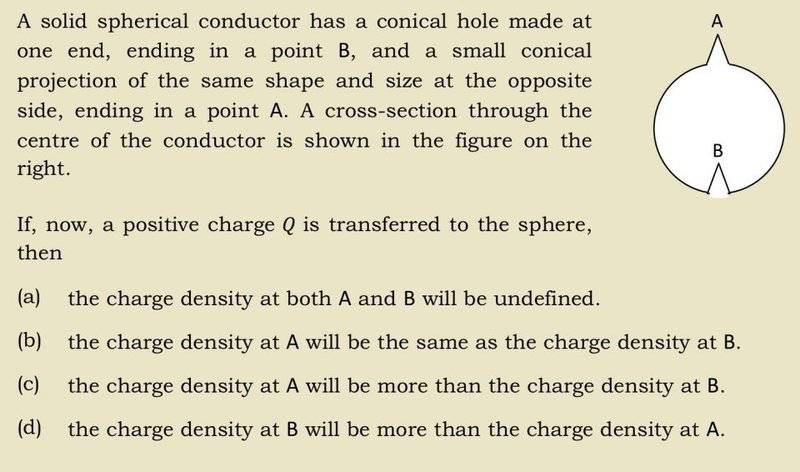
1. Homework Statement :
IMG_0868.JPG


Homework Equations

:[/B] A conductor is an equipotential surface. The charge density near a conductor is proportional to the electric field. Electric field is the negative gradient of potential and thus electric field is in a direction normal to the surface.

The Attempt at a Solution

: [/B]Since electric field is the gradient of potential, if the surface of a conductor has sharp turns, the gradient will be undefined (cannot draw a tangent plane at such points) and thus the charge density is undefined.
So I think it is option (a). Am I right?

Thanks.
 
Physics news on Phys.org
If the electrostatic potential is defined everywhere in space, so is the charge density. Why don't you sketch a couple of equipotentials very near the surface of the conductor? The charge density on the surface is higher where the electric field is stronger and the electric field is stronger where the equipotentials come closer together.
 
  • Like
Likes   Reactions: Isomorphism
I agree with your analysis of point A, but I think for point B the charge density should have a well-defined value.
 
  • Like
Likes   Reactions: Isomorphism
@kuruman : Thanks for the help. Maybe I should not be too rigorous about the pointed cones.
If I round off the cones a little, then A will be a concave surface and B will be a convex surface. It looks like the charges would be crowded at B compared to A. Therefore B has a lesser charge density than A.

How do I draw an equipotential for this surface that wouldn't look symmetric at both A and B?

@mfb But there is a sharp edge at B as well. Why doesn't the reasoning at A work at B as well?
 
I would expect the field to vanish around B because it is an inner corner. Zero field gives zero charge density and zero divergence problems.

If we round off the corners a bit, then both A and B have defined charge densities and B has a smaller one than A, sure.
 
  • Like
Likes   Reactions: Isomorphism

Similar threads

Replies
10
Views
2K
  • · Replies 26 ·
Replies
26
Views
3K
  • · Replies 18 ·
Replies
18
Views
3K
  • · Replies 17 ·
Replies
17
Views
3K
Replies
9
Views
2K
Replies
23
Views
5K
Replies
11
Views
4K
  • · Replies 2 ·
Replies
2
Views
1K
  • · Replies 22 ·
Replies
22
Views
4K
Replies
5
Views
2K