Why Does Light Form a Cone When Refracted in a Swimming Pool?

Click For Summary
SUMMARY

The discussion centers on the phenomenon of light refraction in a swimming pool, specifically how light forms a cone when entering water from air. Participants reference Snell's Law, which relates the angles of incidence and refraction, and the critical angle for total internal reflection, calculated as arcsin(1/1.33). The conversation emphasizes the importance of visual diagrams to illustrate the angles involved and the behavior of light rays as they change angles of incidence.

PREREQUISITES
  • Understanding of Snell's Law and its application to refraction
  • Knowledge of the refractive index, specifically for air and water
  • Familiarity with the concept of total internal reflection
  • Ability to create and interpret geometric diagrams related to light behavior
NEXT STEPS
  • Research the mathematical principles behind Snell's Law and its applications
  • Learn about the critical angle and conditions for total internal reflection
  • Explore the concept of light rays in 3-D environments and their implications
  • Study the creation of accurate diagrams to represent optical phenomena
USEFUL FOR

Students studying optics, physics educators, and anyone interested in understanding the behavior of light in different mediums, particularly in relation to refraction and total internal reflection.

joelkato1605
Messages
19
Reaction score
2
Homework Statement
You are several meters under water (η = 1.33), swimming in a pool, and look skywards. Light from outside the pool will form a cone. Describe why and compute the
angle of the cone.
Relevant Equations
snell's law
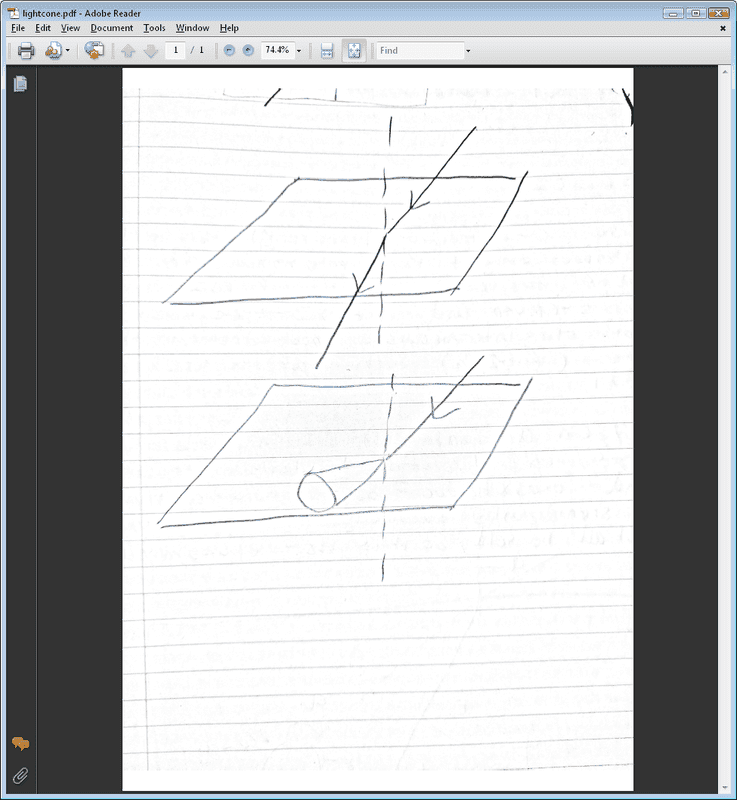
The first sketch is what I assumed would happen, where the light beams bends. And the second is meant to depict the light forming a cone, which I don't understand.

[Mentors provided help re-posting the image that was missing]
1605191601830.png
 

Attachments

Last edited by a moderator:

Physics news on Phys.org
Thanks for the reply I edited my question, however I'm not sure where to start with a solution.
 
joelkato1605 said:
The first sketch is what I assumed would happen, where the light beams bends. And the second is meant to depict the light forming a cone, which I don't understand.
:cool: What do they look like ? Snell has to do with angles. Which angles in the picture ?
 
BvU said:
:cool: What do they look like ? Snell has to do with angles. Which angles in the picture ?
The refractive index of air is 1, so 1*sin( theta initial)=1.33*sin(theta cone) then maybe assume theta inital =90?

I'm not really sure but that is all I can think of.
 
Draw a picture with an eye below the surface of the water.

Draw a ray of light from air to the eye, passing through the water. Draw another ray at a different angle of incidence. And another. And another.

What happens as you change the angle of incidence of the ray?

Look up "total internal reflection" - at what angle does it occur?

What happens when you get total internal reflection?
 
Diagrams:
 

Attachments

We have a picture :cool: !

Any description of what it represents ? Ah, yes:
joelkato1605 said:
The first sketch is what I assumed would happen, where the light beams bends. And the second is meant to depict the light forming a cone, which I don't understand.
Forget the second picture -- nobody understands it.

In the top picture, where are the angles we encounter in Snell's law ?

Now follow Frodo's advice
 
  • Like
Likes   Reactions: berkeman
So is it just the critical angle:
arcsin(1/1.33)?
 
  • #10
You have part of the answer. I miss
Describe why and compute the angle of the cone.
 
  • #11
Your diagram is not very good for doing an analysis. Where is the eye you were asked to put in? It's all about angles - how can you measure angles in your diagram?

Perhaps some was my error as, when I said draw a picture, I should have said draw a diagram.

You should have drawn a diagram like below where you are looking at a cross section through the experiment - it is a 2-dimensional diagram. Solve the problem in 2-D before generalising your solution to 3-D. Using the diagram:

1. Draw a ray of light going from B to the eye. Label the angle of incidence and the angle of refraction. To do that you will need to draw in the normal.

2. Draw a ray of light going from C to the eye. Label the angle of incidence and the angle of refraction.

3. Draw a ray of light going from D to the eye. Label the angle of incidence and the angle of refraction.

What do you notice is happening as the angle of incidence of the ray increases from B to C to D?

When you thoroughly understand what is happening in the diagram, think about what happens in 3-D.

diagram.png
 

Attachments

  • diagram.png
    diagram.png
    5 KB · Views: 237

Similar threads

  • · Replies 15 ·
Replies
15
Views
2K
  • · Replies 11 ·
Replies
11
Views
1K
  • · Replies 2 ·
Replies
2
Views
8K
Replies
2
Views
4K
  • · Replies 1 ·
Replies
1
Views
2K
Replies
1
Views
3K
  • · Replies 1 ·
Replies
1
Views
3K
  • · Replies 1 ·
Replies
1
Views
2K
Replies
2
Views
2K
  • · Replies 11 ·
Replies
11
Views
2K