Why Does My Vacuum Leak Rate Change at 25 Microns of Mercury?

Click For Summary

Discussion Overview

The discussion revolves around the observed change in leak rate behavior in a vacuum system at a pressure of 25 microns of mercury during a leak test related to an inertial electrostatic confinement fusion reactor. Participants explore potential explanations for this phenomenon, including flow regimes and the implications for the reactor's operation.

Discussion Character

  • Exploratory
  • Technical explanation
  • Debate/contested

Main Points Raised

  • Kuba describes a leak test where the leak rate follows a quadratic curve below 25 microns and becomes constant above this pressure, suggesting a possible transition between free molecular flow and viscous flow.
  • Some participants inquire about the method of measuring the leak and the composition of the gas entering the chamber, suggesting that understanding the gas composition could provide insights into the observed leak rate behavior.
  • There is a discussion about the adequacy of the mechanical pump and the necessity of a diffusion pump to achieve the required vacuum levels for deuterium introduction.
  • Concerns are raised regarding the leak rate being significantly higher than the desired pressure for introducing deuterium, questioning the validity of the experimental conditions.
  • Kuba clarifies that the deuterium will be introduced in a controlled manner to maintain a dynamic equilibrium, which he believes will prevent significant contamination.
  • There is a mention of the pressure gauge's measurement principle, with a participant suggesting that the gauge itself could be a source of error in the measurements.

Areas of Agreement / Disagreement

Participants express differing views on the implications of the leak rate behavior and the adequacy of the vacuum system for the intended experimental conditions. There is no consensus on the cause of the change in leak rate at 25 microns, and the discussion remains unresolved regarding the best approach to ensure the integrity of the experiment.

Contextual Notes

Participants acknowledge the complexity of vacuum systems, including real and virtual leaks, and the challenges in achieving the desired vacuum levels for fusion experiments. The discussion highlights the need for precise measurements and the potential impact of equipment choices on experimental outcomes.

kubaanglin
Messages
47
Reaction score
5
Hello Physics Forums,

After about one year of research and construction, I have nearly finished building a functioning inertial electrostatic confinement fusion reactor. Just to be clear, I do not wish to discuss the dangerous activities that are involved with my project as I know such topics are prohibited on this forum. My question is purely related to a recent leak test I recorded.

For reference, here is my reactor generating a 7 kV plasma at around 60 microns of mercury:
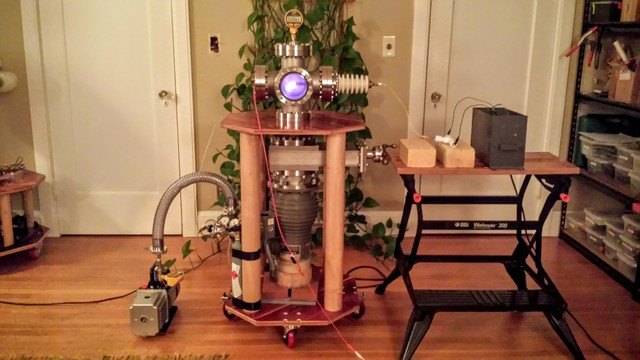
20160406_221656.jpg

20160406_222241.jpg

Here is the plasma at a lower pressure of 10 microns of mercury:
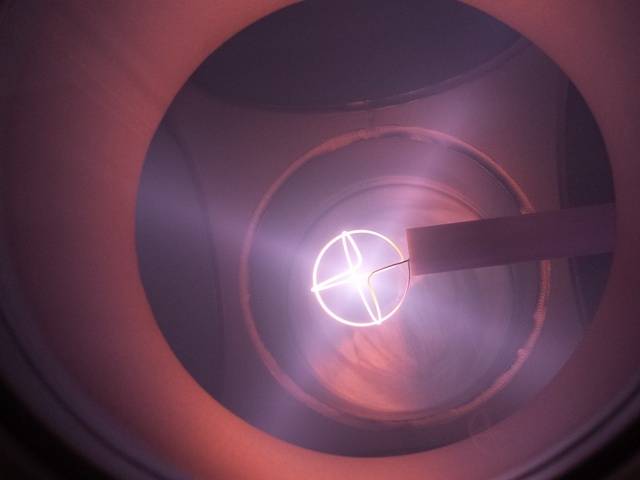
photo_2016_03_31_13_49.jpg


For the leak test, I first evacuated the entire vacuum system using only the mechanical pump to a pressure of 0 microns of mercury. This pressure was read by an electronic gauge that can accurately read pressures within one micron. Then, I closed the gate valve and started my stopwatch. As air began leaking back into the main chamber, I recorded the pressure every 30 seconds. Here is the data I recorded:
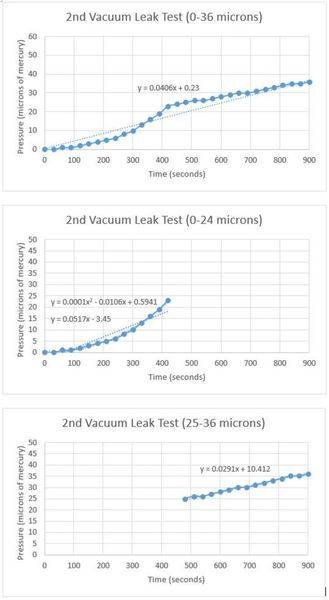
2nd_vacuum_leak_test.jpg


I have repeated this test multiple times and I can verify that the results are consistent. When the pressure is below 25 microns, the leak rate follows a quadratic curve. When the pressure in the chamber is above 25 microns, the leak rate suddenly slows and becomes constant. Could 25 microns be the transition point between free molecular flow and viscous flow within my reactor? I asked my AP physics teacher, but he was not certain this was the cause. I don't think off-gassing has anything to do with this, but it does seem like a possibility.

I would greatly appreciate any ideas that might explain this data.

I wasn't sure which "thread level" to tag this thread, so I put "high school" as I am a high school student. If this is wrong, please let me know.

Thanks,
Kuba
 
Last edited:
  • Like
Likes   Reactions: Drakkith
Science news on Phys.org
So your leak test involves watching the pressure increase over time after you stop evacuating? How do you intend to find the leak?
 
All vacuum systems have a leak rate of some value as there is no such thing a perfectly sealed vacuum chamber (due to real and virtual leaks). The leak rate I recorded from my vacuum chamber is extremely low and more than suitable for my project. I am asking why the leak rate's relationship to time suddenly changes at 25 microns. I am not looking to find the leak, as that would not only be impossible but also pointless considering the tolerances required for my project to work.
 
Is there any way to determine the composition of the gas you are getting?

That would be an extremely valuable clue as to where it's coming from, which would be an extremely valuable clue as you why you're getting the curve that you are.
 
The gas flowing into the chamber is just the air in my room, so mostly Nitrogen and Oxygen. I did not introduce deuterium into the chamber previous to the test.
 
Are you using a two stage mechanical pump?
 
Then why if the mechanical pump can provide a vacuum to your specs so you need a diffusion pump that I see in your pic.
 
The mech pump can pump down to about 10e-4 torr. For fusion to occur, the contents of the chamber must be only deuterium. Therefore, I must use a diffusion pump to get the chamber down to about 10e-7 torr before refilling with deuterium.
 
  • #10
kubaanglin said:
I am not looking to find the leak, as that would not only be impossible but also pointless considering the tolerances required for my project to work.

But what is your tolerance? You need 10-7 Torr but your leak rate is 3.745xE10-5
/sec. two orders of magnitude greater than your lowest pressure to introduce the deuterium. How can you justify that leak rate?

kubaanglin said:
I am not looking to find the leak, as that would not only be impossible but also pointless considering the tolerances required for my project to work.
So considering the rate of contamination of the deuterium since you cannot/will not control your leak do you justify the validity of your experiment?

Forget about the "anomalous" behavior of the leak rate, concentrate on assuring your deuterium is not unduly contaminated.
 
  • #11
Getting the chamber down to 10e-7 is a bit overkill, its just that my diffusion pump happens to be capable of doing that. The mech pump is capable of getting the pressure just above the level at which it should be, so a diffusion pump is required. The deuterium will be leaked into the chamber while the gate valve is just barely open in order to sustain a dynamic equilibrium. Refilling the chamber to about 10 microns occurs rather quickly, so the leak rate is not significant. When the dynamic equilibrium is stable, the leak rate will not over-contaminate the deuterium. The deuterium can have some contaminants, just very very few.
 
  • #12
By what principle does your pressure gauge measure pressure? I will be signing off until tomorrow.
 
  • #13
It uses a self-heated thermistor bridge with integral temperature compensation from 0 to 50 °C.
 
  • #14
Maybe it's an issue with the pressure meter. What kind is it?
 

Similar threads

Replies
1
Views
2K
  • · Replies 8 ·
Replies
8
Views
3K
  • · Replies 3 ·
Replies
3
Views
2K
  • · Replies 19 ·
Replies
19
Views
6K
  • · Replies 15 ·
Replies
15
Views
3K
  • · Replies 19 ·
Replies
19
Views
10K
  • · Replies 8 ·
Replies
8
Views
4K
  • · Replies 4 ·
Replies
4
Views
9K
  • · Replies 3 ·
Replies
3
Views
4K
Replies
1
Views
5K