Why Does Stoke's Stream Function Represent Fluid Flow?

2 replies · 2K views · last reply
chriswong
Messages
2
Reaction score
0
Summary:: Stoke stream function

[Mentor Note -- Thread moved from the technical forums, so no Homework Template is shown]
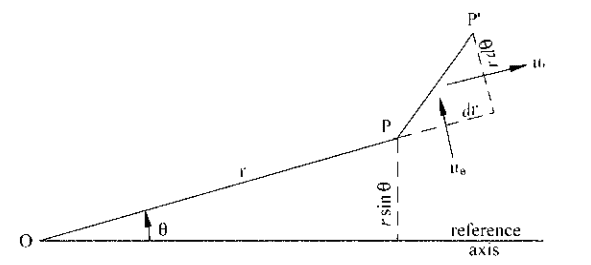
Diagram of polar coordinates in a plane with origin O and reference axis; point P at radius r and angle θ from the axis, with the vertical r sin θ marked, a nearby point P' offset by dr and r dθ, and unit vectors u_r and u_θ at P.

Why the quantity of fluid that crosses the surface of revolution formed by the vector OP is

Mathematical expression 2πr sin θ(u_r r dθ − u_θ dr), showing a flux integrand in spherical-type coordinates with radial and azimuthal velocity components u_r and u_θ.
?
 
Last edited by a moderator:
What vector? There appears to be several here (or else the picture without context is just confusing to me). Have you tried to work this out on your own, and if so, what did you try so far?
 
Sorry about that. Here are more information.
"Let a function Ψ be defined such that if the position vector OP is rotated around the reference axis, that is, if the coordinate ω is varied through 2π while r and θ are held fixed, the quantity of fluid that crosses the surface of revolution formed by the vector OP will be 2pc. Now apply this definition to two points P and P' that are close together, as shown in the Figure. Then if the line element PP' is rotated about the reference axis, the resulting surface will have a quantity of fluid 2πdΨ crossing it per unit time. "

I am wondering why the flow rate across a unit area of the surface is
Handwritten-style expression 2πr sin θ(u_r r dθ − u_θ dr), showing the flux integrand for a surface of revolution in spherical-type coordinates with unit vectors u_r and u_θ.