Why Does the Energy-Stress Tensor Exclude Other Forces?

  • Context: Graduate 
  • Thread starter Thread starter VictorMedvil
  • Start date Start date
  • Tags Tags
    Tensor
Click For Summary

Discussion Overview

The discussion revolves around the energy-stress tensor in general relativity (GR) and its treatment of various forces, particularly whether it adequately accounts for all forms of energy density, including those from electromagnetic fields and other sources. Participants explore the implications of this tensor for quantum-level interactions and the mathematical foundations of GR.

Discussion Character

  • Debate/contested
  • Technical explanation
  • Mathematical reasoning

Main Points Raised

  • Some participants question why the energy-stress tensor appears to focus on electromagnetic energy density and whether this indicates a flaw in GR's mathematics for quantum interactions.
  • Others assert that the stress-energy tensor includes contributions from all sources, not limited to electromagnetic fields, and encompasses stress-energy due to matter as well.
  • A participant clarifies that the expression provided earlier was specifically for the electromagnetic stress-energy tensor and not a general form.
  • It is noted that there is no single version of the energy-stress tensor; its form depends on the types of sources present.
  • One model for the energy-momentum tensor for charges is presented, resembling that of an ideal fluid, which includes internal energy density and pressure.
  • Disagreements arise regarding the interpretation of the energy-momentum tensor, with some emphasizing the need to include mechanical aspects of charges and others pointing out that it must also account for stress-energy unrelated to charges.
  • Participants discuss the terminology, suggesting that the term "energy-momentum-stress tensor" might be more appropriate to reflect its components.

Areas of Agreement / Disagreement

Participants express differing views on the completeness of the energy-stress tensor in accounting for various forces. While some agree that it includes all sources, others contend that the focus on electromagnetic fields is misleading, indicating that the discussion remains unresolved.

Contextual Notes

There are limitations in the discussion regarding the assumptions made about the definitions of the energy-stress tensor and the specific contexts in which different forms apply. The mathematical expressions provided depend on the conventions used and the types of sources considered.

VictorMedvil
Messages
41
Reaction score
4
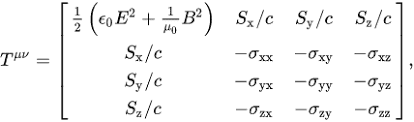
Hello, I was wondering why the energy-stress tensor only accounts for electromagnetic Energy Density and does not include the other forces? Secondary question could this be a flaw within the mathematics of GR making it give nonsense answers for Quantum level interactions?
download.png
 
Physics news on Phys.org
VictorMedvil said:
I was wondering why the energy-stress tensor only accounts for electromagnetic Energy Density and does not include the other forces?

It does include the other forces. The stress-energy tensor includes all stress-energy from all sources. These are not limited to "forces", by which I assume you mean stress-energy density due to fields; stress-energy due to matter is also included.
 
  • Informative
Likes   Reactions: VictorMedvil
VictorMedvil said:
the energy-stress tensor

What you wrote down is not "the stress-energy tensor" without qualification. It is only the stress-energy tensor due to electromagnetic fields.
 
  • Like
  • Informative
Likes   Reactions: vanhees71 and VictorMedvil
PeterDonis said:
What you wrote down is not "the stress-energy tensor" without qualification. It is only the stress-energy tensor due to electromagnetic fields.
Okay thanks that clears that up, what is the other version of the Energy-Stress tensor look like?
 
VictorMedvil said:
what is the other version of the Energy-Stress tensor look like?

It depends on what kinds of sources are present. There is no single "version" that covers all cases.
 
  • Informative
Likes   Reactions: VictorMedvil
PeterDonis said:
It depends on what kinds of sources are present. There is no single "version" that covers all cases.
Okay Thanks PeterDonis.
 
PeterDonis said:
It does include the other forces. The stress-energy tensor includes all stress-energy from all sources. These are not limited to "forces", by which I assume you mean stress-energy density due to fields; stress-energy due to matter is also included.
Yes, and I did mean due to fields but there is no "any case" it just depends on the Stress sources exactly what I wanted to know :smile:.
 
VictorMedvil said:
Yes, and I did mean due to fields but there is no "any case" it just depends on the Stress sources exactly what I wanted to know :smile:.
The most general form (or definition) of the stress-energy tensor in GR is
$$
T_{\mu\nu} = \pm \frac{2}{\sqrt{|\bar g|}} \frac{\delta \mathcal S}{\delta g^{\mu\nu}},
$$
where ##\pm## depends on your sign conventions, ##\bar g## is the metric determinant, and ##\mathcal S## is the action for what you are computing the stress-energy tensor for (ie, not including the Einstein-Hilbert part of the action).
 
  • Like
  • Informative
Likes   Reactions: vanhees71 and VictorMedvil
PeterDonis said:
It does include the other forces. The stress-energy tensor includes all stress-energy from all sources. These are not limited to "forces", by which I assume you mean stress-energy density due to fields; stress-energy due to matter is also included.
No, that's the energy-momentum tensor of the electromagnetic field only. The total energy-momentum tensor also has to include the "mechanical" part of the charges. Only the total energy-momentum tensor is conserved!

One model for an energy-momentum tensor for the charges is that of an ideal fluid,
$$T_{\text{mech}}^{\mu \nu} = (U+P) u^{\mu} u^{\nu} -P \eta^{\mu \nu},$$
where ##U## and ##P## are the internal energy density and pressure as measured in the local rest frame of the fluid, and ##u^{\mu}=u^{\mu}(x)## is the four-velocity flow field in units of ##c##, i.e., normalized such that ##u_{\mu} u^{\mu}=1##.
 
  • Like
  • Skeptical
  • Informative
Likes   Reactions: VictorMedvil, Motore and dextercioby
  • #10
vanhees71 said:
No, that's the energy-momentum tensor of the electromagnetic field only. The total energy-momentum tensor also has to include the "mechanical" part of the charges.
I think you are misreading Peter’s post.
 
  • Like
Likes   Reactions: Motore
  • #11
vanhees71 said:
No, that's the energy-momentum tensor of the electromagnetic field only.

I'm not sure why you quoted me for this response; you are saying the same thing I was saying.
 
  • #12
vanhees71 said:
The total energy-momentum tensor also has to include the "mechanical" part of the charges.

It also has to include stress-energy that might have nothing whatever to do with charges at all.
 
  • #13
PeterDonis said:
I'm not sure why you quoted me for this response; you are saying the same thing I was saying.
Obviously it was a misunderstanding, because you wrote "It does include the other forces. The stress-energy tensor includes all stress-energy from all sources." What's written in #1 is the em. part only, as far as I read this expression.
 
  • #14
PeterDonis said:
It also has to include stress-energy that might have nothing whatever to do with charges at all.
Of course, that's what the energy-momentum tenor is (perhaps one should rather call it energy-momentum-stress tensor, because the space-space components are the usual stress tensor also known in non-relativistic continuum mechanics).

That's also clear when looking at the most simple case of an ideal fluid, where
$$T^{\mu \nu} = (U+P) u^{\mu} u^{\nu} - P g^{\mu \nu}$$
(in west-coast convention for the metric). Indeed it contains both the internal energy and the stress (pressure) in the expression for the energy density, which is ##T^{00}##.
 

Similar threads

  • · Replies 3 ·
Replies
3
Views
2K
  • · Replies 10 ·
Replies
10
Views
3K
  • · Replies 17 ·
Replies
17
Views
3K
  • · Replies 21 ·
Replies
21
Views
3K
  • · Replies 3 ·
Replies
3
Views
1K
  • · Replies 28 ·
Replies
28
Views
2K
  • · Replies 27 ·
Replies
27
Views
3K
  • · Replies 21 ·
Replies
21
Views
4K
  • · Replies 3 ·
Replies
3
Views
2K
  • · Replies 12 ·
Replies
12
Views
3K