Why does the mass attenuation coefficient have a negative gradient?

Click For Summary
SUMMARY

The mass attenuation coefficient (MAC) exhibits a negative gradient as photon energy increases due to the decreasing probability of photoelectric absorption interactions per unit distance traveled in a medium. This phenomenon is attributed to the matrix element of the electrical dipole operator between atomic wave functions, which diminishes rapidly as the wavelength becomes smaller than the size of atomic orbitals. The jagged features in the MAC graph correspond to absorption edges, indicating thresholds for inner-shell electron ionization.

PREREQUISITES
  • Understanding of mass attenuation coefficient (MAC)
  • Knowledge of photoelectric absorption processes
  • Familiarity with atomic wave functions and dipole operators
  • Basic concepts of photon energy and ionization thresholds
NEXT STEPS
  • Research the relationship between photon energy and photoelectric absorption
  • Study the concept of absorption edges in atomic physics
  • Explore the role of matrix elements in quantum mechanics
  • Investigate the implications of electron excitation energies on MAC
USEFUL FOR

Physicists, materials scientists, and anyone studying photon interactions with matter, particularly in the context of x-ray absorption and atomic structure.

epsilon
Messages
29
Reaction score
1
I am currently trying to understand the mass attenuation coefficient (MAC) with regards to photoelectric absorption. Consider this graph:
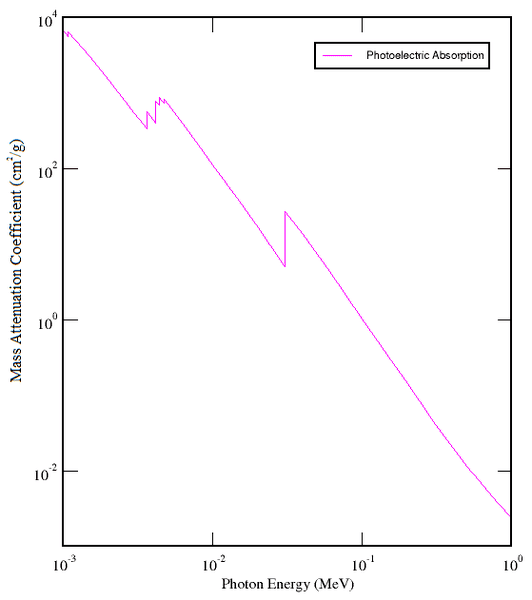
NaKSb_photoelectric_absorption - Copy.png


Why does this have a negative gradient? Why does the MAC decrease as the photon energy increases?

From what I understand, the MAC is the rate of energy loss of a photon as it traverses a medium, independent of the density of the medium and is therefore solely a property of the atomic arrangement, etc. Hence why would a photon be losing energy slower if it is initially higher energy? Also, I believe the jagged parts of the line are the electron excitation energies of atoms, but how does this tie into the negative gradient?

Many thanks in advance!
 
Physics news on Phys.org
Everybody knows that x-rays penetrate matter, so you should not be surprised.

As to why, this is due to the matrix element of the electrical dipole operator between atomic wave functions. It goes down fast when the wavelength is smaller than the size of the orbitals.
Yes, the jagged parts are the absorption edges, when the photon energy is at the threshold for ionisation of an inner-shell electron.
 
  • Like
Likes   Reactions: epsilon
I also found that the MAC is easier to understand as the probability of a photoelectric absorption interaction per unit distance traveled into the material, for anyone else who is wondering!
 
  • Like
Likes   Reactions: PietKuip

Similar threads

  • · Replies 6 ·
Replies
6
Views
2K
  • · Replies 3 ·
Replies
3
Views
1K
  • · Replies 8 ·
Replies
8
Views
2K
  • · Replies 15 ·
Replies
15
Views
3K
  • · Replies 6 ·
Replies
6
Views
11K
  • · Replies 2 ·
Replies
2
Views
3K
  • · Replies 1 ·
Replies
1
Views
1K
  • · Replies 2 ·
Replies
2
Views
2K
  • · Replies 3 ·
Replies
3
Views
2K
  • · Replies 6 ·
Replies
6
Views
3K