RMalayappan
- 16
- 0
My physics teacher cooked up an experiment today on the fly where we tried to calculate the horizontal distance traveled, D, from a rubber tube through which water was siphoned from a graduated cylinder elevated a certain distance H from the ground:
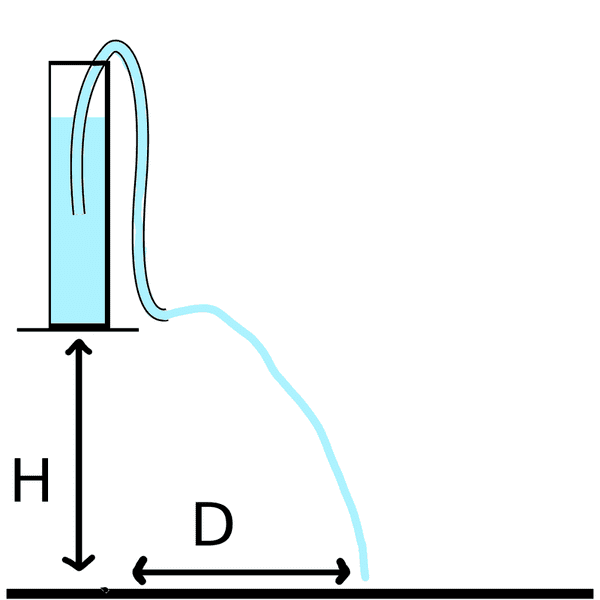
He modified an experiment he had found of the same sort but with a hole in the cylinder instead, in which case he could use Torricelli's Law to find that [itex]v=sqrt(2gh)[/itex] for water exiting with the surface a distance of h above the hole and basic kinematics to find the horizontal distance upon impact with the ground. We tried the same equations with h being the height of the tube above the opening and the calculations gave a distance that was much farther than the actual distance. What is the proper way to go about this problem and why did the application of the same equations give such a gross overshoot?
He modified an experiment he had found of the same sort but with a hole in the cylinder instead, in which case he could use Torricelli's Law to find that [itex]v=sqrt(2gh)[/itex] for water exiting with the surface a distance of h above the hole and basic kinematics to find the horizontal distance upon impact with the ground. We tried the same equations with h being the height of the tube above the opening and the calculations gave a distance that was much farther than the actual distance. What is the proper way to go about this problem and why did the application of the same equations give such a gross overshoot?