SUMMARY
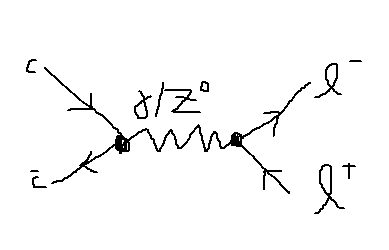
The discussion centers on the decay mechanisms of the ##\chi_0## meson, specifically why it does not decay into a pair of charged leptons. The consensus is that while electromagnetic (EM) and weak interactions are theoretically possible, they are heavily suppressed compared to strong interactions. The ##\chi_{c0}## meson, with a mass of ##3.4 GeV/c^2##, primarily decays through strong interactions, with EM decays being suppressed by a factor of approximately ##10^{-4}## and weak decays by about 12 orders of magnitude. C-parity conservation further complicates the decay process, prohibiting certain EM decay channels.
PREREQUISITES
- Understanding of meson decay processes
- Familiarity with quantum numbers such as angular momentum (J) and C-parity
- Knowledge of electromagnetic (EM) and weak interactions in particle physics
- Basic principles of Feynman diagrams and decay channels
NEXT STEPS
- Research the decay mechanisms of other charmonium states, particularly ##\chi_{c1}## and ##\chi_{c2}##
- Study the principles of C-parity conservation in particle decays
- Examine the role of Feynman diagrams in predicting particle interactions
- Explore the differences in decay rates between strong, weak, and electromagnetic interactions
USEFUL FOR
Particle physicists, researchers in quantum field theory, and students studying meson decay processes will benefit from this discussion.