spaghetti3451
- 1,311
- 31
I would like to consider the interaction terms in the Standard Model which allow the following decay process:
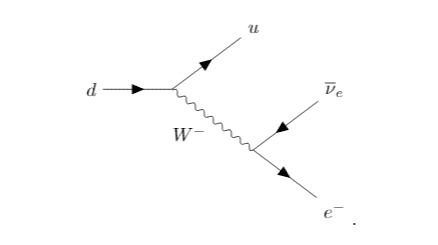
The only interaction terms in the Standard Model which allow this decay process are contained in the charged current interactions:
$$\mathcal{L}_{cc}
= ie_{W}\big[W_{\mu}^{+}(\bar{\nu}'_{m}\gamma^{\mu}(1+\gamma_{5})e'_{m} + V_{mn}\bar{u}'_{m}\gamma^{\mu}(1+\gamma_{5})d'_{n})
+ W_{\mu}^{-}(\bar{e}'_{m}\gamma^{\mu}(1+\gamma_{5})\nu'_{m} + (V^{\dagger})_{mn}\bar{d}'_{m}\gamma^{\mu}(1+\gamma_{5})u'_{n})\big].$$
-----------------------------------------------------------------------------------------------------------------------------------
1. Is the vertex between the quarks only allowed by the term ##ie_{W}W_{\mu}^{+} V_{mn}\bar{u}'_{m}\gamma^{\mu}(1+\gamma_{5})d'_{n}##?
2. Is this because the down quark enters the vertex and therefore must not have a bar on top of it?
3. Simialrly, is the vertex between the leptons only allowed by the term ##ie_{W}W_{\mu}^{-} (V^{\dagger})_{mn}\bar{d}'_{m}\gamma^{\mu}(1+\gamma_{5})u'_{n}##?
The only interaction terms in the Standard Model which allow this decay process are contained in the charged current interactions:
$$\mathcal{L}_{cc}
= ie_{W}\big[W_{\mu}^{+}(\bar{\nu}'_{m}\gamma^{\mu}(1+\gamma_{5})e'_{m} + V_{mn}\bar{u}'_{m}\gamma^{\mu}(1+\gamma_{5})d'_{n})
+ W_{\mu}^{-}(\bar{e}'_{m}\gamma^{\mu}(1+\gamma_{5})\nu'_{m} + (V^{\dagger})_{mn}\bar{d}'_{m}\gamma^{\mu}(1+\gamma_{5})u'_{n})\big].$$
-----------------------------------------------------------------------------------------------------------------------------------
1. Is the vertex between the quarks only allowed by the term ##ie_{W}W_{\mu}^{+} V_{mn}\bar{u}'_{m}\gamma^{\mu}(1+\gamma_{5})d'_{n}##?
2. Is this because the down quark enters the vertex and therefore must not have a bar on top of it?
3. Simialrly, is the vertex between the leptons only allowed by the term ##ie_{W}W_{\mu}^{-} (V^{\dagger})_{mn}\bar{d}'_{m}\gamma^{\mu}(1+\gamma_{5})u'_{n}##?