fitz_calc
- 41
- 0
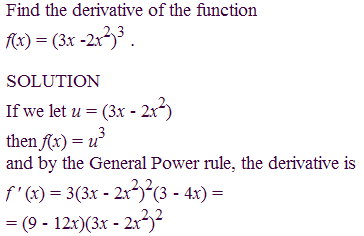
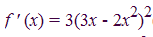
This is an example I found online. I know how to get to this:
The discussion revolves around the application of the chain rule in calculus, particularly in the context of finding derivatives of composite functions. Participants are exploring the reasoning behind specific terms, such as "3-4x," that appear in derivative calculations.
There is an ongoing exploration of the chain rule and its application, with some participants offering insights into the process. Confusion remains regarding certain steps in the derivative calculation, indicating a productive dialogue without a clear consensus yet.
Participants mention challenges with class notes and seek clarification on concepts that may not have been thoroughly covered in their coursework. There is also a reference to the complexity of composite functions and their derivatives.
fitz_calc said:![]()
This is an example I found online. I know how to get to this:, but why is 3-4x brought into the problem? sorry for the newbie questions tonight but my notes from class don't really cover the material very well, thanks.![]()
rocophysics said:that's a great way Casey, makes a lot of sense too; exactly how i learned logs
fitz_calc said:ok i think I'm getting it. i tried a homework problem:
y=(4+x^4)^5 => u=g(x)=4+x^4 , f(u)=u^5
then f(x)=f(g(x)) => 5u^4 * (4x^3) => 5(4+x^4)^4 * (4x^3)
* a bit of confusion here -- why can't I multiply the 5 by (4+x^4)^4?
I know the answer is 20x^3 (4+x^4)^4 but can't figure out why the 5 isn't distributed in the last step, thanks