Why is angular momentum conserved?

Join the discussion
Registration is free. Ask a follow-up in this thread, or start your own.
2 replies · 2K views
Abhishek11235
Messages
174
Reaction score
39
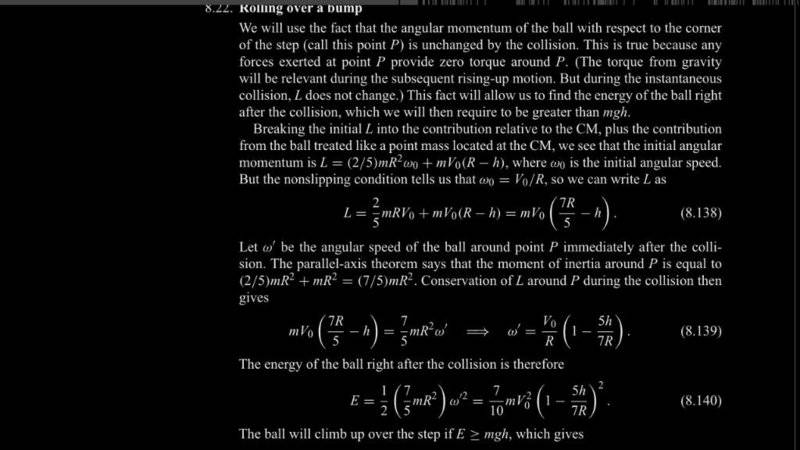
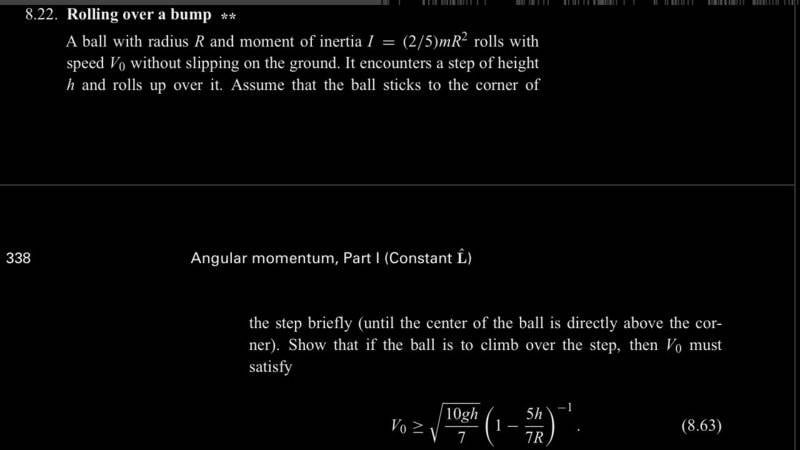
So,this is problem from David Morin's Classical Mechanics(Screenshot 1). I solved the problem. Then I went to see the solution in manual hoping for out of box thinking. As in screenshot 2 is solution by Morin. My question is why he conserves angular momentum about the point (R-h) below C.M? There is torque due to its own weight. Actually I want to understand meaning of the statement he has written in bracket.

If texts is small here is what he has written:
"torque from gravity will be relevant during the subsequent rising-up motion. But during the instantaneous collision, L does not change."
Screenshot_2019-02-15-23-46-47.jpeg
Screenshot_2019-02-15-23-52-23.jpeg
 

Attachments

  • Screenshot_2019-02-15-23-46-47.jpeg
    Screenshot_2019-02-15-23-46-47.jpeg
    25.9 KB · Views: 547
  • Screenshot_2019-02-15-23-52-23.jpeg
    Screenshot_2019-02-15-23-52-23.jpeg
    49.4 KB · Views: 510
Physics news on Phys.org
You are looking at a collision that is being modeled as instantaneous. As long as this is a good approximation is appropriate, the time of the collision is too short for the torque to transfer any relevant angular momentum to the system.
 
  • Like
Likes   Reactions: Abhishek11235
The argument is that although there is a torque due to gravity while the ball is rotating about the corner, the time required for the ball to go over the corner is short enough so that the angular momentum does not change appreciably.
 
  • Like
Likes   Reactions: Abhishek11235