Why is differential neutron flux commonly used in nuclear reactors?

Click For Summary
SUMMARY

Differential neutron flux is commonly used in nuclear reactors due to its ability to provide detailed spectral information, allowing for comparisons even when sampling intervals (delta E) differ. This method is advantageous for analyzing neutron behavior and energy distributions. Integral neutron flux, while also relevant, presents different characteristics and requires specific unfolding codes such as SANDP or STAYS’L for accurate calculations. Understanding these distinctions is crucial for effective reactor analysis and design.

PREREQUISITES
  • Knowledge of neutron flux spectra in nuclear reactors
  • Understanding of differential and integral neutron flux concepts
  • Familiarity with unfolding codes like SANDP and STAYS’L
  • Basic principles of nuclear reactor physics
NEXT STEPS
  • Research the differences between differential and integral neutron flux
  • Learn how to use SANDP for neutron flux calculations
  • Explore STAYS’L and its applications in reactor analysis
  • Study neutron flux sampling techniques and their implications
USEFUL FOR

Nuclear engineers, reactor physicists, and researchers involved in neutron flux analysis and reactor design will benefit from this discussion.

oksuz_
Messages
70
Reaction score
3
Hi,

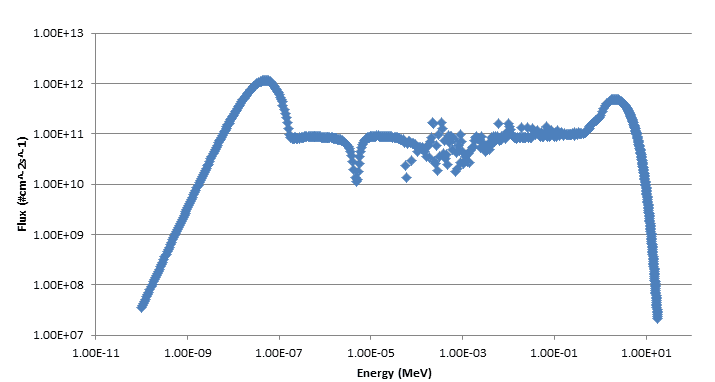
Below are the neutron flux spectra of a nuclear reactor. In the first spectrum, y-axis is differential flux and in the second spectrum, y-axis is flux (created by multiplying differential flux by energy in MeV). As far as I have seen so far, differential flux is used commonly. I am just wondering that why it is like that. Is there an advantage for using differential flux instead of just flux?
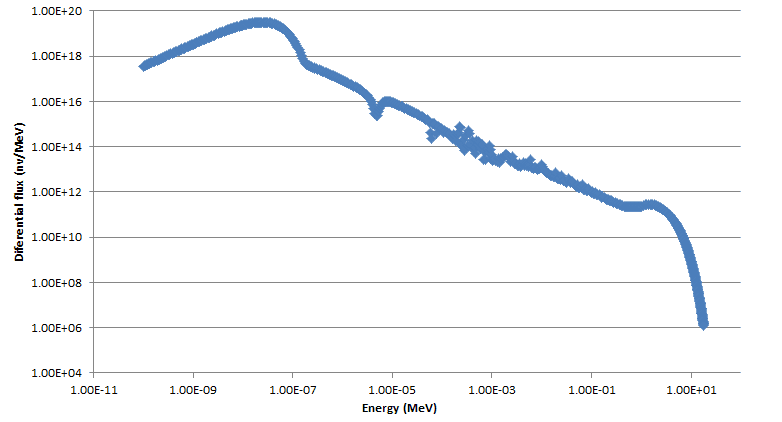
dif_flux of BP#1.png
flux of BP#1.png


Thank you.
 

Attachments

  • dif_flux of BP#1.png
    dif_flux of BP#1.png
    6.6 KB · Views: 1,048
  • flux of BP#1.png
    flux of BP#1.png
    5.2 KB · Views: 1,435
Engineering news on Phys.org
Off hand, I would say it depends on what information you are looking for.
 
Hi
It permits to compare the spectra even if the sampling (delta E) is different
PSR
 
Hello, I have seen also in some papers Integral neutron flux. I am trying to obtain it just as unfolding codes as SANDP or STAYS´L do. If somebody knows how to do that calculations I will appreciate it. The behavior in the integral neutron flux is also different from those shown previously. Thank you very much
 

Similar threads

Replies
5
Views
3K
Replies
1
Views
2K
  • · Replies 9 ·
Replies
9
Views
3K
  • · Replies 1 ·
Replies
1
Views
2K
  • · Replies 1 ·
Replies
1
Views
3K
Replies
3
Views
2K
Replies
1
Views
2K
  • · Replies 46 ·
2
Replies
46
Views
15K
  • · Replies 6 ·
Replies
6
Views
3K
  • · Replies 15 ·
Replies
15
Views
4K