Why is the (1/2) in the Gravity Force Term for Fluid Mechanics?

Click For Summary

Homework Help Overview

The discussion revolves around understanding a specific term in a fluid mechanics formula related to the force balance due to gravity. Participants are examining the presence of the factor (1/2) in the equation for gravitational force in a fluid context.

Discussion Character

  • Conceptual clarification, Assumption checking

Approaches and Questions Raised

  • Participants are attempting to clarify the reasoning behind the (1/2) factor in the gravity term, with some referencing the geometry of the fluid element involved. Questions arise regarding the application of differential lengths and the implications of using triangular versus rectangular areas in calculations.

Discussion Status

The discussion is ongoing, with various interpretations being explored. Some participants provide insights into the geometry of the fluid element, while others seek clarification on the assumptions made regarding differential lengths and volume calculations. There is no explicit consensus yet.

Contextual Notes

Participants are navigating the complexities of fluid mechanics principles, particularly in relation to the geometry of the fluid elements being analyzed. The original poster's question stems from a textbook reference, indicating a need for deeper understanding rather than a straightforward problem-solving scenario.

swmmr1928
Messages
55
Reaction score
0
This is not a problem statement this is not homework this is not a textbook exercise. This is my own question about a formula in a textbook. I was given an infraction because I did not post this here.
Homework Statement


zxWrF.png

Source: Fluid Mechanics 2nd ed. - P. Kundu, I. Cohen.pdf

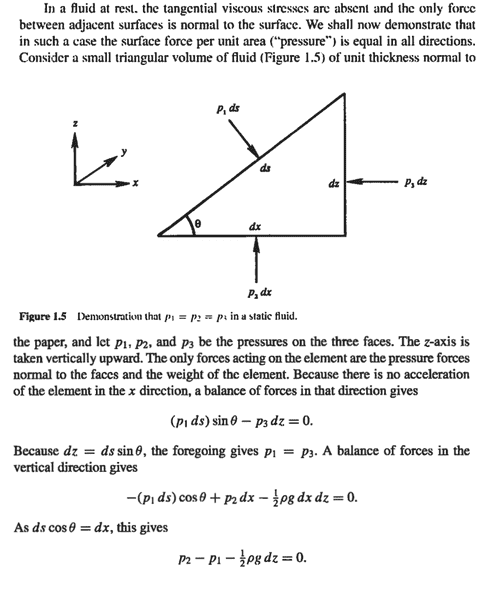
I am trying to understand the force balance, specifically the force due to gravity. Why is the (1/2) present?

Homework Equations


(1/2) * ρ * g * dx * dz


The Attempt at a Solution


I tried my own force balance and I agree with the book except for the gravity term:

ƩF in vertical = 0 = +p2dx - Fgravity - p1ds*cos(θ)
Fgravity = m*a = m*g = ρ*V*g
m=V*ρ
ƩF in vertical = 0 = +p2dx - ρ*V*g - p1ds*cos(θ)
 
Physics news on Phys.org
Oh I have received an email regarding the thread I started in the general physics section. Another user replied:

"m=ρ*A*d <=> (since d=1, for its of unit thickness)
m=ρ*(dxdz/2) = 1/2 ρ dx dz (since A is that of a triangle) and hence
F= -1/2 ρ dx dz g"

So is this correct: ?
V = s*A
A=1/2*x*y
V=1/2*x*y*s
s=1
V=1/2*x*y

How are you able to suddenly invoke differential length?
 
swmmr1928 said:
I am trying to understand the force balance, specifically the force due to gravity. Why is the (1/2) present?
It's a triangle, so its volume is 1/2 that of a rectangular element. Area = 1/2dxdz.
 
How are you able to suddenly invoke differential length?
 
swmmr1928 said:
How are you able to suddenly invoke differential length?
What's sudden about it? The infinitesimal fluid element in your diagram has a triangular cross section with sides dx & dz.
 

Similar threads

  • · Replies 12 ·
Replies
12
Views
2K
  • · Replies 20 ·
Replies
20
Views
2K
  • · Replies 10 ·
Replies
10
Views
2K
  • · Replies 11 ·
Replies
11
Views
2K
  • · Replies 1 ·
Replies
1
Views
2K
Replies
13
Views
2K
  • · Replies 38 ·
2
Replies
38
Views
4K
  • · Replies 6 ·
Replies
6
Views
1K
  • · Replies 8 ·
Replies
8
Views
2K