Why is the CO2 level lower in my house than outside?

  • Thread starter Thread starter mess
  • Start date Start date
  • Tags Tags
    Co2 Outside
Click For Summary
SUMMARY

The discussion centers on the phenomenon of lower indoor CO2 levels compared to outdoor levels, specifically with a high-accuracy IR CO2 sensor from Sensirion. The indoor readings ranged from 342 to 388 ppm, while outdoor levels fluctuated between 432 and 464 ppm. Participants suggested potential explanations, including the possibility of CO2 absorption by construction materials or water, sensor calibration issues, and the need for a longer measurement period to account for lag in indoor CO2 response to outdoor changes. The consensus indicates that further testing and data collection over a 24-hour period is essential for accurate analysis.

PREREQUISITES
  • Understanding of CO2 measurement techniques and sensors, specifically IR CO2 sensors.
  • Familiarity with parts per million (ppm) as a measurement unit for gas concentrations.
  • Knowledge of HVAC systems and their impact on indoor air quality.
  • Basic principles of gas solubility and absorption in materials.
NEXT STEPS
  • Conduct a 24-hour CO2 measurement test both indoors and outdoors to observe fluctuations.
  • Research the calibration procedures for the Sensirion CO2 sensor to ensure accurate readings.
  • Investigate the effects of construction materials on indoor CO2 levels.
  • Explore the relationship between humidity and CO2 absorption in various materials.
USEFUL FOR

This discussion is beneficial for environmental scientists, HVAC professionals, and anyone interested in indoor air quality management, particularly those utilizing CO2 sensors for monitoring purposes.

  • #31
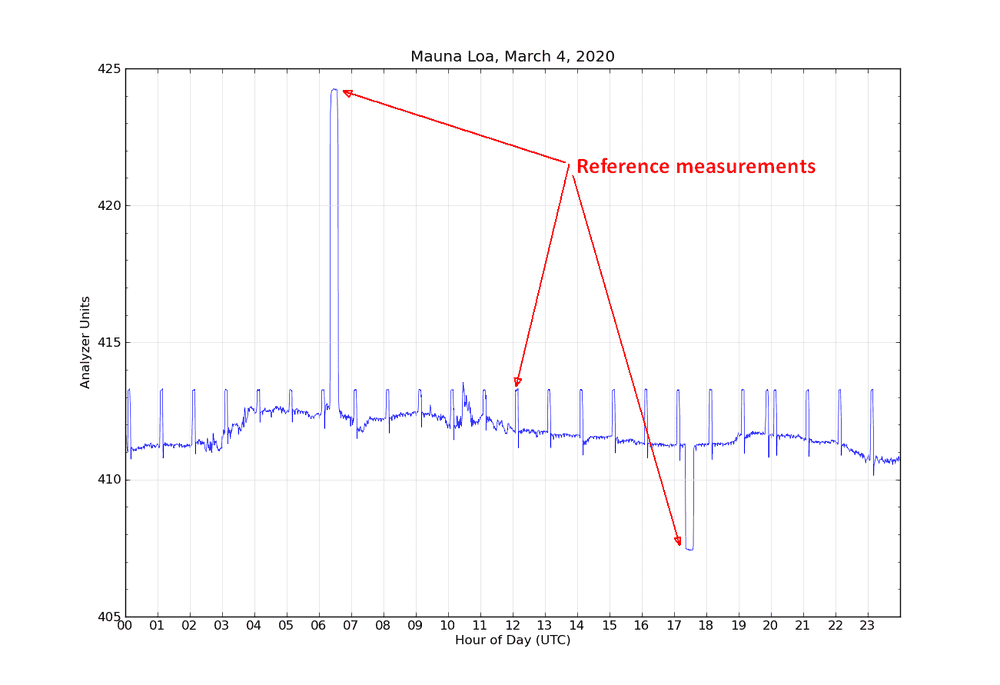
See How we measure background CO2 levels on Mauna Loa for hourly measurements during the day at Mauna Loa which says

Measurement Method

An example of the output from the analyzer for one day is shown in Figure 1 [below]. Two separate intake lines are used for sampling ambient air. The intake lines are from the top of a 38 m tall tower next to the observatory, to avoid any influence on the measurements by human activities at the observatory. Each intake line is measured for five minutes, alternating between line 1 and line 2. Once an hour, the reference gas R0 is measured for five minutes. Once per day, two target tanks are measured for fifteen measurements each (seen in hour 6 and hour 17 in Figure 1). The first few minutes after each gas change are not used to allow time for the previous gas to be completely flushed from the analysis system. The difference of the ambient air measurements from the reference R0 are calculated, and these differences are put into equation 1 to calculate the true ambient mole fraction CO2. By making the measurements relative to the difference from R0, any short term drifts in the analyzer are accounted for.
Clipboard01.png
 
  • Like
Likes   Reactions: OmCheeto
Earth sciences news on Phys.org
  • #32
Could it be that the AC water condensate is scrubbing CO2 from the air inside your house?

Try measuring CO2 at the AC outlet vent and at the inlet (filter). Note any differences. I assume the meter does automatic temperature correction?
 
Last edited:
  • Like
Likes   Reactions: hmmm27
  • #33
Since you are recording in December, I'm going to suggest that there is a substantial thermal difference between inside and outside. Here I'm assuming you are some place where it gets reasonably chilly in December. If that is the case, we may note that warmer air expands -- fewer molecules / m**3 -- and colder air contracts -- more molecules / m**3. We should expect the infrared transmittance of the air to go up when it is warmer on this basis, because there are fewer molecules to absorb the signal. So, we may indeed see changes in the detector based on temperature with constant ppm of CO2, beyond changes that are simply based on the temperature of the detector itself.

Boyle: amount of substance / Volume = Pressure / (R * Temperature)

As temperature goes up, amount of gas in a fixed volume goes down. Temp is in Kelvin here, so we'd need maybe 30°C to make a 10% difference. The relative concentration of CO2 in the gas should remain constant, so the "apparent concentration" of CO2 in the air would appear to go down a little as the air heats up based on a spectrophotometer like this device for a naive calculation that didn't take this into account.

Now, I'd like to think that a device with a humidity and temperature sensor in it have those things so it can correct for such factors! But, as it claims "Best price / performance", perhaps there wasn't enough engineering $$ spent on that calibration, or this one is defective, or there is a lot of variance between devices, making that sort of calibration difficult without individually calibrating each one which might be too expensive. It seems deeply suspicious to me that the device measures lower concentrations as time progresses over a short period. (Because the IR lamp heats up the detector or the gas? Because the detector has some issue? Because the IR source gets brighter as it warms?) But, I'm not a analytical chemist, so listen to anyone with actual experience with NDIR photometry over me.

There is probably someone in the engineering department of the company that can help you out, but finding that person is going to take some doing. I might see if the detector reaches some steady state if left on for a few hours, and if so, try those measurements instead. And of course, a real scientist might prepare calibrated samples in a closed gas bag and recalibrate the thing himself and see whether he could experimentally account for whatever nonsense the device is putting out and correct for it.

The only other speculation that came to me is that air conditioning might remove some CO2 from the air as it condensed out some of the water from the air. The air recirculates. Maybe it could do it if your home was particularly air tight. <Vigorous hand waving> Of course, in December, this seems unlikely unless you are enjoying summer at this time of year. However, I am really just rampantly speculating at this point and should quit before I get even further behind.

It is certainly observed that bubbling gas through water systems (e.g. ozone treatment of water) pulls dissolved CO2 out of the water driving away some of the hardness. This is something of the opposite of the process:

CO3(2-) + 2 H+ <==> HCO3- + H+ <==> H2CO3 <==> CO2 + H20 (and the CO2 escapes with the gas)

Normally, all these variants exist in solution in some concentration in equilibrium, based on pH. However, when bubbling gas through the system, it pulls out CO2, thereby driving the reaction to the right. This consumes both CO2 and H+ ions. This has the net effect of removing some of the acidity from the water, and because carbonates are often less soluble than bicarbonates, you might observe CaCO2 coming out of solution and coating your pipes.

So, we might imagine that a steady process of condensing water out of the air would remove the CO2 with it. CO2 is far more soluble in water than oxygen or nitrogen. There is also a lot less of it in the air, so if we steadily draw away small amounts of CO2, O2 and N2 with water condensing out of air, the CO2 will be rapidly depleted and the O2+N2 won't change much. Eventually, you might have a fairly pure N2, O2 mixture. The problem is that it would have us believe that the CO2 is not leaking into your house at a comparatively tremendous rate to replace it. Since generally people don't asphyxiate in their homes from CO2 buildup even if they stay inside for days -- you may have recently tried this experiment yourself in the last year -- it seems quite reasonable to expect that the house is in fact not that air tight, and this mechanism really couldn't account for your observations. This former scientist would prefer to go with the explanation that CO2 is in steady state exchange with the outside air. The CO2 ppm inside and outside is going to be very similar and you are just observing miscalibration or other confusion in the device.

...but you know, I haven't actually measured, so confidence is low.
 
Last edited:
  • Like
Likes   Reactions: russ_watters
  • #34
mess said:
Summary:: I purchased a high accuracy IR CO2 sensor. Outside it reads ~400ppm CO2 inside I am getting about ~300ppm co2.

How is this possible? I can't think of what could be absorbing Co2 inside my house, when I am producing it at a pretty high rate.

I have my HVAC running on a frequent cycle mode also. I have no plants.

The sensor: https://www.sensirion.com/en/enviro...n-dioxide-sensors/carbon-dioxide-sensors-co2/

Here is the data:

Inside:��������������
2020/12/05 12:12:22PM342
2020/12/05 12:12:19PM346
2020/12/05 12:12:17PM349
2020/12/05 12:12:14PM350
2020/12/05 12:12:12PM353
2020/12/05 12:12:09PM364
2020/12/05 12:12:07PM370
2020/12/05 12:12:04PM372
2020/12/05 12:12:02PM375
2020/12/05 12:11:59PM377
2020/12/05 12:11:56PM378
2020/12/05 12:11:54PM381
2020/12/05 12:11:51PM382
2020/12/05 12:11:49PM384
2020/12/05 12:11:46PM388
Outside:������������������
2020/12/05 11:28:28AM432
2020/12/05 11:28:26AM433
2020/12/05 11:28:23AM434
2020/12/05 11:28:21AM437
2020/12/05 11:28:18AM438
2020/12/05 11:28:16AM440
2020/12/05 11:28:13AM442
2020/12/05 11:28:11AM443
2020/12/05 11:28:08AM444
2020/12/05 11:28:06AM445
2020/12/05 11:28:03AM444
2020/12/05 11:28:01AM446
2020/12/05 11:27:58AM449
2020/12/05 11:27:56AM450
2020/12/05 11:27:53AM450
2020/12/05 11:27:50AM453
2020/12/05 11:27:48AM463
2020/12/05 11:27:45AM464
2020/12/05 11:27:43AM463
The difference in humidity inside versus humidity outside might be causing the difference in your CO2 values. mixkixandwoofyco2andhumiditytrimmedtimestamps.png
mixkixandwoofyco2andhumiditytrimmedtimestamps.png


I was recently trying to set up a Cozir CO2 sensor outdoors on a 12 foot pole. I had two of these pole devices, For weeks of tests at a time, the data returned was displeasing. I took the sensors off of the poles, and put them in 2" diameter 3/4" high plastic containers. I made a moisture absorber with a 1 pint screw lid canning jar, a small sample pump, with 1/4" copper tubing inlets and outlets hot glued to the plastic containers and the jar. The moisture absorbent is silica gel from a craft supplies store (Joanne crafts).

With the humidity absorbing device inline, the two CO2 sensors (now on my workbench, not outdoors) show steady consistent values. . What I am trying to build is several remote CO2 meters to estimate local CO2 emissions. The sample pump came from Excess Solutions and Halted Electronic Supply, San Jose. CA
 
  • Like
  • Informative
Likes   Reactions: BillTre, Keith_McClary and jrmichler
  • #35
https://www.researchgate.net/publication/318919872_Study_on_effect_of_temperature_and_humidity_on_the_CO_2_concentration_measurement
 
  • Like
Likes   Reactions: fresh_42
  • #36
The more I study this problem, the harder it gets.
I was thinking that maybe a refrigeration type dehydrator would remove the 'relative humidity' factor from the equation, but then I remembered that water absorbs CO2, and such a device may be scrubbing CO2 from the sample.

Low and behold, the same problem seems to exist for silica drying agents:

Errors in measurements of CO2 with the use of drying agents

"...silica gel (145 g anhydrous weight, mesh 6-20) adsorbed approximately 2 mmol CO2 (38% of total) over a period of 15 min..."
 
  • Like
  • Informative
Likes   Reactions: mess and BillTre
  • #37
Your carbon dioxide readings indicate you may have exhaled on or near the sensor. Keep the sensor several feet from your nose, six feet is a good separation. Wait awhile before recording the readings in order to give the sensor time to sense the atmosphere of interest rather than the atmosphere entrained around the sensor from another location or your breath. Perhaps the instrument manual will indicate the time to respond to a change in concentration. 90 seconds is response time for a TSI Q-Trak. If the manual does not indicate the response time, you can exhale on the sensor and note how long it takes to come down from the peak concentration to the ambient concentration.
 
  • Informative
Likes   Reactions: Tom.G