Why is the denominator squared in the quotient rule?

Join the discussion
Registration is free. Start your own thread to ask a follow-up.
12 replies · 6K views
EchoRush
Messages
9
Reaction score
1
TL;DR
A quick question about the theory behind the quotient rule?
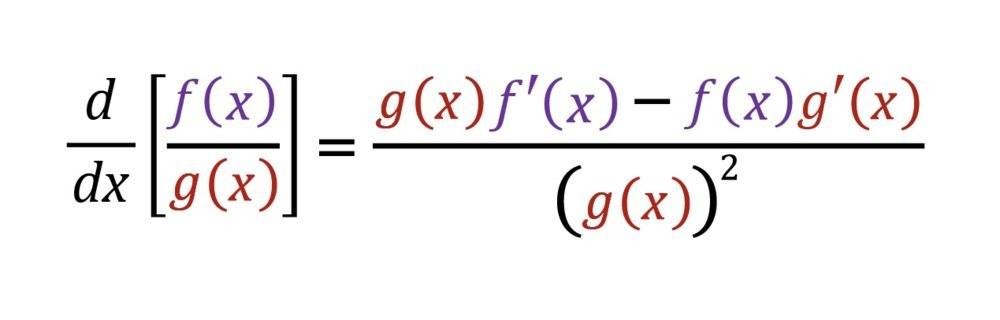
Now, I understand how to use the quotient rule for derivatives and everything. I do not struggle with using it, my question is mostly about the formula itself...I very much enjoy WHY we do things in math, not just “here’s the formula, do it”...Here is the formula for the quotient rule of derivatives.
A688273F-7DB7-447F-9B43-B63AADA0DA65.jpeg

Now, my question is. Why do we square the g(x) in the denominator? I almost feel like the formula for quotient rule should just be what is in the numerator? Why do we square the g(x)? Where does that come from? Why g(x) squared?
 
Physics news on Phys.org
Do you know the product rule and the chain rule? Why don't you try deriving the quotient rule using the product rule and the chain rule?
 
  • Like
Likes   Reactions: symbolipoint and EchoRush
phyzguy said:
Do you know the product rule and the chain rule? Why don't you try deriving the quotient rule using the product rule and the chain rule?

would that explain why the g(x) is squared? It just seems weird to me. Why not just have g(x) function in the denom.?The fact that it is squared makes me wonder it’s origin.
 
EchoRush said:
would that explain why the g(x) is squared? It just seems weird to me. Why not just have g(x) function in the denom.?The fact that it is squared makes me wonder it’s origin.
It is squared because ##x^n## differentiates to ## \sim x^{n-1}## and with ##n=-1## you get the one square on the right. You haven't answered @phyzguy 's question!
 
I always have trouble remembering the order of the terms in the numerator, so I tend to use the product rule.

As people have been suggesting, try using the product rule on ##f(x) [g(x)]^{-1}## and you should see exactly where all of the terms come from. Don't take our word for it, it will really help your understanding.
 
  • Like
Likes   Reactions: symbolipoint, EchoRush and fresh_42
RPinPA said:
I always have trouble remembering the order of the terms in the numerator, so I tend to use the product rule.
And I always thought I was the only one ...
 
fresh_42 said:
And I always thought I was the only one ...
Me too! I realized early on that the quotient rule was just a consequence of the product rule, so I didn't need to memorize the quotient rule. I never use it.
 
RPinPA said:
I always have trouble remembering the order of the terms in the numerator, so I tend to use the product rule.
fresh_42 said:
And I always thought I was the only one ...
I came up with my own mnemonic device for the quotient rule, and one I've never seen anywhere else. Here it is, in the context of the differential of u/v.
$$d(\frac u v) = \frac{v du - u dv}{v^2}$$
How do I remember which term in the numerator comes first? The vd one, an abbreviation for something unrelated to mathematics.

For a derivative instead of a differential, replace du by du/dx or u' and similar for dv.
 
The derivative of [itex]\frac{f(x)}{g(x)}[/itex] is given, using the definition of the derivative, by [itex]\lim_{h\to 0}\frac{\frac{f(x+h)}{g(x+h)}- \frac{f(x)}{g(x)}}{h}[/itex].
To do that quotient, [itex]\frac{f(x+h)}{g(x+h)}- \frac{f(x)}{g(x)}[/itex], get the "common denominator", [itex]g(x)g(x+ h)[/itex]: [itex]\frac{f(x+ h)g(x)}{g(x)g(x+h)}- \frac{f(x)g(x+h)}{g(x)g(x+h)}[/itex]. (it is that "g(x)g(x+h)" in the denominator that will give "[itex]g^2(x)[/itex]" after we take the limit.)
 
Mark44 said:
I came up with my own mnemonic device for the quotient rule, and one I've never seen anywhere else. Here it is, in the context of the differential of u/v.
$$d(\frac u v) = \frac{v du - u dv}{v^2}$$
How do I remember which term in the numerator comes first? The vd one, an abbreviation for something unrelated to mathematics.

For a derivative instead of a differential, replace du by du/dx or u' and similar for dv.
Another way is like this:
Function (Hi)/(Ho)

Mnemonic: Ho d Hi minus Hi d Ho, over Ho Ho

Symbolified: (Ho*dHi-Hi*dHo)/(HoHo)
(Try writing on paper using better 'typesetting' to see it better.)
 
EchoRush said:
would that explain why the g(x) is squared?

Yes, if you know how to apply the chain rule to differentiate ##(g(x))^{-1}##.

I find the explanation given by @HallsofIvy the most intuitive explanation of the denominator in the quotient rule. To explain the numerator, you need the same trick used to prove the product rule.
 
The Quotient Rule Rhyme (for D hi/low):
If the quotient rule you wish to know,
It's low Dhi less hi Dlow
Draw a line and down below
The denominator squared must go.
 
  • Like
Likes   Reactions: lekh2003