Why is the NMR multiplicity incorrect in some places?

  • Thread starter Thread starter etotheipi
  • Start date Start date
  • Tags Tags
    multiplicity Nmr
Click For Summary

Discussion Overview

The discussion revolves around the interpretation of NMR multiplicities in relation to a specific molecular structure and its corresponding NMR spectrum. Participants are examining the reasoning behind the multiplicities assigned to different peaks in the spectrum based on the neighboring hydrogens of carbon atoms.

Discussion Character

  • Debate/contested

Main Points Raised

  • One participant questions the assignment of multiplicities, stating that for carbon ##X##, the neighboring carbon ##Y## has 2 hydrogens, leading to a triplet peak, which they find acceptable.
  • The same participant argues that for carbon ##Y##, since its neighboring carbon (##X##) has 3 hydrogens, the peak should be a quartet, which contradicts the provided answer.
  • Another participant concurs with the initial argument, suggesting that the assignment in the assignment is incorrect.
  • A third participant echoes this sentiment, reinforcing the idea that the assignment is wrong.
  • A later reply points out that the incorrect assignment is also reflected in some online resources, providing a link as evidence.

Areas of Agreement / Disagreement

Participants generally agree that the assignment of NMR multiplicities in the question is incorrect, but the discussion remains focused on the reasoning behind this conclusion rather than reaching a definitive resolution.

Contextual Notes

Participants have not fully explored all assumptions related to the NMR analysis, and there may be dependencies on specific definitions or interpretations of multiplicity that are not fully clarified.

etotheipi
I was doing a question that wanted you to determine the structure given a molecular formula and an NMR spectrum. The following was the answer:
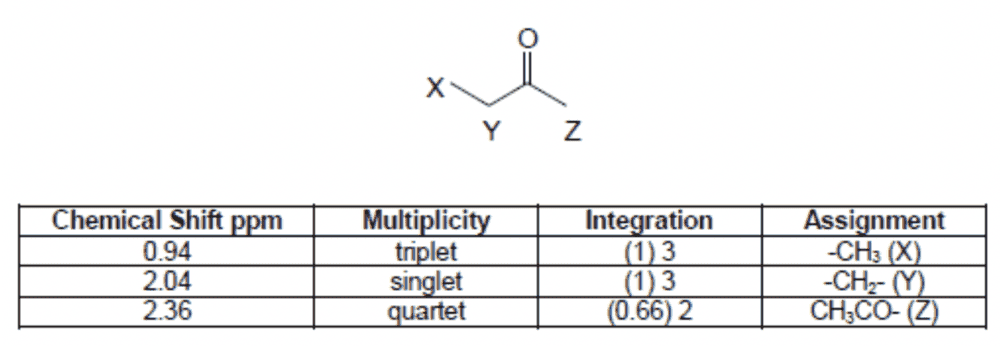
1583685998403.png

I'm unsure as to how the multiplicities were obtained. For ##X##, the neighbouring carbon ##Y## has 2 hydrogens, so this peak is a triplet (OK so far!).

But for ##Y##, the neighbouring carbon (##X##?) has 3 hydrogens so shouldn't that peak should be a quartet? And ##Z##'s neighbouring carbon has no hydrogens so this peak should just be a singlet. This also agrees with the integration, since both ##X## and ##Z## have 3 hydrogens but ##Y## only has 2. I am not sure why they have put it the other way around?

Thank you!
 
Chemistry news on Phys.org
I agree with you argumentation. It looks like the assignment is wrong.
 
  • Like
Likes   Reactions: etotheipi
DrStupid said:
I agree with you argumentation. It looks like the assignment is wrong.

Ah, awesome. Vindication!
 
It’s wrong online in some places as well. This is the wrong assignment!
https://physics.bgu.ac.il/COURSES/LAB_C/NMR/htbooks/nmr/spectra/mek-016.gif
 
  • Like
Likes   Reactions: etotheipi

Similar threads

  • · Replies 4 ·
Replies
4
Views
3K
Replies
8
Views
2K
  • · Replies 3 ·
Replies
3
Views
4K
  • · Replies 4 ·
Replies
4
Views
3K
  • · Replies 3 ·
Replies
3
Views
3K
  • · Replies 10 ·
Replies
10
Views
2K
  • · Replies 4 ·
Replies
4
Views
5K
Replies
1
Views
4K
  • · Replies 6 ·
Replies
6
Views
3K
  • · Replies 5 ·
Replies
5
Views
3K