Why is the professor's method for solving the integral more efficient?

  • Thread starter Thread starter nhrock3
  • Start date Start date
  • Tags Tags
    Mistake
Click For Summary

Homework Help Overview

The discussion revolves around understanding the transition from Cartesian to polar coordinates in the context of calculating an integral over a volume defined by a sphere. Participants are examining the implications of a professor's method, particularly regarding the expression involving \(2 \cos \phi\) and its relevance to the problem setup.

Discussion Character

  • Exploratory, Assumption checking, Conceptual clarification

Approaches and Questions Raised

  • Participants are questioning the professor's notation and the reasoning behind the use of \(2 \cos \phi\). There are attempts to clarify the geometric relationships within the sphere, including angles and lengths related to points in spherical coordinates. Some participants are exploring the law of cosines and how it applies to the problem.

Discussion Status

The discussion is ongoing, with various interpretations being explored. Some participants are attempting to reconcile their understanding of the professor's method with their own approaches. There is a mix of confusion and insight as they navigate the geometric and algebraic aspects of the problem.

Contextual Notes

Participants are working under the constraints of a homework assignment, which may limit the information they can use or the methods they can apply. There is also a suggestion that the professor's approach is intentionally designed to aid understanding, though this is met with skepticism by some participants.

nhrock3
Messages
403
Reaction score
0
why does the prof wrote a mistake there and wrote 2cos theta in there
??

(i didnt typed the question correctly,the original is
i need to calculate the integral on the volume enclosed by z>=0 and the sphere which is written in the photo.)
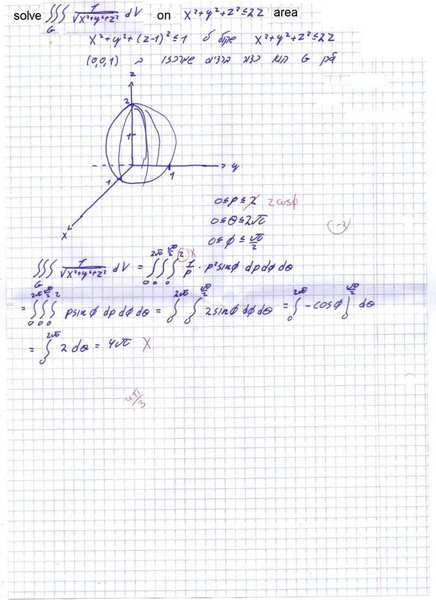
24oq2ww.jpg

how mathematicky can i get this transition

how to get this expression
from cartesian to polar and get the 2 cos teta on the interval

[tex]\rho\le 2\cos \phi[/tex]

??
 
Physics news on Phys.org
hi nhrock3! :smile:

if the origin is O, and if the centre of the sphere is C, and if P is a point on the sphere,

what are the angles of triangle OCP, and what is the length of OP ? :wink:
 
tiny-tim said:
hi nhrock3! :smile:

if the origin is O, and if the centre of the sphere is C, and if P is a point on the sphere,

what are the angles of triangle OCP, and what is the length of OP ? :wink:

OP^2=0C^+PC^2
how it changes the intervals?
 
nhrock3 said:
OP^2=0C^+PC^2

no, it's not a right-angle
 
What are the lengths of OP & PC ?

Isn't φ the angle from the z axis to OP ?

Use the law of cosines to answer tiny-tim's question.
 
SammyS said:
What are the lengths of OP & PC ?

Isn't φ the angle from the z axis to OP ?

Use the law of cosines to answer tiny-tim's question.


i can't imagine the angle


Isn't φ the angle from the z axis to OP ?


could you draw it please
 
C is the centre, so CO = CP = r = 1.

Angle COP = φ.

So how long is OP?​
 
Or just use that [itex]x^2+y^2+z^2=\rho^2[/itex] and [itex]z=\rho \cos\phi[/itex] to transform

[tex]x^2+y^2+z^2=2z[/tex]

into an equation that uses only rho and phi.
 
tiny-tim said:
C is the centre, so CO = CP = r = 1.

Angle COP = φ.

So how long is OP?​


OP^2=CO^2+CP^2-2OC*PCcos(180-2φ)

what to do now?
 
  • #10
nhrock3 said:
OP^2=CO^2+CP^2-2OC*PCcos(180-2φ)

what to do now?

well, now put the numbers in :confused:
 
  • #11
ok i got it
if we try and solve it in a different way.
but if we do variable change
x=u y=v z-1=w
then the jacobian is 1
and the integral is a ball of radius from 0 to 1

unlike here where our radius is from 0 to 2cos

why??
 
  • #12
Placing the origin at the center of the sphere naturally makes the limits of integration simple for a sphere. I hope you changed the integrand accordingly.
z → w+1
 
  • #13
nhrock3 said:
ok i got it
if we try and solve it in a different way.

no, nhrock3, you haven't got it …

you still haven't a clue why your prof did that …
nhrock3 said:
why does the prof wrote a mistake there and wrote 2cos theta in there

your prof is a clever guy who knows how best to teach this subject (and who knows what's coming up in the exams :rolleyes:)

it is not clever for you to give up on his method and to "try and solve it in a different way" :redface:

(and presumably you still think your prof wrote a mistake?)

start again …​
nhrock3 said:
OP^2=CO^2+CP^2-2OC*PCcos(180-2φ)

what to do now?
tiny-tim said:
well, now put the numbers in :confused:

in other words, put CO = CP= PC = 1 …

what do you get?
 

Similar threads

  • · Replies 1 ·
Replies
1
Views
2K
  • · Replies 5 ·
Replies
5
Views
2K
  • · Replies 33 ·
2
Replies
33
Views
3K
  • · Replies 7 ·
Replies
7
Views
8K
  • · Replies 3 ·
Replies
3
Views
12K
  • · Replies 8 ·
Replies
8
Views
3K
Replies
8
Views
6K
  • · Replies 10 ·
Replies
10
Views
5K
  • · Replies 4 ·
Replies
4
Views
2K
  • · Replies 2 ·
Replies
2
Views
3K