Why is the Speed of Light what it is

Click For Summary

Discussion Overview

The discussion centers on the reasons behind the speed of light being approximately 186,000 miles per second. Participants explore theoretical, historical, and conceptual aspects of this phenomenon, including implications from Einstein's theories and electromagnetic theory.

Discussion Character

  • Exploratory
  • Technical explanation
  • Conceptual clarification
  • Debate/contested

Main Points Raised

  • One participant asks about the restrictions on the speed of light and why it cannot travel faster.
  • Another participant references Einstein's theory of special relativity, stating that light cannot travel slower or faster than its constant speed, which is perceived the same by all inertial observers.
  • A historical perspective is provided, mentioning the discovery of the electric constant \(\epsilon_0\) and magnetic constant \(\mu_0\), and how Maxwell's equations predict the speed of electromagnetic waves, which coincidentally matches the speed of light.
  • Some participants discuss the curvature of spacetime as predicted by Einstein, suggesting that this curvature protects causality and restricts the speed of light to its observed value.
  • One participant expresses understanding after discussing the hyperbolic nature of spacetime and its implications for the speed of light.

Areas of Agreement / Disagreement

Participants present multiple viewpoints and models regarding the speed of light, including its relationship to spacetime curvature and electromagnetic theory. There is no consensus on a singular explanation, and the discussion remains unresolved.

Contextual Notes

Some claims depend on specific interpretations of relativity and electromagnetic theory, and there are unresolved questions regarding the fundamental constants involved.

roy_e17
Messages
1
Reaction score
0
Can anyone explain what restricts the speed of light to about 186,000 miles per second? Why can't it travel faster?
 
Science news on Phys.org
Fun fact: it actually can't travel slower either. Light always goes at the same speed. Einstein's theory of special relativity says that there is one, and only one, special speed in the universe which is "seen" to be the same by all (inertial) observers. And there are several ways of calculating that light must travel at that speed. (To think of it one way, photons are massless particles, and all massless particles have to move at that one special speed at all times. I don't remember the reasoning behind that offhand, but perhaps someone else can elaborate, or I could look up the details.)

For an alternative explanation, consider this: back in the 1700's and 1800's, physicists did experiments with charged particles and magnets and discovered two fundamental constants of nature, the electric constant [itex]\epsilon_0[/itex] and the magnetic constant [itex]\mu_0[/itex]. And shortly afterwards, James Maxwell developed a theory that neatly explained the results of those experiments and also predicted that electromagnetic waves should travel at a particular speed, namely [itex]1/\sqrt{\epsilon_0 \mu_0}[/itex]. If you plug in the numerical values, you get the speed of light. (In fact, at the time, nobody knew that light was an electromagnetic wave, so you can imagine that Maxwell was rather surprised when he calculated the wave speed and found that it matched the speed of light, which had previously been measured.) So you could say that light travels at the speed it does because of the "electrical" and "magnetic" properties of empty space.

Of course, that begs the question of why the electric and magnetic constants have the values they do. We don't really have a good answer for that.
 
roy_e17 said:
Can anyone explain what restricts the speed of light to about 186,000 miles per second? Why can't it travel faster?

because the “t”>=0
 
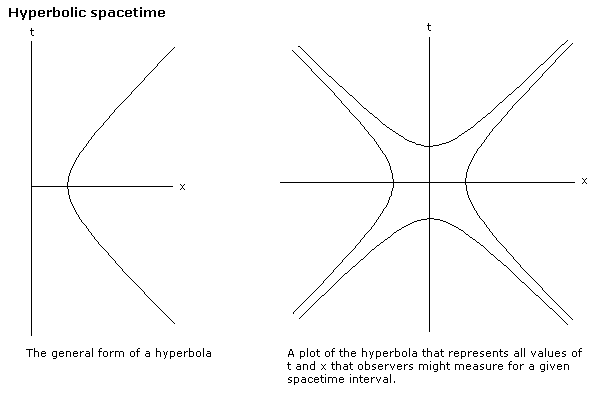
It is to do with the curvature of the spacetime predicted by Einstein, which curves like hyperbolic space (in order to protect causality). If you draw a diagram of hyperbolic space with one time dimension and one space dimension:
Relhyperb.gif


Then no single event should be allowed to cross the "space" axis, this means restricting the speed of light to 186,000mi/s (which equates to a 45 deg line going between two hyperbolics), otherwise the information the light carried would cross the "space" axis and reach an observer before an event happened.

(an event can be veiwed as happening anywhere along a hyperbolic line depending on the observers location and velocity, but it cannot jump from one line to the next.)
 
gk007 said:
It is to do with the curvature of the spacetime predicted by Einstein, which curves like hyperbolic space (in order to protect causality). If you draw a diagram of hyperbolic space with one time dimension and one space dimension:

Relhyperb.gif


Then no single event should be allowed to cross the "space" axis, this means restricting the speed of light to 186,000mi/s (which equates to a 45 deg line going between two hyperbolics), otherwise the information the light carried would cross the "space" axis and reach an observer before an event happened.

(an event can be veiwed as happening anywhere along a hyperbolic line depending on the observers location and velocity, but it cannot jump from one line to the next.)

I got it!Thank you so much!
 

Similar threads

  • · Replies 6 ·
Replies
6
Views
3K
  • · Replies 11 ·
Replies
11
Views
1K
  • · Replies 14 ·
Replies
14
Views
2K
  • · Replies 5 ·
Replies
5
Views
6K
  • · Replies 25 ·
Replies
25
Views
2K
  • · Replies 11 ·
Replies
11
Views
4K
  • · Replies 12 ·
Replies
12
Views
13K
  • · Replies 21 ·
Replies
21
Views
3K
  • · Replies 19 ·
Replies
19
Views
2K
  • · Replies 4 ·
Replies
4
Views
4K