Why is the Sun Yellow/Orange and Not White?

  • Context: Undergrad 
  • Thread starter Thread starter nmsurobert
  • Start date Start date
  • Tags Tags
    Color Sun The sun
Click For Summary

Discussion Overview

The discussion revolves around the perceived color of the Sun as depicted in various images, particularly focusing on why the Sun appears yellow/orange rather than white in certain photographs. Participants explore the implications of false color imaging, the effects of atmospheric conditions, and the interpretation of solar images taken outside Earth's atmosphere.

Discussion Character

  • Exploratory
  • Technical explanation
  • Debate/contested

Main Points Raised

  • Some participants express confusion regarding the color representation of the Sun in images, questioning why it appears yellow/orange instead of white.
  • There is mention of false color imaging techniques used in solar photography, with some participants noting that colors are assigned for better contrast and visibility.
  • One participant suggests that the colorization may be due to filters used during imaging or post-processing, while others agree that both factors could contribute.
  • Some participants discuss the role of human perception in color detection, explaining how different wavelengths of light are interpreted by the eye and brain.
  • There are references to specific wavelengths and their associated colors, with some participants discussing their experiences with solar imaging and the effects of different filters.
  • A participant shares their background in astronomy and expresses a desire to understand the topic better, indicating a personal connection to the subject matter.

Areas of Agreement / Disagreement

Participants generally agree that the images in question utilize false color techniques, but there is no consensus on the specific reasons for the color choices or the implications of these choices. The discussion remains unresolved regarding the exact nature of the Sun's color representation in imaging.

Contextual Notes

Limitations include the potential for misunderstanding the effects of color filters and post-processing on solar images, as well as the subjective nature of color perception in human vision.

Who May Find This Useful

This discussion may be of interest to individuals studying astronomy, photography, or those curious about solar imaging techniques and color perception.

nmsurobert
Messages
288
Reaction score
36
I'm confused by these pictures.
I understand that the picture on the right has had color "assigned" to it because we can see uv light but the picture on the left is supposed to be taken in the visible spectrum. why is it yellow/orange and not white? isn't the sun white? both of these images where taken by soho, which to my understanding is way outside of our atmosphere.
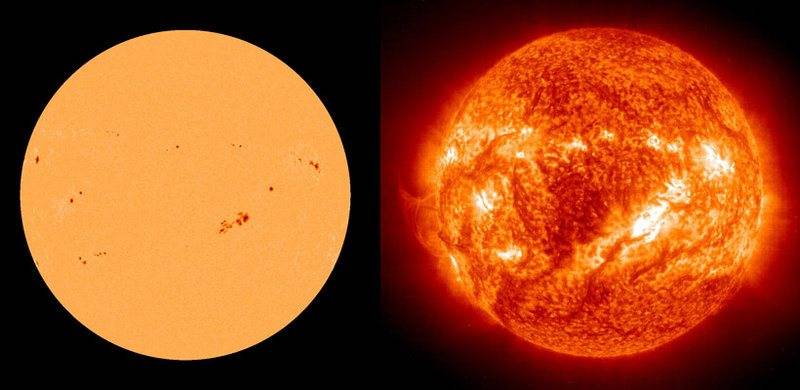
sun_uv_visible_compare_3feb2002_soho_820x400.jpg
 

Attachments

  • sun_uv_visible_compare_3feb2002_soho_820x400.jpg
    sun_uv_visible_compare_3feb2002_soho_820x400.jpg
    34.8 KB · Views: 1,219
Astronomy news on Phys.org
jim mcnamara said:
This answer says 'green dominates', but look at the very visual link for a clear explanation

yes by the spectrum, but that top right image in the link is false colour ( just in case the OP gets mislead by the green comment :wink: )

nmsurobert said:
I'm confused by these pictures.
I understand that the picture on the right has had color "assigned" to it because we can see uv light but the picture on the left is supposed to be taken in the visible spectrum. why is it yellow/orange and not white? isn't the sun white? both of these images where taken by soho, which to my understanding is way outside of our atmosphere.

the left and right are both false colours
They use Orange in the left image for the same reason my solar imaging uses anything from orange to red ... mainly because it gives better contrast between the black sunspot/active regions and the surrounding solar disk and it is a hell of a lot easier to look at through the solar telescope than if it was a bright white which would be hard on the eye(s)

The right mage is the Helium II ( 304 Angstrom) image and the orange for that just happens to be what they chose to differentiate it from the other images and their chosen colours ...
https://umbra.nascom.nasa.gov/images/latest.html

@nmsurobert , don't get hung up on the colours, you will even find they vary a bit between the 2 different spacecraft SOHO and SDO
it's no big deal :smile:Dave
 
Last edited:
  • Like
Likes   Reactions: nmsurobert and jim mcnamara
davenn said:
yes by the spectrum, but that top right image in the link is false colour ( just in case the OP gets mislead by the green comment :wink: )
the left and right are both false colours
They use Orange in the left image for the same reason my solar imaging uses anything from orange to red ... mainly because it gives better contrast
between the black sunspot/active regions and the surrounding solar disk and it is a hell of a lot easier to look at through the solar telescope
than if it was a bright white which would be hard on the eye(s)

The right mage is the Helium II ( 304 Angstrom) image and the orange for that just happens to be what they chose to differentiate it from the
other images and their chosen colours ...
https://umbra.nascom.nasa.gov/images/latest.html

@nmsurobert , don't get hung up on the colours, you will even find they vary a bit between the 2 different spacecraft SOHO and SDO
it's no big deal :smile:Dave
This makes a ton of sense. I'm not too worried about it. I was sure they had their reasons. But I'm first year teacher teaching an astronomy class and I can already hear a few students asking me what I'm asking you guys haha.
 
  • Like
Likes   Reactions: davenn
nmsurobert said:
But I'm first year teacher teaching an astronomy class and I can already hear a few students asking me what I'm asking you guys haha.

best wishes with your astronomy teaching, it's an awesome subject with so many fields of interest
Tho I have a broad interest in astronomy, my main interests are in solar activity and also how it affects the Earth

maybe you would like to keep an eye on these 2 threads of mine ...

https://www.physicsforums.com/threads/solar-imaging-and-techniques.925656/
and
https://www.physicsforums.com/threads/for-those-aurora-chasers-a-heads-up.923833/

regards
Dave
 
davenn said:
best wishes with your astronomy teaching, it's an awesome subject with so many fields of interest
Tho I have a broad interest in astronomy, my main interests are in solar activity and also how it affects the Earth

maybe you would like to keep an eye on these 2 threads of mine ...

https://www.physicsforums.com/threads/solar-imaging-and-techniques.925656/
and
https://www.physicsforums.com/threads/for-those-aurora-chasers-a-heads-up.923833/

regards
Dave
thank you. when i entered college, i went into physics because i wanted to study the sun, ironically. i did about two years of quasar research in college so I'm not a complete newbie when it comes to astronomy. sometimes i stump myself though... like now.
i will check out those threads. thank you!
 
  • Like
Likes   Reactions: davenn
I believe the most accurate data would be a pixel location and an electron per second count. The light hits the detector and causes the electron to run through the circuit. A cosmic ray hitting a ccd detector would count as one photon same as a purple photon (400 nm) counts as one hit.
 
stefan r said:
I believe the most accurate data would be a pixel location and an electron per second count. The light hits the detector and causes the electron to run through the circuit. A cosmic ray hitting a ccd detector would count as one photon same as a purple photon (400 nm) counts as one hit.

How does this relate to the thread topic?
 
davenn said:
the left and right are both false colours
They use Orange in the left image for the same reason...
What exactly do you mean by that? I've taken photos with a monochrome camera and colorized them, but it is nearly impossible to tell what is colorized and what isn't when looking at a visible light photo of the sun. Here's one of my eclipse photos, taken with a solar filter and a standard DSLR, with no editing -- it is only "colorized" if the filter makes it look yellow-orange:

EclipseSample.jpg
 

Attachments

  • EclipseSample.jpg
    EclipseSample.jpg
    13.5 KB · Views: 629
  • #10
russ_watters said:
What exactly do you mean by that? I've taken photos with a monochrome camera and colorized them, but it is nearly impossible to tell what is colorized and what isn't when looking at a visible light photo of the sun. Here's one of my eclipse photos, taken with a solar filter and a standard DSLR, with no editing -- it is only "colorized" if the filter makes it look yellow-orange:

exactly, and right there is your answer
and that top left image is likely to be either a) "colourised by the filter or b) colourised in post-processing or c) a bit of both

my 2 new narrow band Ha (Hydrogen alpha) filters give the sun quite a red colour.
 
  • #11
davenn said:
exactly, and right there is your answer
and that top left image is likely to be either a) "colourised by the filter or b) colourised in post-processing or c) a bit of both

my 2 new narrow band Ha (Hydrogen alpha) filters give the sun quite a red colour.
Ok, fair enough; I just hadn't heard the use of the word "colorized" except to refer to post-processing.
 
  • #12
Drakkith said:
How does this relate to the thread topic?
The thread topic was "color of the sun". Our eyes see color when several sensors in the human eye detect slightly different intensity. If you look at monochromatic light 570, 580, and 590 nm radiation you will see three different colors (assuming not color blind). If you look at 620, 630, and 640 you just see red. Every detector including eyes are in effect taking a black and white image. The color that you see is created because the signal from one sensor has a different intensity than the signal from another. Your brain assembles the difference into colors.
 

Similar threads

  • · Replies 49 ·
2
Replies
49
Views
5K
Replies
2
Views
2K
  • · Replies 6 ·
Replies
6
Views
4K
  • · Replies 9 ·
Replies
9
Views
5K
  • · Replies 40 ·
2
Replies
40
Views
4K
  • · Replies 1 ·
Replies
1
Views
2K
  • · Replies 207 ·
7
Replies
207
Views
14K
  • · Replies 5 ·
Replies
5
Views
2K
  • · Replies 7 ·
Replies
7
Views
14K