Why Is This Dynamics Problem So Challenging?

  • Thread starter Thread starter Saladsamurai
  • Start date Start date
  • Tags Tags
    Dynamics Hard
Click For Summary

Discussion Overview

The discussion revolves around a challenging dynamics problem related to the general plane motion of a rigid body, specifically focusing on the angular velocities of interconnected gears. Participants are attempting to solve a homework problem that involves calculating the angular velocities of gears A, B, and C based on given parameters and relationships between their velocities.

Discussion Character

  • Homework-related
  • Mathematical reasoning
  • Debate/contested

Main Points Raised

  • One participant states the known answers for the angular velocities of gears A, B, and C as 14 rad/s, 28.8 rad/s, and 26.7 rad/s, respectively, and describes their approach to finding these values.
  • Another participant questions the equality of two velocities (Vp and Vp') between gears C and B, suggesting that the solution they are referencing implies they are not equal, but they seek clarification on this point.
  • Some participants mention the concept of relative and absolute velocities, indicating that while the same points may have the same velocity, the presence of other factors (like gear DE's motion) complicates the situation.
  • One participant proposes a method to calculate the angular velocities of the gears based on the distance traveled by the outer ring and its relationship to the gear sizes, but acknowledges that their calculated value of 20 rad/s does not match the known answer for gear C.
  • A later reply corrects an earlier calculation regarding the distance to the end of the link, suggesting that the correct total distance should be 160 mm instead of 120 mm, leading to a recalculated angular velocity for gear C.

Areas of Agreement / Disagreement

Participants express differing views on the relationships between the velocities of the gears, particularly regarding the equality of Vp and Vp'. There is no consensus on the correct approach to solving the problem, and multiple competing methods and interpretations are presented.

Contextual Notes

Some participants note the complexity introduced by relative velocities and the need for clarity in the steps of the solution. There are unresolved calculations and assumptions regarding the relationships between the gears and their respective angular velocities.

Who May Find This Useful

This discussion may be useful for students and enthusiasts of dynamics, particularly those dealing with problems involving the motion of rigid bodies and interconnected gears.

Saladsamurai
Messages
3,009
Reaction score
7
!Desperate!This Dynamics Problem is Killing ME!

Homework Statement


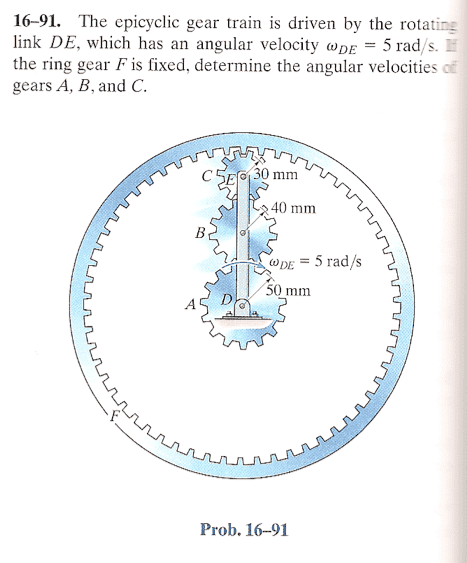
We have ben dealing with General Plane motion of a rigid body and this problem has been getting the best of me for some time now
Picture1-7.png


I know from the text that the answers are \omega_a=14 rad/s \omega_b=28.8 rad/s and \omega_c=26.7 rads\s


Now so far this is all I have been able to accomplish. I know that since member DE id rotating about E, the velocity of gear C's center of gravity is

v_c=r_{DE}\omega_D=.8 m/s

I also know that this velocity must be equal to r_c\omega_c\Rightarrow \omega_C=\frac{.8}{.03}=26.667 This I presume is true since where C makes contact at F can be considered the instantaneous center of zero velocity (IC from now on).

I cannot seem to get this concept to work for the other gears though. I think that where gear C and B meet, their tangential velocities must be equal. Thus using IC to find that velocity,

(v_t)_c=(v_t)_b=r_{c/IC}*\omega_c=.06*26.667=1.60 m/s But now I am lost. I want to find the angular velocities of gears B and A.

Can someone please help me out here?

Thanks
 
Physics news on Phys.org
Okay, can someone clear this up for me...There is a velocity pointing to the right in between gears C and B, let's call it Vp. Now there is also a velocity pointing leftward between gears B and A, let's call it Vp'... now here is my question: IS Vp=Vp' ?

I am looking at a solution to this problem that the person who wrote it skipped a lot of steps in. It appears from their solution that Vp is not equal to Vp'. I don't see why not?
 
Maybe, because there are relative and apsolute velocity? You are right that same points have same velocity Vp=Vp' but you have velocity from DE. I have no time in this moment to solve you this problem. I'll try later.
 
Saladsamurai said:

Homework Statement


We have ben dealing with General Plane motion of a rigid body and this problem has been getting the best of me for some time now

Picture1-7.png


I know from the text that the answers are \omega_a=14 rad/s \omega_b=28.8 rad/s and \omega_c=26.7 rads\s


Now so far this is all I have been able to accomplish. I know that since member DE id rotating about E, the velocity of gear C's center of gravity is

v_c=r_{DE}\omega_D=.8 m/s

I also know that this velocity must be equal to r_c\omega_c\Rightarrow \omega_C=\frac{.8}{.03}=26.667 This I presume is true since where C makes contact at F can be considered the instantaneous center of zero velocity (IC from now on).

I cannot seem to get this concept to work for the other gears though. I think that where gear C and B meet, their tangential velocities must be equal. Thus using IC to find that velocity,

(v_t)_c=(v_t)_b=r_{c/IC}*\omega_c=.06*26.667=1.60 m/s But now I am lost. I want to find the angular velocities of gears B and A.

Can someone please help me out here?

Thanks
I'm no expert in mechanics or dynamics but here is how I would do this problem:
The outer ring has radius 50+ 40+ 30= 120 mm. Since the arm is rotating at 5 radians/s and there are 2\pi radians in the entire circle, the arm will complete 5/2\pi of the entire circle in a second. That circle has circumference 240\pi mm so the arm covers (5/2\pi)(240\pi)= 600 mm/s. The cog with radius 30 mm must cover that same distance in one second. Since it has circumference 60\pi mm, that means it must make 600/60\pi= 10/\pi complete turns per second. At 2\pi radians per turn, that is 20 radians/s.

The other two cogs, with radii of 40 and 50 mm, must also cover 600 mm/s and so you can calculate their angular speeds the same way.
 
....I like the approach Halls, however I know that 20 rad/s is not the solution to that gear, as given in OP. I think it is the relative velocities that are screwing me up.
 
...
 
Does anyone even look in this forum?
 
HallsofIvy said:
I'm no expert in mechanics or dynamics but here is how I would do this problem:
The outer ring has radius 50+ 40+ 30= 120 mm. Since the arm is rotating at 5 radians/s and there are 2\pi radians in the entire circle, the arm will complete 5/2\pi of the entire circle in a second. That circle has circumference 240\pi mm so the arm covers (5/2\pi)(240\pi)= 600 mm/s. The cog with radius 30 mm must cover that same distance in one second. Since it has circumference 60\pi mm, that means it must make 600/60\pi= 10/\pi complete turns per second. At 2\pi radians per turn, that is 20 radians/s.

The other two cogs, with radii of 40 and 50 mm, must also cover 600 mm/s and so you can calculate their angular speeds the same way.


Small error here -- you have the wrong distance to the end of the link. It should be 50 + 80 + 30 = 160 mm.
So:
160mm * 2*pi = 320*pi
(5 rad/sec) / 2*pi = 800 mm
800 mm / (60mm radius)/pi * (2*pi radians/turn) = 26.67 rad/sec

Now that you have omegaC, use that rotation rate to find the distance gear B travels.
 

Similar threads

  • · Replies 3 ·
Replies
3
Views
5K
  • · Replies 2 ·
Replies
2
Views
5K
  • · Replies 4 ·
Replies
4
Views
2K
Replies
3
Views
3K
  • · Replies 15 ·
Replies
15
Views
5K
  • · Replies 11 ·
Replies
11
Views
2K
  • · Replies 1 ·
Replies
1
Views
3K
  • · Replies 1 ·
Replies
1
Views
2K
  • · Replies 2 ·
Replies
2
Views
2K
  • · Replies 3 ·
Replies
3
Views
2K