Why Is This Dynamics Problem So Challenging?

  • Thread starter Thread starter Saladsamurai
  • Start date Start date
  • Tags Tags
    Dynamics Hard
Join the discussion
Registration is free. Ask a follow-up in this thread, or start your own.
7 replies · 6K views
Saladsamurai
Messages
3,009
Reaction score
7
!Desperate!This Dynamics Problem is Killing ME!

Homework Statement


We have ben dealing with General Plane motion of a rigid body and this problem has been getting the best of me for some time now
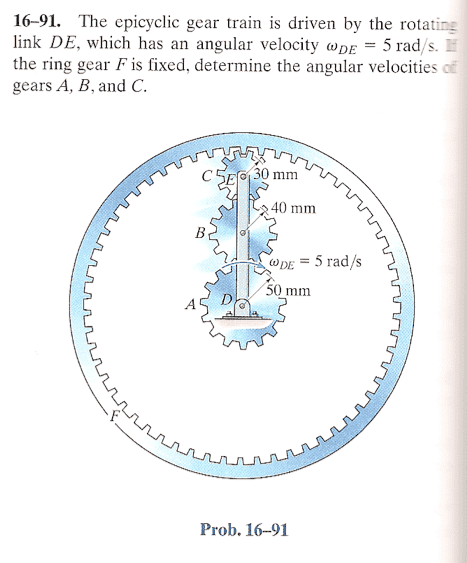
Picture1-7.png


I know from the text that the answers are [itex]\omega_a=14 rad/s[/itex] [itex]\omega_b=28.8 rad/s[/itex] and [itex]\omega_c=26.7 rads\s[/itex]


Now so far this is all I have been able to accomplish. I know that since member DE id rotating about E, the velocity of gear C's center of gravity is

[itex]v_c=r_{DE}\omega_D=.8 m/s[/itex]

I also know that this velocity must be equal to [itex]r_c\omega_c\Rightarrow \omega_C=\frac{.8}{.03}=26.667[/itex] This I presume is true since where C makes contact at F can be considered the instantaneous center of zero velocity (IC from now on).

I cannot seem to get this concept to work for the other gears though. I think that where gear C and B meet, their tangential velocities must be equal. Thus using IC to find that velocity,

[itex](v_t)_c=(v_t)_b=r_{c/IC}*\omega_c=.06*26.667=1.60 m/s[/itex] But now I am lost. I want to find the angular velocities of gears B and A.

Can someone please help me out here?

Thanks
 
Physics news on Phys.org
Okay, can someone clear this up for me...There is a velocity pointing to the right in between gears C and B, let's call it Vp. Now there is also a velocity pointing leftward between gears B and A, let's call it Vp'... now here is my question: IS Vp=Vp' ?

I am looking at a solution to this problem that the person who wrote it skipped a lot of steps in. It appears from their solution that Vp is not equal to Vp'. I don't see why not?
 
Maybe, because there are relative and apsolute velocity? You are right that same points have same velocity Vp=Vp' but you have velocity from DE. I have no time in this moment to solve you this problem. I'll try later.
 
Saladsamurai said:

Homework Statement


We have ben dealing with General Plane motion of a rigid body and this problem has been getting the best of me for some time now

Picture1-7.png


I know from the text that the answers are [itex]\omega_a=14 rad/s[/itex] [itex]\omega_b=28.8 rad/s[/itex] and [itex]\omega_c=26.7 rads\s[/itex]


Now so far this is all I have been able to accomplish. I know that since member DE id rotating about E, the velocity of gear C's center of gravity is

[itex]v_c=r_{DE}\omega_D=.8 m/s[/itex]

I also know that this velocity must be equal to [itex]r_c\omega_c\Rightarrow \omega_C=\frac{.8}{.03}=26.667[/itex] This I presume is true since where C makes contact at F can be considered the instantaneous center of zero velocity (IC from now on).

I cannot seem to get this concept to work for the other gears though. I think that where gear C and B meet, their tangential velocities must be equal. Thus using IC to find that velocity,

[itex](v_t)_c=(v_t)_b=r_{c/IC}*\omega_c=.06*26.667=1.60 m/s[/itex] But now I am lost. I want to find the angular velocities of gears B and A.

Can someone please help me out here?

Thanks
I'm no expert in mechanics or dynamics but here is how I would do this problem:
The outer ring has radius 50+ 40+ 30= 120 mm. Since the arm is rotating at 5 radians/s and there are [itex]2\pi[/itex] radians in the entire circle, the arm will complete [itex]5/2\pi[/itex] of the entire circle in a second. That circle has circumference [itex]240\pi[/itex] mm so the arm covers [itex](5/2\pi)(240\pi)[/itex]= 600 mm/s. The cog with radius 30 mm must cover that same distance in one second. Since it has circumference [itex]60\pi[/itex] mm, that means it must make [itex]600/60\pi= 10/\pi[/itex] complete turns per second. At [itex]2\pi[/itex] radians per turn, that is 20 radians/s.

The other two cogs, with radii of 40 and 50 mm, must also cover 600 mm/s and so you can calculate their angular speeds the same way.
 
....I like the approach Halls, however I know that 20 rad/s is not the solution to that gear, as given in OP. I think it is the relative velocities that are screwing me up.
 
Does anyone even look in this forum?
 
HallsofIvy said:
I'm no expert in mechanics or dynamics but here is how I would do this problem:
The outer ring has radius 50+ 40+ 30= 120 mm. Since the arm is rotating at 5 radians/s and there are [itex]2\pi[/itex] radians in the entire circle, the arm will complete [itex]5/2\pi[/itex] of the entire circle in a second. That circle has circumference [itex]240\pi[/itex] mm so the arm covers [itex](5/2\pi)(240\pi)[/itex]= 600 mm/s. The cog with radius 30 mm must cover that same distance in one second. Since it has circumference [itex]60\pi[/itex] mm, that means it must make [itex]600/60\pi= 10/\pi[/itex] complete turns per second. At [itex]2\pi[/itex] radians per turn, that is 20 radians/s.

The other two cogs, with radii of 40 and 50 mm, must also cover 600 mm/s and so you can calculate their angular speeds the same way.


Small error here -- you have the wrong distance to the end of the link. It should be 50 + 80 + 30 = 160 mm.
So:
160mm * 2*pi = 320*pi
(5 rad/sec) / 2*pi = 800 mm
800 mm / (60mm radius)/pi * (2*pi radians/turn) = 26.67 rad/sec

Now that you have omegaC, use that rotation rate to find the distance gear B travels.