Why isn't my electromagnet working?

  • Context: High School 
  • Thread starter Thread starter KaleLetendre
  • Start date Start date
  • Tags Tags
    Electromagnet Work
Click For Summary

Discussion Overview

The discussion revolves around troubleshooting a non-functional electromagnet constructed from an iron cylinder and copper wire. Participants explore potential issues related to wire insulation, electrical connections, and the construction method, focusing on practical application and experimentation.

Discussion Character

  • Exploratory
  • Technical explanation
  • Debate/contested
  • Homework-related

Main Points Raised

  • One participant describes their setup, including an iron cylinder and copper wire, and expresses confusion about why it does not work as an electromagnet.
  • Another participant questions whether the copper wire is insulated, suggesting that lack of insulation could be a problem.
  • Some participants note that using non-insulated wire means the current must flow in a spiral around the core to create a magnetic field.
  • There are suggestions to ensure that wire turns do not touch each other if non-insulated wire is used.
  • Concerns are raised about potential short circuits or open circuits affecting the electromagnet's functionality.
  • A participant proposes scraping the enamel insulation from the ends of the wire to ensure proper electrical contact.
  • Another participant agrees that the wire should be insulated if it was previously used in an inductor, but emphasizes the need to remove the insulation at the ends for connection.
  • One participant confirms success after following the advice to scrape the wire ends, indicating that the previous issues were resolved.

Areas of Agreement / Disagreement

Participants generally agree on the importance of wire insulation and proper electrical contact for the electromagnet to function. However, there are differing views on the initial state of the wire and the necessity of insulation, leading to some uncertainty in the discussion.

Contextual Notes

Limitations include assumptions about the wire's condition and the specifics of the power source used. The discussion does not resolve all potential issues, such as the exact cause of the initial failure.

Who May Find This Useful

Individuals interested in DIY electronics, electromagnet construction, or troubleshooting electrical circuits may find this discussion relevant.

KaleLetendre
Messages
13
Reaction score
10
In my adventures through my attempt at a home laboratory i decided i would try to play with electricity a bit more.

I took an iron cylinder 1 inch diameter 6 inch length and wrapped about 4 meters of 1mm copper wire around it with a small length hanging off each side.
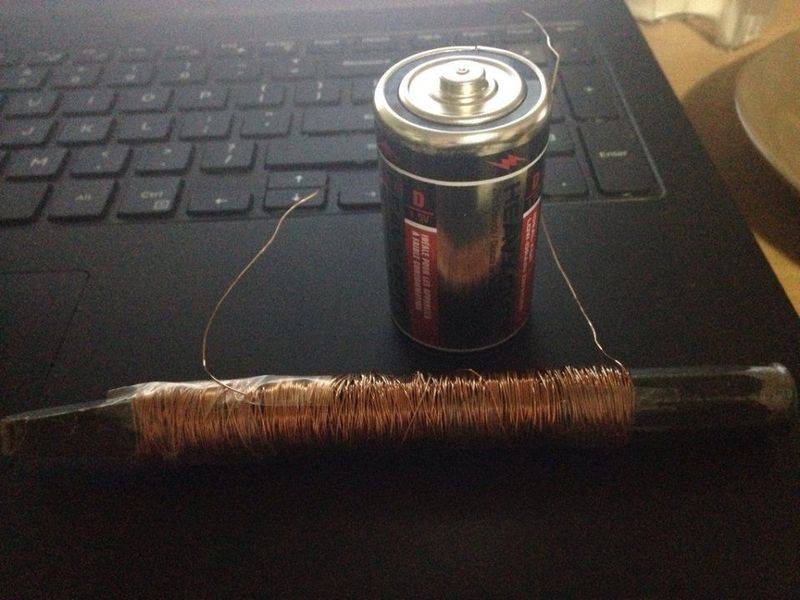
ImageUploadedByPhysics Forums1464331677.588642.jpg


To my understanding when i touch each side to a power source the result would be the magnetized iron, this was not the case. What did i do wrong?
 
  • Like
Likes   Reactions: Delta2
Physics news on Phys.org
Is the copper wire insulated?
 
  • Like
Likes   Reactions: Delta2
No its not
 
I got the copper wire from an old T.V. Where it was used in an inductor
 
KaleLetendre said:
No its not
There you go, you just built a big, straight wire. :smile:

The make an electromagnet, the current has to flow in a spiral around the core. You need insulated wire for that.

KaleLetendre said:
I got the copper wire from an old T.V. Where it was used in an inductor
If it was used in an inductor, then it should be insulated. It is possible that the insulation is broken (or melted), making short circuits.
 
Ok i get it so i could say wrap the wire in electrical tape and then coil it and it should work
 
If you still use non-insulated wire, make sure the individual turns don't touch each other.
 
  • Like
Likes   Reactions: Delta2
jtbell said:
If you still use non-insulated wire, make sure the individual turns don't touch each other.
You need also to put some tape around the iron core to isolate it.
 
If it was used in an inductor then it must be ok for the job. There must either be an open circuit (is there any way for you to know current is actually flowing?) or a flat battery or a short between the ends of the coil.
With the amount of current that cell could probably supply, you could expect to see small sparks when you brush one of the contacts with one end of the wire.
 
  • #10
Thinking about this some more I guess that you just cut the wire and didn't strip the clear laquer insulation from the ends and there is no electrical contact. Try scraping gently with a knife or with emery paper. Alternatively, applying a hot soldering iron with solder may well dissolve the laquer and give it good 'tinned' ends for a good contact. I am sure that will sort out your prob.
 
  • #11
DrClaude said:
Is the copper wire insulated?
KaleLetendre said:
No its not
KaleLetendre said:
I got the copper wire from an old T.V. Where it was used in an inductor

well actually if it came from a coil in an old TV ... it WILL be insulated, else it wouldn't have worked for that coil

What you haven't done is scrape the enamel insulation of the ends of the wire
so use a razor blade, craft knife etc and scrape the almost clear enamel insulation of around an inch off each end
THEN it will have proper connection to the batterycheers
Dave

PS ... I didn't read sophie's post fully ... in full agreement
 
  • #12
It works! Thank you all
 
  • Like
Likes   Reactions: davenn
  • #13
KaleLetendre said:
It works! Thank you all

well done :smile:

scraping the ends of the wire did the trick, I assume ?cheers
Dave
 
  • #14
It really is unfair that they use so much 'gold' coloured laquer. Many other colours are available and everyone would spot a red or purple wire isn't plain copper.
 
  • Like
Likes   Reactions: davenn
  • #15
sophiecentaur said:
It really is unfair that they use so much 'gold' coloured laquer. Many other colours are available and everyone would spot a red or purple wire isn't plain copper.

so true
... a nice trap for young players :wink:
 
  • Like
Likes   Reactions: Drakkith and sophiecentaur

Similar threads

  • · Replies 2 ·
Replies
2
Views
3K
  • · Replies 22 ·
Replies
22
Views
4K
  • · Replies 42 ·
2
Replies
42
Views
3K
Replies
152
Views
7K
  • · Replies 17 ·
Replies
17
Views
2K
  • · Replies 6 ·
Replies
6
Views
2K
  • · Replies 4 ·
Replies
4
Views
10K
  • · Replies 6 ·
Replies
6
Views
3K
  • · Replies 2 ·
Replies
2
Views
2K
  • · Replies 43 ·
2
Replies
43
Views
7K