Why Isn't There More Current in Reverse Diode?

  • Context: Undergrad 
  • Thread starter Thread starter gracy
  • Start date Start date
  • Tags Tags
    Current Diode Reverse
Click For Summary
SUMMARY

The discussion clarifies the behavior of reverse-biased diodes, specifically addressing the negligible current flow in this state. It highlights that while a reverse-biased diode does not conduct significant current, a small reverse leakage current exists due to minority charge carriers crossing the junction. The depletion region widens as majority carriers move away from the junction, effectively acting as an insulator. Understanding these principles is crucial for grasping diode functionality in electronic circuits.

PREREQUISITES
  • Understanding of semiconductor physics
  • Familiarity with diode operation and characteristics
  • Knowledge of depletion region dynamics
  • Basic concepts of charge carriers (electrons and holes)
NEXT STEPS
  • Study the behavior of diodes under different biasing conditions
  • Learn about the depletion region and its impact on diode performance
  • Explore reverse leakage current in various semiconductor devices
  • Investigate the role of minority carriers in semiconductor junctions
USEFUL FOR

Electronics students, electrical engineers, and anyone interested in understanding semiconductor behavior and diode applications in circuits.

gracy
Messages
2,486
Reaction score
83
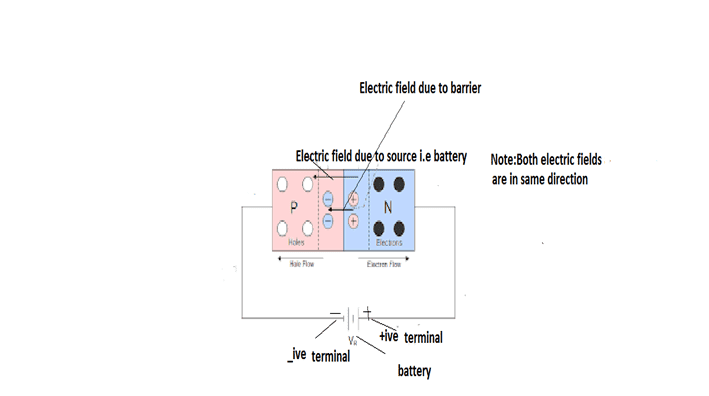
I am not getting why there can't be (or very negligible )current in reverse diode.According to this image
upload_2014-12-13_15-3-51.png

positive terminal of battery would suck electrons from n-type and pass them to negative terminal of battery.And Negative terminal would provide electrons to p type and from there we can see in image force on electrons is opposite to electric field so electrons can easily pass the barrier and can go to n-type and hence complete the circuit(i.e initially electrons were sucked from n-type and lastly they go towards n-type)So in this way in reverse diode also there is sufficient (in good amount)current available.
Where am i going wrong?
 

Attachments

  • upload_2014-12-13_14-55-25.png
    upload_2014-12-13_14-55-25.png
    11.2 KB · Views: 532
Physics news on Phys.org
I think you need to look at what happens in the depletion zone. Not sure. (It's very late and I'm tired.)
 
Drakkith said:
I think you need to look at what happens in the depletion zone. Not sure. (It's very late and I'm tired.)
I have tried my best to look at all aspects.No ,matter whenever you feel comfortable ,you can answer.Please ..but do explain me this.
 
With no voltage applied there is a thin depletion region at the junction. This has very few charge carriers so it acts like an insulator preventing current flow.

...Negative terminal would provide electrons to p type

If you inject more electrons into the p-type you reduce the number of holes even more and the depletion region gets wider. You also get a build up of negative charge near the junction that eventually matches the applied voltage preventing further electrons from flowing into the p-type. In this mode the diode behaves a bit like a capacitor.

Perhaps see..
http://www.science-campus.com/engineering/electronics/semiconductor_theory/diode_2.html
 
One important thing you must know is we say current to flow in diode iff any charge carriers "cross the junction"between p and n.

1)ē are majority in N and holes in P.
2)-ve terminal is connected to P. So it will attract holes from P side . result: holes will move away from junction and get collected in -ve terminal
3)ē will too move away from junction to the +ve terminal there in N side.
4)these two will cause widening of depletion region as majority charge carriers move sideways .
Now ur concept of small current is true . its called reverse leakage current . minority ē in P and minority holes in N will cross junction resulting in current .
 

Similar threads

  • · Replies 14 ·
Replies
14
Views
5K
  • · Replies 4 ·
Replies
4
Views
4K
  • · Replies 10 ·
Replies
10
Views
5K
  • · Replies 7 ·
Replies
7
Views
2K
  • · Replies 3 ·
Replies
3
Views
3K
  • · Replies 1 ·
Replies
1
Views
2K
  • · Replies 14 ·
Replies
14
Views
5K
  • · Replies 4 ·
Replies
4
Views
3K
Replies
2
Views
3K
  • · Replies 4 ·
Replies
4
Views
1K