Why the at term on the exponential turned positive

Click For Summary
SUMMARY

The discussion centers on the mathematical concept of the absolute value function and its impact on the exponential function, specifically f(t) = e^{|t|}. Participants clarify that for t < 0, |t| is defined as -t, which leads to the positive term in the exponential. The integration approach discussed involves splitting the integral into two parts: integrating e^{2t} from -∞ to 0 and e^{-t} from 0 to ∞. This method effectively addresses the behavior of the function across different intervals of t.

PREREQUISITES
  • Understanding of exponential functions
  • Familiarity with absolute value concepts
  • Basic knowledge of integration techniques
  • Ability to analyze piecewise functions
NEXT STEPS
  • Study the properties of the absolute value function in calculus
  • Learn about piecewise function definitions and their applications
  • Explore integration techniques for improper integrals
  • Investigate the behavior of exponential functions in different quadrants
USEFUL FOR

Students and educators in mathematics, particularly those studying calculus and integration techniques, as well as anyone looking to deepen their understanding of exponential functions and absolute values.

Firepanda
Messages
425
Reaction score
0
Firstly, I don't get why the at term on the exponential turned positive (red arrow).. can someone explain that please?
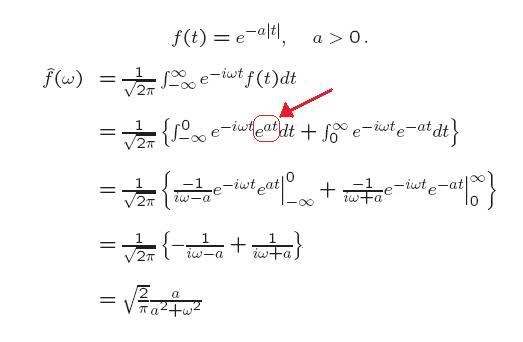
291kgae.jpg


And how do I start on this? How do I split it up such that I can do it for t>0 and t=<0?
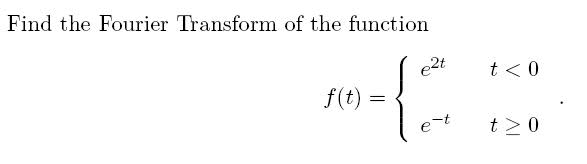
2li8pef.jpg


Do I just integrate e^2t between -inf and 0 and integrate e^-t between 0 and inf?


Thanks!
 
Physics news on Phys.org
What is |t| when t is negative?
 
dx said:
What is |t| when t is negative?

positive, ah I see now, thanks

still stuck on 2nd though

edit: actually why would that change the sign of the a?
 
Just split the integral into two parts, one on (-∞,0) and the other on (0,∞).
 
edit: actually why would that change the sign of the a?

You should really draw f(t)=e^{|t|}. And then give a function that represents f(t) in the first quadrant and f(t) in the second quadrant.
 
|t| = -t by definition when t is negative.
 

Similar threads

Replies
2
Views
2K
  • · Replies 8 ·
Replies
8
Views
2K
  • · Replies 4 ·
Replies
4
Views
1K
Replies
8
Views
2K
  • · Replies 2 ·
Replies
2
Views
2K
Replies
2
Views
2K
  • · Replies 2 ·
Replies
2
Views
2K
  • · Replies 2 ·
Replies
2
Views
3K
Replies
4
Views
1K
Replies
2
Views
2K